
November 19, 2026
When should you use hypochlorous acid spray — morning or night?

Use hypochlorous acid spray in the morning or at night, following your product’s directions; the clock alone does not determine the right routine. For a facial spray intended for leave-on use, make it a separate step before moisturizer, let it dry before layering, and keep your usual cleansing and daytime sunscreen steps.
- When to use hypochlorous acid spray: morning or night, according to the product’s directions and your routine.
- Morning misting does not replace sunscreen; evening misting does not replace cleansing.
- Let a leave-on facial mist dry before layering other skincare products.
- Xoxo Gina HALO™ Wellness Mist lists a 150 mL bottle and pH 4.5; neither specifies application frequency.
When should you use hypochlorous acid spray—morning or night?
Choose the time you can use the spray consistently and as directed, rather than treating morning or night as inherently better. A facial mist has to fit around cleansing, moisturizer, sunscreen, and any treatment instructions you already follow.
The Xoxo Gina HALO™ Wellness Mist product information identifies a 5 fl oz / 150 mL bottle and a formulation at pH 4.5. Those details describe the product, not a morning-only or nighttime-only schedule.
| Timing option | Best for | How it fits | Limitation |
|---|---|---|---|
| Morning | People who want a step in their existing morning routine | Use as directed before moisturizer and sunscreen | Does not replace sun protection |
| Night | People who prefer skincare after removing the day’s makeup and sunscreen | Cleanse, use the mist as directed, and continue with moisturizer | Does not remove makeup or replace cleansing |
| After exercise | People whose skincare routine follows a workout | Cleanse as appropriate, then follow the facial spray’s directions | An extra application still has to fit the label’s instructions |
Morning offers a convenient place before your daytime products. Night offers a place after cleansing. Neither option is a reason to add more applications than the product calls for.
Why this matters
A simple routine is easier to understand when every step has a clear job. Cleansing removes buildup; moisturizer helps maintain hydration; sunscreen provides sun protection when used as directed. A facial mist does not take over all those roles.
For your 2026 skincare routine, start with the instructions on the bottle rather than a schedule copied from someone else. Your goal is a routine you understand—not another step you repeat without knowing why.
Morning: mist before your daytime layers
Morning is a practical choice when you already wash your face and apply skincare before leaving home. Keep the sequence straightforward, and avoid spraying over a finished sunscreen layer as a substitute for applying the mist earlier.
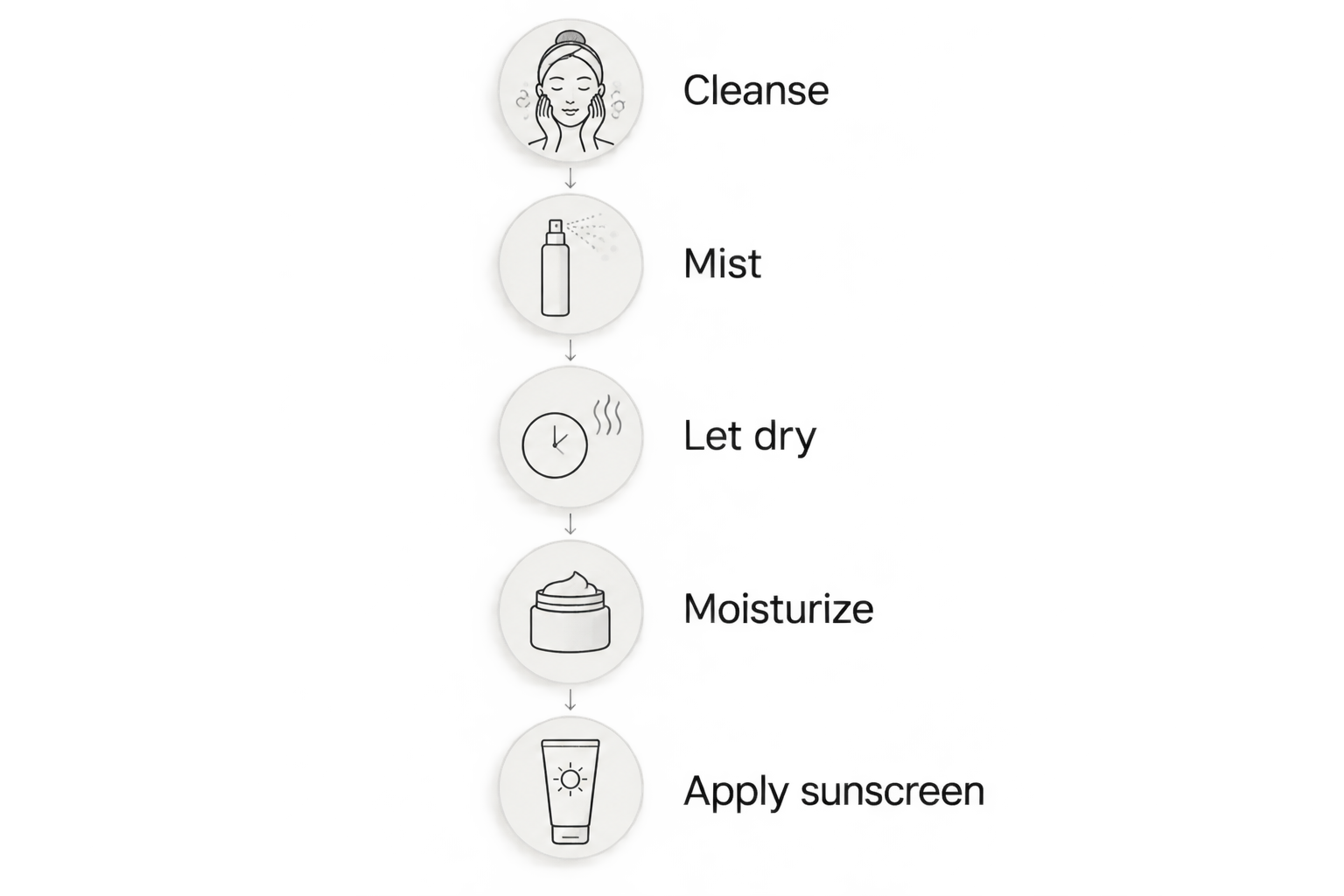
For a leave-on facial mist, use this order unless its directions say otherwise:
- Cleanse. Follow your usual cleansing routine and remove cleanser as directed.
- Mist. Apply the facial spray according to its label, including any instructions about eyes or application distance.
- Let dry. Allow the mist to dry rather than immediately mixing wet layers together.
- Moisturize. Continue with a moisturizer that suits your routine.
- Apply sunscreen. Follow your sunscreen’s application and reapplication directions.
This order keeps the mist separate from your final sun-protection step. It also gives you a repeatable place for the product, without inventing a waiting period in seconds or minutes.
The morning advantage is convenience, not a proven clock-based advantage. If your mornings already feel crowded, choosing nighttime instead keeps the routine simpler. Do not add a morning application just because a social post calls it essential.
Night: cleanse first, then keep it simple
Nighttime works when you prefer to finish your skincare in one place after the day is done. Remove makeup and sunscreen with your usual cleansing method before using a facial mist; spraying over them does not perform the same job.
For your 2026 evening routine, follow the product’s application directions after cleansing. Let a leave-on mist dry, then continue with the rest of your routine according to those products’ instructions.
The benefit of choosing night is organizational: the step sits beside habits you already have. The limitation is equally clear. A mist is not permission to skip washing your face or to assume every treatment product belongs in the same application session.
If you use a prescription topical, its instructions take priority over a generic skincare sequence. Ask your pharmacist or prescribing clinician where an optional facial mist belongs rather than changing a prescribed routine yourself.
Night is a sensible choice when it makes the routine easier to follow. There is no need to stay awake waiting for a particular hour or to apply another layer immediately before bed unless the label directs it.
After exercise: fit the mist around cleanup
A workout can make a midday skincare step more convenient than either morning or night. Treat that as a change in schedule—not an automatic reason to increase how often you spray.
After exercise, clean your face as appropriate for your routine and follow the facial product’s directions. If you then apply moisturizer and daytime sunscreen, let the mist dry before those layers.
The practical advantage is timing: you are already taking care of your skin after activity. The limitation is that misting does not remove sweat, makeup, or visible buildup in the way cleansing does.
For a gym bag in 2026, keep the original label readable and check the product’s storage instructions. Do not assume a bottle can stay in a hot parked car simply because it is convenient to leave it beside your trainers.
Why the right timing varies
Your routine determines where the spray fits. These factors matter more than choosing a particular hour:
- Label directions. A product’s stated uses, frequency, and application instructions come before a general routine suggestion.
- Cleansing schedule. Place a leave-on facial mist after cleansing rather than asking it to remove the day’s buildup.
- Daytime sunscreen. Put the mist earlier in your routine, and keep sunscreen application and reapplication separate.
- Other skincare instructions. Prescription products and treatments can have specific requirements that a generic layering guide cannot replace.
- Skin response. If a new product causes discomfort, stop using it instead of adding applications to push through the reaction.
- Daily activities. A workout, shower, or travel day can change the most convenient time without changing the product’s directions.
Keep the distinction clear: timing is about placement; frequency is about how often you use the product. Moving an application from morning to evening does not necessarily mean adding another application.
Read the formula, not just the category
Hypochlorous acid is a category ingredient, not a complete set of instructions. You still need to read the individual product’s intended use, ingredients, directions, and storage information.
The supplied details for Xoxo Gina HALO™ Wellness Mist identify purified water, hypochlorous acid, and pH 4.5. The stated bottle size is 5 fl oz / 150 mL. A pH value describes acidity; bottle volume describes quantity. Neither establishes how often your face needs misting.
Xoxo Gina HALO™ Wellness Mist is best for shoppers seeking a 150 mL hypochlorous acid spray with a stated pH of 4.5. That is a product-selection distinction, not a claim that its size or pH makes it more effective than another formula.
For the people behind the product, read Gina Rivera’s founder story. Keep that background separate from application instructions: a founder story explains the brand, while the label tells you how to use the bottle in your hand.
Should you use hypochlorous acid spray before or after moisturizer?
Before moisturizer is a straightforward place for a leave-on facial mist, unless its directions say otherwise. Apply as directed and let it dry before continuing, rather than spraying and immediately blending everything together.
You do not need to invent an exact countdown. If a product gives a specific wait time, follow it; otherwise, letting the mist dry gives you a clear transition between steps without adding unsupported precision.
Can you use hypochlorous acid spray morning and night?
Morning and night use should follow the individual product’s directions, not a universal rule. Choosing both times adds applications, so check frequency instructions rather than assuming that a facial spray is suitable for unlimited use.
For sensitive or reactive skin, introduce one new product at a time. That makes it easier to identify what changed if your skin becomes uncomfortable. A convenient routine is useful; a more crowded routine is not automatically better.
Should you spray hypochlorous acid over sunscreen or makeup?
Using a facial mist before sunscreen and makeup keeps the sequence simpler. A spray applied later does not replace sunscreen reapplication, and it does not remove makeup at the end of the day.
If you want to use a mist over finished makeup, check that specific product’s directions. Do not assume that a product’s suitability for bare facial skin also establishes how it should be used over every cosmetic formula.
Make the routine easier to follow
Choose an existing habit as the reminder: morning cleansing, evening makeup removal, or your post-workout shower. Keep the bottle where its storage instructions allow, not wherever happens to be most visible.
For a family bathroom in 2026, keep each product’s intended user and instructions clear. An adult’s facial routine does not establish directions for a child, and a shared household bottle does not mean everyone needs the same application schedule.
Write down when you introduce a new skincare product if your routine changes often. Note the product and the application time—not a promised result or an assumed deadline for improvement. This keeps the record practical without turning everyday skincare into a complicated tracking project.
FAQ
When is the best time to use hypochlorous acid spray on my face?
The best time is when the facial spray fits your routine and its label directions. Morning or night can provide a place after cleansing and before moisturizer; keep daytime sunscreen as a separate step.
Should I use hypochlorous acid spray before or after washing my face?
Use a leave-on facial mist after cleansing unless the product directs otherwise. The mist does not replace removing makeup, sunscreen, or buildup with your usual cleansing method.
Do I have to wait before applying moisturizer?
Let a leave-on facial mist dry before applying moisturizer, unless its directions specify a different method. Follow any stated waiting time rather than choosing an arbitrary number of minutes.
Can I use hypochlorous acid spray every morning and every night?
Use the frequency stated for your individual product. A morning-and-night schedule adds applications, and there is no single frequency that applies to every hypochlorous acid spray.
Does hypochlorous acid spray replace sunscreen?
Hypochlorous acid facial spray does not replace sunscreen. Apply sunscreen and reapply it according to its own directions, regardless of when you use a mist.
When should I use Xoxo Gina HALO™ Wellness Mist?
Use Xoxo Gina HALO™ Wellness Mist according to its current label directions. Its stated 150 mL size and pH 4.5 describe the product but do not establish a morning-only, nighttime-only, or twice-daily schedule.
Can I use my facial spray to clean surfaces too?
Use a spray on surfaces only when that specific product’s label includes the intended surface use. Facial-use directions do not establish surface-cleaning instructions or disinfection claims.
One last thing
Move the step before you multiply it. If morning misting keeps getting missed, try placing the label-directed application in your evening routine instead of deciding you need applications at both times.
Make that your 2026 routine check: a clear purpose, a clear place, and directions you can follow. The right schedule is not the busiest one.