November 18, 2026
What pH is hypochlorous acid spray?

Hypochlorous acid spray has no single standard pH: the value depends on the formula, and mildly acidic conditions favor hypochlorous acid over its related hypochlorite form. pH alone does not tell you a spray’s concentration, skin suitability, or effectiveness—you also need its intended use and directions.
- Hypochlorous acid pH describes acidity, not concentration or proven skin benefits.
- Xoxo Gina HALO™ states pH 4.5 for its hypochlorous acid wellness mist.
- Check intended use, ingredients, storage instructions, and expiration information alongside pH.
- Do not adjust a finished spray’s pH or mix it with household cleaners.
What pH is hypochlorous acid spray?
Hypochlorous acid sprays have formulation-specific pH values. An acidic solution favors hypochlorous acid, written as HOCl, while a more alkaline solution favors hypochlorite, written as OCl⁻. These are related chemical forms, not interchangeable descriptions of a finished skincare product.
The useful question is not whether every spray reaches the same number. It is whether the maker states a pH and provides directions for the use you have in mind. In 2026, read a pH claim alongside the rest of the label—not as a stand-alone quality score.
Xoxo Gina HALO™ Wellness Mist: pH 4.5
Gina Rivera is the founder behind the brand. The Xoxo Gina HALO™ Wellness Mist product description states pH 4.5 and a bottle size of 5 fl oz / 150 mL; it also identifies purified water and hypochlorous acid among its ingredients.
Xoxo Gina HALO™ is a fit for hypochlorous acid spray shoppers who want a disclosed pH of 4.5. That disclosure answers the acidity question directly. It does not, by itself, establish how your skin will respond or prove that the formula performs better than another spray.
Why this matters
A sensitive-skin routine does not need another number to worry about. It needs useful information. Knowing a formula’s pH helps you understand its chemistry, but treating that number as a promise of comfort or results asks it to do too much.
For your 2026 skincare routine, separate the questions: What is the spray’s pH? What is it intended for? What does the label tell you to do? Clear answers are more useful than an unexplained claim that a formula is balanced.
What different pH conditions tell you
The pH scale describes acidity and alkalinity. In standard chemistry, neutral water has a pH of about 7 at 25 °C; a lower value is acidic, and a higher value is alkaline at that temperature.
For hypochlorous acid, pH also affects the balance between HOCl and OCl⁻. The acid-dissociation midpoint is approximately pH 7.5 near room temperature. That is a chemistry reference point—not a recommended skincare target.
| Condition | What it tells you | What it does not establish |
|---|---|---|
| Below the HOCl dissociation midpoint | HOCl is favored over OCl⁻ | Whether the finished spray suits your skin |
| Near the dissociation midpoint | Both forms are present in similar proportions | A universal ideal pH for face sprays |
| Above the dissociation midpoint | OCl⁻ becomes increasingly favored | Whether a product is appropriate for a particular use |
| A disclosed finished-product pH | The maker provides a specific acidity value | Concentration, shelf life, or proven results |
A lower number is not automatically a better formula. The finished product must be assessed as a whole, including its concentration, packaging, stability, and directions.
Do not use this table to reformulate a bottle at home. Its purpose is to explain why pH matters—not to turn skincare shopping into a chemistry experiment.
Is pH the same as concentration?
No. pH describes acidity; concentration describes how much of a substance is present. A concentration stated in parts per million, or ppm, answers a different question from a pH value.
Two formulas can have the same pH without containing the same concentration of hypochlorous acid. Two formulas can also state the same concentration while differing in other formulation details. Neither figure replaces directions for use.
| Label detail | What it describes | Best for |
|---|---|---|
| pH | How acidic or alkaline the solution is | Understanding the formula’s acid–base conditions |
| Concentration | How much of a specified substance is present | Understanding the stated amount in the formula |
| Intended use | Where and how the product is meant to be used | Deciding whether it belongs in your routine |
| Storage directions | How the maker instructs you to keep the product | Caring for the finished formula as directed |
When comparing labels in 2026, keep those categories separate. A prominent pH number should not distract you from an unclear intended use, and a concentration figure should not be treated as a complete skin-suitability claim.
Why hypochlorous acid pH varies
Hypochlorous acid pH varies because finished sprays are formulated and maintained under different conditions. The number reflects the solution—not just the presence of HOCl on an ingredient list.
- Formulation choices. The ingredients and acid–base conditions determine the finished solution’s pH. An ingredient name alone does not reveal that value.
- Intended use. A skincare mist and a surface-use product must be evaluated against their own directions. A shared ingredient does not make their uses interchangeable.
- Water chemistry. Dissolved substances and buffering conditions affect acid–base behavior. A water-source description is not a substitute for a finished-product pH measurement.
- Measurement conditions. Temperature and the measurement method matter when interpreting a precise pH reading. Compare values with appropriate context.
- Changes after opening. Adding another liquid or transferring a spray into a container with residue changes the conditions the maker formulated for. Keep the product as supplied unless its directions say otherwise.
These factors explain why the lowest number is not a sensible shopping goal. Choose a clearly described formula for the intended use, then follow its instructions.
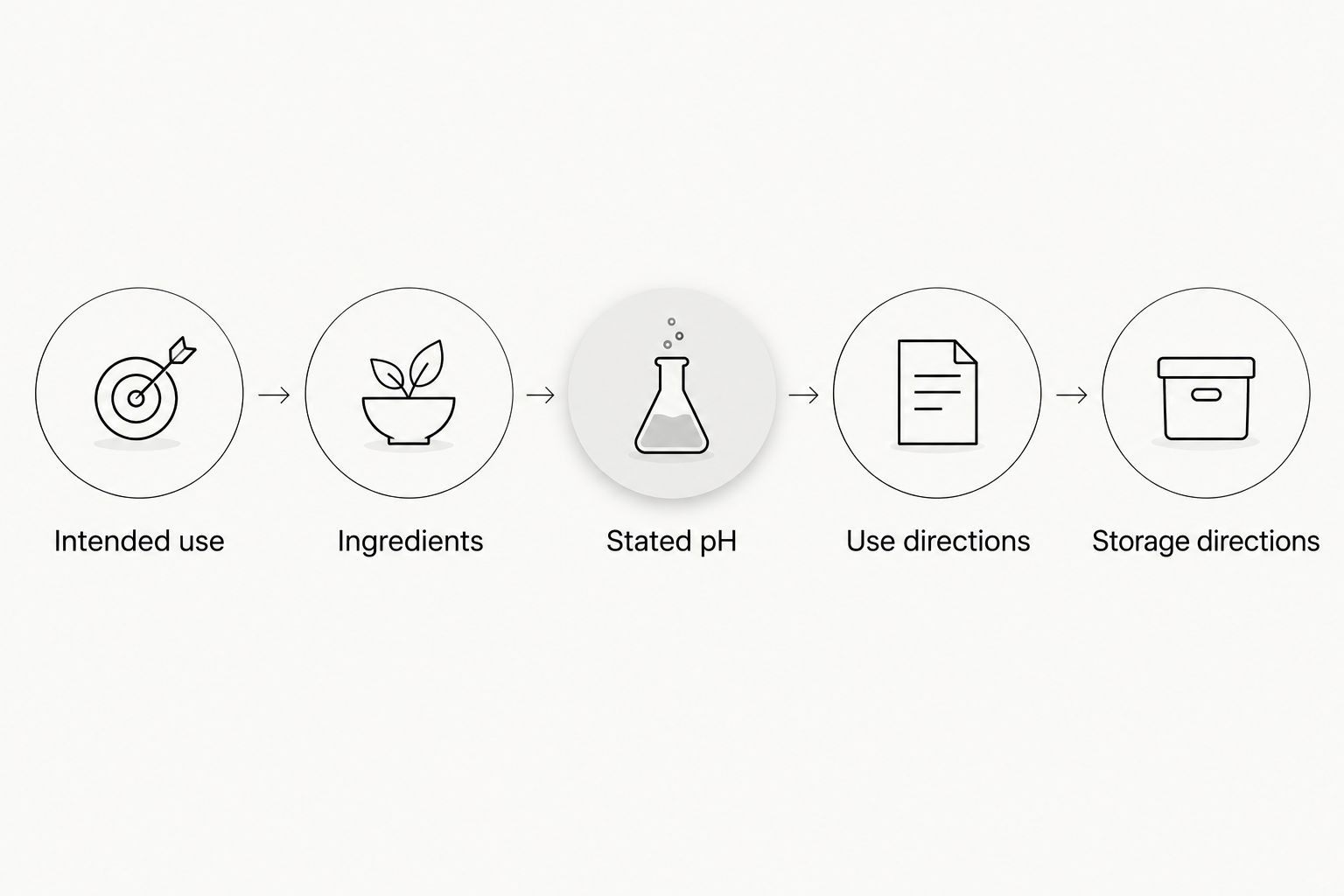
Read the bottle in this order
Start with the use, not the number. This simple label check keeps pH in its proper place and gives you a repeatable way to assess a spray without making unsupported assumptions.
- Intended use. Confirm that the product is intended for the area you plan to use it on. Do not assume a surface spray belongs on your face.
- Ingredients. Read the complete ingredient list. A short list makes ingredients easier to review, but ingredient count alone does not establish gentleness.
- Stated pH. Look for an actual value or a clearly described specification. Do not translate an unexplained balanced claim into a precise number.
- Use directions. Check application instructions and any restrictions. Do not invent a frequency because the product comes in a mist bottle.
- Storage directions. Find the storage and expiration information before deciding where the bottle will live.
If you have reactive skin, introduce a new product cautiously and follow its instructions. A disclosed pH is useful information, not a guarantee against irritation. Stop using a product that causes irritation rather than trying to correct its pH yourself.
Does pH 4.5 mean a spray is better for sensitive skin?
pH 4.5 describes acidity, not a guaranteed sensitive-skin outcome. Skin response depends on the finished formula and the individual using it. A favorable-looking number cannot establish that every person will find a spray comfortable.
Skin’s surface is normally mildly acidic, but it does not have one fixed pH across every person and body area. Matching a simplified skin-pH claim is therefore not enough to prove suitability.
For a sensitive-skin purchase in 2026, favor clear information over broad promises. Read the ingredients, confirm the intended use, and avoid treating terms such as natural or balanced as substitutes for product-specific directions.
Can you change a hypochlorous acid spray’s pH?
Do not change a finished hypochlorous acid spray’s pH at home. Adding an acid, an alkaline ingredient, or another skincare product changes the formula and can alter its chemistry. Mixing with household cleaners can create hazardous reactions.
That includes adding seemingly familiar ingredients to make a spray stronger, gentler, or closer to your preferred pH. Familiarity does not make a mixture predictable. Use the bottle as directed and keep different products in their own containers.
If a label does not answer your question, ask the maker. A home adjustment is not a substitute for formulation information.
Does the same pH mean the same everyday fit?
No. Two sprays with the same stated pH are not necessarily equivalent in concentration, packaging, ingredients, or intended use. Compare the complete product description, not one shared number.
For your gym bag, check storage instructions before leaving a bottle in a hot car. For your bathroom shelf, keep the original label readable. These practical checks help you follow the formula’s directions without inventing a special routine around its pH.
For family shopping, do not extend an adult’s directions to every family member. Check any age-specific instructions and keep application boundaries clear. A pH value does not answer those questions.
What pH cannot tell you about a bottle
A stated pH has a real benefit: it makes one part of the formula more transparent. Its limitation is just as important. It cannot stand in for evidence about every other characteristic of a spray.
A pH number alone does not establish:
- How long the finished formula remains within its specifications.
- Whether the product is suitable for children or a particular skin concern.
- Whether a spray intended for surfaces is appropriate for skin.
- Whether a mist replaces a cleanser, moisturizer, or another routine step.
- Whether one named product performs better than another.
For Xoxo Gina HALO™, the disclosed pH is a useful formulation detail, not a reason to promise outcomes beyond the product information. Keep that same standard when reading any hypochlorous acid skincare label.
FAQ
What pH should a hypochlorous acid spray be?
There is no single pH that establishes suitability for every hypochlorous acid spray. Read the finished product’s stated pH alongside its intended use, ingredients, and directions rather than choosing the lowest number.
Is hypochlorous acid acidic or alkaline?
Hypochlorous acid is a weak acid. The pH of a finished spray depends on the overall formula, so the ingredient name alone does not provide the bottle’s exact pH.
What does pH 4.5 mean on a face mist?
pH 4.5 means the formula is acidic. That value describes acid–base conditions; it does not state concentration or guarantee that the product will suit every person’s skin.
Is hypochlorous acid pH the same thing as ppm?
Hypochlorous acid pH and ppm describe different properties. pH describes acidity, while ppm expresses concentration; neither figure replaces product-specific directions.
What pH does Xoxo Gina HALO™ state for its wellness mist?
Xoxo Gina HALO™ states pH 4.5 for its wellness mist. The product description also states a bottle size of 5 fl oz / 150 mL.
Can I add water to make a hypochlorous acid spray gentler?
Do not add water unless the product’s directions explicitly instruct you to dilute it. Dilution changes the finished formula and does not establish that the result is more suitable for your skin.
Does a good pH mean a hypochlorous acid spray never expires?
A stated pH does not establish an unlimited shelf life. Follow the product’s expiration and storage information rather than judging its condition from the original pH claim.
One last thing
The pH scale is logarithmic, not linear. A small-looking numerical difference represents a meaningful chemical difference, but it still does not translate directly into better skin results.
For your next purchase in 2026, use a simple rule: choose the intended use first, read the whole label second, and interpret pH within that context. You do not need the lowest number. You need clear directions for the bottle you actually plan to use.