
November 26, 2026
Is it safe to spray hypochlorous acid directly in your eyes?

Do not spray hypochlorous acid directly into open eyes unless the specific product’s labeling explicitly permits that use. A face mist or eyelid cleanser is not automatically an eye drop; if a non-ophthalmic spray gets into your eyes, rinse promptly with lukewarm running water and follow the exposure instructions on its label.
- Is hypochlorous acid spray safe for eyes? Only use a product as its eye-specific labeling directs.
- Closed-eyelid care and direct application into open eyes are different uses.
- Xoxo Gina HALO™ Wellness Mist is not established here as suitable for direct eye application.
- For accidental exposure, rinse immediately; persistent pain or vision changes need urgent medical attention.
Is it safe to spray hypochlorous acid directly in your eyes?
No—not simply because the bottle contains hypochlorous acid. Permission to use a product on your face, around your eyes, or on closed eyelids does not establish permission to spray it onto the eye itself. Likewise, directions for using a hypochlorous acid spray on reactive skin do not replace eye-specific instructions.
Match the intended use to the exact label:
| Product labeling | Best for | Useful distinction | Limit |
|---|---|---|---|
| Explicitly labeled for direct ocular use | The eye application described on the label | Gives instructions for that specific route | Does not authorize other uses or application methods |
| Labeled for eyelid or lash hygiene | External eyelid care as directed | Identifies the intended external treatment area | Does not automatically permit spraying open eyes |
| Labeled for face or body | Skin application as directed | Fits a skin-care routine | Facial use does not establish ocular suitability |
| Labeled for surface cleaning | The listed surfaces | Provides surface-specific instructions | Surface directions are not personal-care directions |
The useful distinction in 2026 is still the simplest one: read the intended use, not just the ingredient name.
Why this matters
An ingredient can appear in products with different intended uses. Those products do not become interchangeable because they share that ingredient, and a reassuring description on the front of a bottle does not replace its directions and warnings.
Your eyes deserve a separate check from your skin. If you have sensitive skin, wear contact lenses, or are packing a mist for the gym, pause before treating a facial spray as an eye-care product. An extra label check is easier than sorting out an avoidable exposure.
This guide separates everyday facial misting, external eyelid care, and direct eye application. It also explains what to do when an accidental spray reaches an open eye.
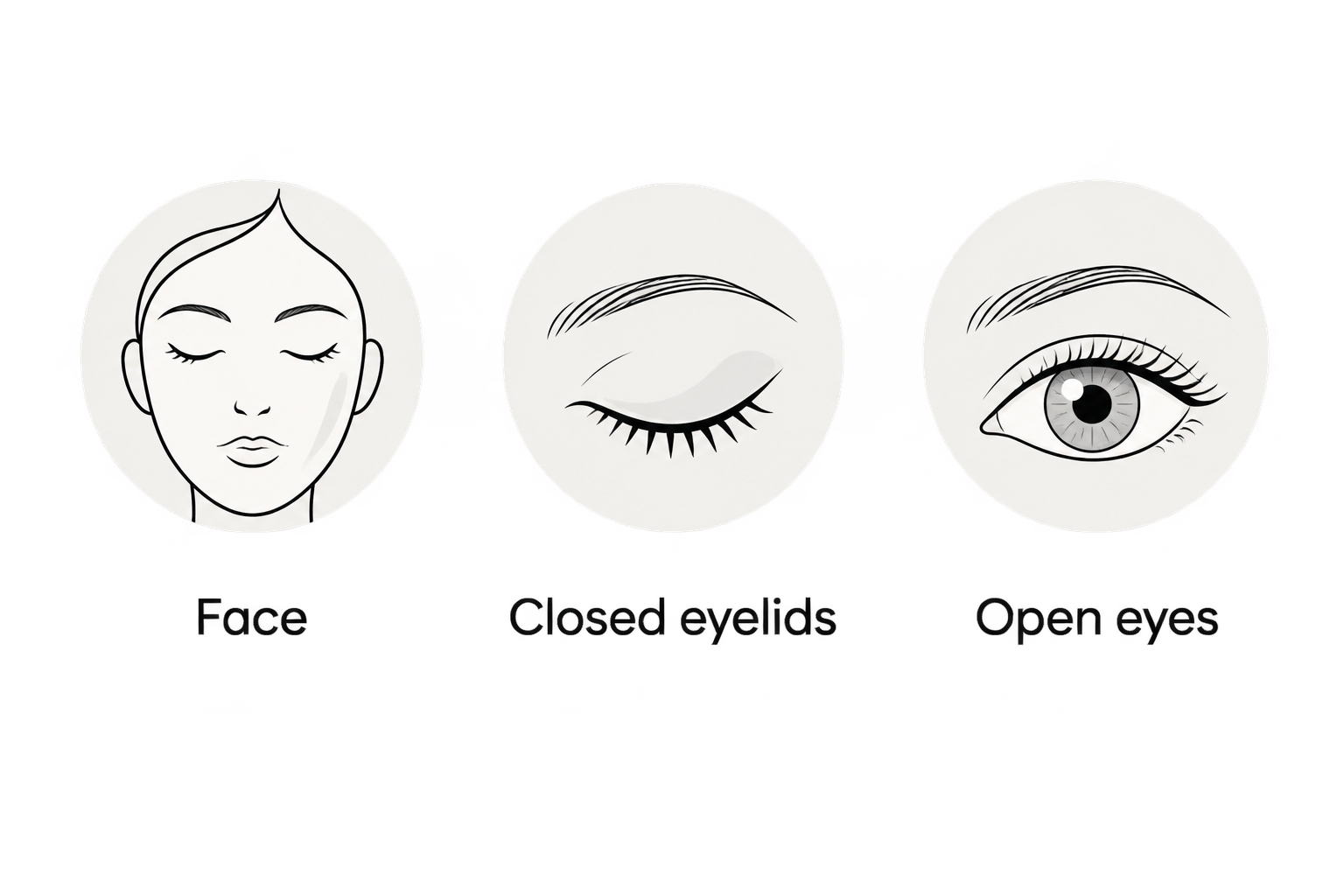
Closed eyelids are not open eyes
Directions to apply a product to closed eyelids describe external use. They do not mean you should hold an eye open, aim at the eye’s surface, or add an extra spray underneath the lid.
For any eyelid product, follow its exact method. Some directions call for applying a product to an applicator rather than spraying toward the face; do not substitute your preferred method for the one printed on the package.
Keep these boundaries clear:
- Face: Follow the facial-use directions and any instruction to avoid the eye area.
- Closed eyelids: Use only when the product specifically permits external eyelid application.
- Open eyes: Use only when the product explicitly permits direct ocular application.
- Contact lenses: Follow both the product instructions and your eye-care professional’s advice.
If a label says to avoid contact with eyes, closing your eyes does not cancel that warning. Choose an application method that follows the label rather than trying to work around it.
Why eye-use suitability varies
Not all hypochlorous acid sprays have the same formulation or directions. That does not make one category universally better; it makes the intended application important.
For your 2026 shopping checklist, focus on these factors rather than a broad promise of gentleness:
- Intended use. Look for clear language distinguishing skin, eyelids, eyes, and surfaces.
- Full formulation. A shared active ingredient does not establish that finished products are interchangeable.
- Concentration and pH. These describe aspects of a formula, but neither establishes eye suitability by itself.
- Sterility and packaging. A skin-care bottle is not evidence that its contents meet requirements for direct eye application.
- Application directions. Spraying, wiping, and instilling drops are different methods. Follow the method specified.
- Warnings and handling. Eye-contact warnings, storage directions, and instructions about the nozzle remain part of correct use.
A short ingredient list is not an eye-safety test. Neither is an absence of fragrance, a particular water source, or a bottle size. Those details cannot substitute for evidence supporting the finished product’s intended use.
What should you do if spray gets in your eye?
Start rinsing immediately. Do not delay rinsing while you search for the product page, read reviews, or wait for someone to answer a message.
Poison Control’s published eye-exposure first-aid guidance recommends irrigation with room-temperature water for 15–20 minutes. Follow the product’s exposure instructions and get individualized advice when the exposure or symptoms warrant it.
- Stop spraying. Set the bottle aside where you can find its label later.
- Begin rinsing. Use a gentle stream of lukewarm running water, not a forceful jet.
- Remove contact lenses. Begin flushing first, then remove lenses if you can do so easily. Continue rinsing.
- Keep rinsing. Let water reach the eye’s surface and blink during irrigation. Do not rub the eye.
- Get exposure advice. In the United States, call Poison Control at 1-800-222-1222. Keep the container available so you can identify the exact product.
Seek urgent medical attention for severe pain, reduced vision, significant light sensitivity, or symptoms that persist after rinsing. Do not keep testing the eye with another spray to see whether the sensation returns.
For a child, begin rinsing promptly and ask Poison Control for help with the specific exposure. A family-oriented product description does not replace age-specific directions or professional advice.
Do not use another product to neutralize the spray
Water is the first-aid rinse described above. Do not try to balance a product’s pH by adding another household substance, and do not put homemade mixtures into your eye.
Avoid treating a facial mist as a substitute for contact-lens solution or an eye rinse. These uses have their own requirements, and a shared ingredient or similar-looking bottle does not establish interchangeability.
If symptoms remain, get advice rather than stacking products. Tell the clinician or Poison Control what entered the eye, when it happened, whether you wear contacts, and what rinsing you have already done.
What the product details actually establish
Gina Rivera is identified in the brand’s founder story, but a founder story is not an eye-use instruction. For Xoxo Gina HALO™ Wellness Mist, the supplied product details identify a 5 fl oz / 150 mL bottle, hypochlorous acid, and a formulation pH of 4.5.
Those are product details—not permission to spray into open eyes. The supplied description also refers to three ingredients, but its ingredient list is truncated, so it cannot serve as a complete label check.
Xoxo Gina HALO™ Wellness Mist is for shoppers considering a hypochlorous acid wellness mist, not a substitute for a labeled eye-care product. Its stated face-and-body role is relevant to a skin-care routine; direct ocular suitability is not established by the supplied information.
For a 2026 purchase, read the current package directions before choosing how to apply it. Bottle volume does not establish sterility, and pH 4.5 alone does not establish that a finished formula belongs in your eyes. Ask for the complete current label if you cannot read it clearly.
Can you mist your face without spraying your eyes?
Follow the product’s facial-use instructions and eye warnings exactly. Do not assume that every face mist uses the same distance, amount, or application method.
If the label directs you to close your eyes, do so before application. If it says to avoid the eye area, keep the spray away from that area rather than relying on closed lids alone.
For gym bags and travel routines, keep the original labeling with the bottle. An unlabeled container makes it harder to check directions or identify a product after an accidental exposure. Do not transfer a facial spray into an eye-drop bottle, where its purpose becomes easy to confuse.
Also remember that an eye-use question and a skin-reaction question are different. If your concern is a change in your complexion after starting a mist, read the separate guide to hypochlorous acid spray and breakouts rather than using eye tolerance as a test of skin compatibility.
Does a lack of stinging mean the spray is safe for eyes?
No. A lack of stinging does not establish eye suitability. Comfort during one accidental exposure is not evidence supporting repeated direct application.
The reverse also matters: stinging does not tell you which ingredient caused the sensation or how serious the exposure is. Rinse first, then use the product identity and your symptoms to get appropriate advice.
Do not use your own eye as a product test. Labels and eye-specific instructions are a better decision point than whether a spray feels comfortable for a moment.
Can you use a facial spray instead of an eyelid cleanser?
Not unless its labeling supports that eyelid use. The word facial describes a broad area; it does not automatically include lash margins or the eye surface.
If an eye-care professional has recommended an eyelid routine, ask which product type and application method they intend. Bring the actual bottle or a clear picture of its full label instead of asking only whether hypochlorous acid is acceptable.
This distinction stays useful in 2026 because the ingredient name alone cannot answer a product-specific question. The finished formulation, intended use, and directions belong in the same decision.
FAQ
Is hypochlorous acid spray safe for eyes?
Only use a hypochlorous acid product in your eyes when its labeling explicitly permits direct ocular application. A face mist or external eyelid cleanser is not automatically suitable for open eyes.
What should I do if hypochlorous acid spray gets in my eye?
Begin rinsing immediately with lukewarm running water. Poison Control’s published guidance recommends rinsing exposed eyes for 15–20 minutes; seek exposure-specific advice and urgent care for severe or persistent symptoms.
Can I spray hypochlorous acid on closed eyelids?
Use a product on closed eyelids only if its directions permit that application. Follow the stated method rather than assuming that all hypochlorous acid sprays are eyelid products.
Can I use hypochlorous acid spray while wearing contacts?
Do not assume a spray is compatible with contact lenses. Follow the product label and your eye-care professional’s instructions, and never substitute a facial mist for contact-lens solution.
Is Xoxo Gina HALO™ Wellness Mist an eye spray?
The supplied product information does not establish Xoxo Gina HALO™ Wellness Mist as a product for direct ocular use. Its stated bottle size and pH do not establish permission to spray it into open eyes.
Does pH 4.5 mean a spray is safe to put in my eyes?
No, pH 4.5 alone does not establish ocular suitability. You need directions supporting that specific use of the finished product.
What should I do if my child sprays a facial mist into their eyes?
Begin rinsing promptly with lukewarm running water and contact Poison Control for exposure-specific guidance. In the United States, call 1-800-222-1222, and seek urgent medical attention for severe pain or vision changes.
One last thing
Look for the verb on the label. Mist, wipe, rinse, and instill are not interchangeable instructions, even when products share an ingredient.
Before your next use, check exactly where the product belongs and how it should get there. If the directions do not clearly authorize direct eye application, do not spray it into your eyes.