
November 20, 2026
Is hypochlorous acid spray safe to use during pregnancy?

A hypochlorous acid ingredient name alone does not establish that a spray is safe during pregnancy. Before adding a hypochlorous acid spray to your pregnancy skincare routine, ask your obstetric clinician or dermatologist to review the exact formula and intended use. A spray labeled for surfaces is not interchangeable with one labeled for skin, and neither a simple ingredient list nor a particular pH establishes pregnancy safety.
- Is hypochlorous acid spray safe during pregnancy? Get product-specific advice rather than relying on the ingredient name.
- Xoxo Gina HALO™ Wellness Mist lists pH 4.5; that formulation detail does not establish pregnancy safety.
- Use a spray only for its labeled purpose, and bring the complete ingredient list to your clinician.
- A skincare mist is not automatically a surface disinfectant, hand sanitizer, or treatment.
Why this matters
Pregnancy changes how you evaluate everyday products. A familiar ingredient, a reassuring product name, or a short formula can make a purchase feel straightforward, but none answers the full question: is this particular product appropriate for you, used this particular way?
Keep the decision specific. When reviewing a product from Xoxo Gina HALO™, or any hypochlorous acid skincare brand, separate what the label documents from what it does not establish. Bottle size, ingredients, and directions help identify a product; they do not replace pregnancy-specific medical advice.
You do not need a more complicated routine. You need a clear reason for each product in it.
Is hypochlorous acid spray safe to use during pregnancy?
There is no responsible blanket yes for every hypochlorous acid spray. Pregnancy suitability is a product-specific question that includes the complete formulation, the application site, the directions, and your medical circumstances.
Start with the intended use. Products described with the same ingredient can serve different purposes, and a skincare direction does not authorize every other use.
| Product or use | Best for | Practical benefit | Important limit |
|---|---|---|---|
| Spray labeled for facial or body skincare | Reviewing a potential skincare step | Gives you skin-specific directions to discuss | Skin labeling alone does not establish pregnancy safety |
| Product labeled for surface cleaning | Following directions for household surfaces | Identifies the intended cleaning application | Surface directions do not authorize spraying your skin |
| Product labeled as a disinfectant | Following its specific disinfection instructions | States the intended disinfection use | A skincare mist should not inherit those claims |
These categories are not a ranking. Match the product to its label before asking whether it belongs in your pregnancy routine.
What would establish a useful answer for you?
A useful clinical conversation starts with an identifiable bottle, not just the words hypochlorous acid. Bring the product name, complete ingredient list, directions, and any concentration information printed on the packaging.
Explain where you plan to apply it and why. Spraying your face, using a product around your mouth, and cleaning a countertop are different questions; ask about the actual use you have in mind.
If you already use prescription skincare, include that information. Your clinician needs the routine as a whole, rather than an isolated ingredient presented without context.
Why the answer varies
The relevant differences are practical, not promotional. Use these factors to organize your product review:
- Intended use: Look for explicit directions covering the area or surface you want to spray.
- Complete formulation: Review every listed ingredient, not only hypochlorous acid on the front label.
- Application site: Ask separately about facial skin, body skin, the eye area, and any other intended location.
- Directions and warnings: Check application instructions, storage guidance, and any limits printed on the bottle.
- Your circumstances: Tell your clinician about reactive skin, current symptoms, and other products or treatments you use.
A concentration or pH value is useful formulation information, but neither should become a stand-alone pregnancy verdict. Likewise, a larger bottle tells you how much product it contains—not how your skin will respond.
Keep the full label in view
Online descriptions can be abbreviated. A front-of-bottle photograph can also leave out directions or the rest of an ingredient list.
For your 2026 product review, save clear photographs of the complete packaging. Ask about the bottle you actually have rather than relying on a general discussion of the ingredient category.
What should you check before the first mist?
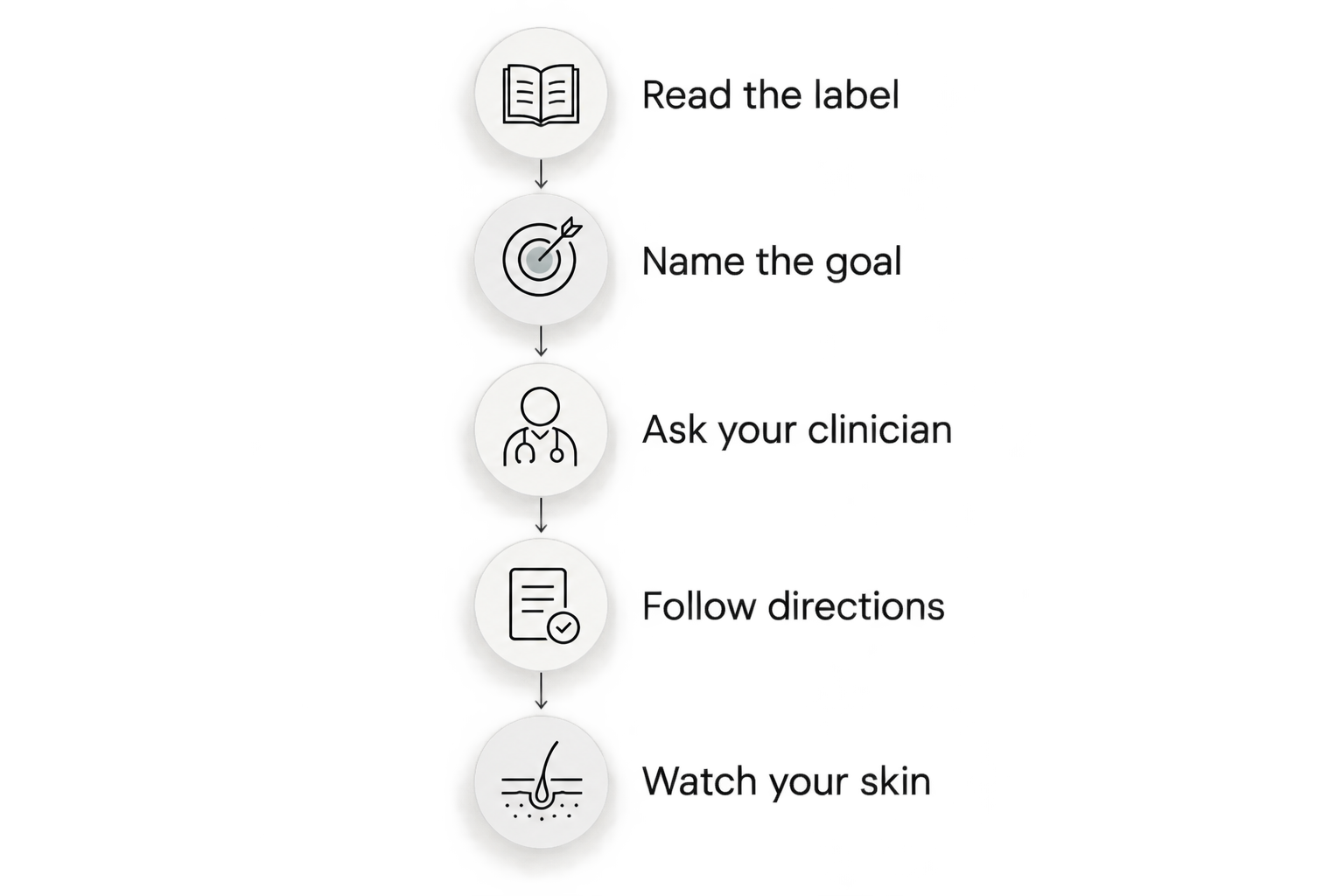
Make the decision before adding another step to your bathroom shelf. This sequence keeps the conversation focused without turning it into a research project.
- Read the label. Confirm the intended use, ingredients, directions, and warnings on the actual product.
- Name the goal. Decide whether you want an optional skincare step or are trying to address a symptom that needs assessment.
- Ask your clinician. Share the label and describe exactly where and how you intend to use the spray.
- Follow directions. If your clinician agrees the product is appropriate, follow the product directions and any individualized advice.
- Watch your skin. Stop using the product if irritation develops, and seek medical advice for persistent or concerning symptoms.
A small-area trial, if your clinician recommends one, addresses local skin tolerance—not pregnancy safety. Keep those questions separate. Skin that feels comfortable after an application does not establish anything about fetal safety.
You also do not need to continue using an optional product while deciding whether it belongs in your routine. Leave room for a clear answer rather than treating a purchase as a commitment.
What does the product information actually tell you?
Gina Rivera's founder story introduces the brand, but product selection during pregnancy still comes back to the bottle and your clinician's advice. The Xoxo Gina HALO™ Wellness Mist product information identifies a 5 fl oz / 150 mL hypochlorous acid mist formulated at pH 4.5.
Xoxo Gina HALO™ Wellness Mist is best for shoppers seeking a 5 fl oz / 150 mL hypochlorous acid mist, not a pregnancy-safety guarantee.
Those details give you something concrete to review. The bottle volume describes the amount supplied, while the pH describes a formulation property; neither establishes pregnancy suitability, clinical effectiveness, or superiority over another spray.
The practical benefit is straightforward product identification. The limit is equally important: a product description is not an individualized medical assessment. For a 2026 pregnancy skincare decision, take the full label—not just those headline details—to your appointment.
Does a simple formula mean pregnancy-safe?
No. A short ingredient list can be easier to read, but ingredient count is not a pregnancy-safety standard. The identity of the ingredients and the intended use matter more than counting them.
The same distinction applies to reassuring language such as natural, gentle, or wellness. Those words do not tell you whether a particular use is appropriate during pregnancy.
Apply that label-first approach across your bathroom shelf. Questions about magnesium deodorant during pregnancy also require a review of the finished formula and intended application, rather than a safety conclusion based on one featured ingredient. A favorable impression of one category does not transfer automatically to another.
Simple is a preference. Pregnancy suitability is a separate assessment. You can value a short formula without asking it to prove something it does not establish.
Can you use it after the gym while pregnant?
Treat post-workout use as a skincare question, not an automatic extension of equipment cleaning. Before spraying your face or body, confirm that the product is labeled for that application and that your clinician agrees it fits your routine.
Keep these tasks separate:
- Skin care: Follow the skin product's directions for the intended area.
- Equipment cleaning: Follow the equipment-cleaning product's instructions and the equipment manufacturer's care guidance.
- Hand cleaning: Do not assume a facial mist replaces handwashing or a product labeled for hand sanitizing.
A product's presence in your gym bag does not make it suitable for every task in that bag. Nor does a surface-cleaning use establish that the same product belongs on facial skin.
For your 2026 gym routine, decide what each product is there to do. Fewer assumptions make the routine easier to follow, especially when you are tired and ready to leave.
What should you do if you already used a spray?
Using a spray before asking about it does not, by itself, establish that harm occurred. It also does not provide enough information for a blanket reassurance. Your next step is to identify the product and describe the exposure accurately.
Keep the bottle available. Tell your clinician what you used, where you applied it, whether it was intended for skin, and whether you have symptoms.
Do not treat an online ingredient summary as a personal exposure assessment. If the product was swallowed, sprayed into the eyes, or used contrary to its warnings, seek prompt advice appropriate to the exposure. In the United States, Poison Control can provide exposure-specific guidance; contact emergency services for severe symptoms.
The useful information is concrete. Product identity, route of exposure, and symptoms give a healthcare professional more to work with than a general question about whether an ingredient sounds safe.
What should you ask at your next appointment?
Bring a short set of questions to your 2026 prenatal or dermatology visit. You do not need technical language to get a specific answer.
- Is this exact product appropriate for the area where I want to use it?
- Does anything in my current skincare or prescription routine change your advice?
- Am I trying to manage a symptom that needs a different assessment?
- What should make me stop using it and contact you?
- Are there application instructions I should follow beyond the label?
Ask about your goal as well as your bottle. If you are seeking help with a new rash, persistent discomfort, or another skin concern, an optional mist should not delay that conversation.
A clinician's answer about one product is not permission to substitute another. Review a different formula on its own terms, even when the front labels feature the same ingredient.
FAQ
Is hypochlorous acid spray safe during pregnancy in 2026?
A hypochlorous acid ingredient name alone does not establish pregnancy safety in 2026. Ask your obstetric clinician or dermatologist to review the exact formula, directions, and intended application.
Can I spray hypochlorous acid on my face while pregnant?
Get product-specific advice before adding a hypochlorous acid facial spray during pregnancy. Confirm that the product is labeled for facial skin, and share its complete ingredient list with your clinician.
Does pH 4.5 mean a spray is pregnancy-safe?
pH 4.5 does not establish pregnancy safety. It describes a formulation property, not an individualized assessment of the product or its use.
Is a three-ingredient hypochlorous acid spray automatically safer?
A three-ingredient formula is not automatically safer during pregnancy. Review the actual ingredients, intended use, and directions rather than treating ingredient count as proof.
Can I use a surface spray as a facial mist?
Do not use surface-cleaning directions as permission to spray your face. Choose a product explicitly labeled for the intended skin application and ask your clinician about pregnancy suitability.
Does a small-area skin test prove pregnancy safety?
A small-area skin test does not prove pregnancy safety. If your clinician recommends one, it addresses local skin tolerance rather than fetal safety.
What if I used hypochlorous acid spray before knowing I was pregnant?
Identify the exact product and discuss the exposure with your clinician rather than assuming either harm or safety. Share the label, application site, and any symptoms.
One last thing
The most useful detail to bring to an appointment is not a reassuring word from the front of the bottle. It is a readable photograph of the entire label.
Save the ingredients, directions, and warnings together. That small step turns a broad pregnancy skincare question into a product-specific conversation—and keeps your next decision grounded in what you actually plan to use.