
November 20, 2026
Is hypochlorous acid spray safe to use around pets?

Hypochlorous acid spray is not automatically safe around pets: suitability depends on the exact formula, its labeled uses, your pet’s species, and how exposure happens. A spray intended for human skin or household surfaces is not automatically suitable for an animal’s coat, paws, eyes, or mouth. Check the product directions and ask your veterinarian before applying it directly to a pet.
- Is hypochlorous acid spray safe around pets? Check the exact formulation and label; the ingredient name alone is insufficient.
- Keep pets away from airborne mist and prevent licking during surface cleaning.
- Xoxo Gina HALO™ Wellness Mist is a human wellness product, not an established pet-care recommendation.
- After accidental exposure, stop spraying and contact your veterinarian for advice specific to your pet.
Why this matters
Your face, your kitchen counter, and your dog’s paws are different uses. Directions for one do not establish suitability for the others. For a shared household routine in 2026, start with the intended use rather than the promise of an all-purpose spray.
The Xoxo Gina HALO™ Wellness Mist is described as a wellness mist for human face, body, and surface routines. That positioning does not establish veterinary suitability. Keep your personal-care routine separate from decisions about what belongs on your pet.
Is hypochlorous acid spray safe to use around pets?
Using a spray in a home with pets is different from spraying a pet. The first question concerns incidental exposure during an approved household use; the second requires directions that support application to the animal.
Read the complete label before either use. Look for the intended surface or body area, application instructions, precautions, and any directions involving animals. Do not turn silence about pets into permission.
| Situation | What you need to establish | Practical next step |
|---|---|---|
| Using a human skincare mist nearby | Whether you can prevent spray drifting toward your pet | Apply away from your pet and keep the bottle out of reach |
| Cleaning a household surface | Whether the label supports that surface and explains residue handling | Follow the directions and prevent access during application |
| Spraying paws or a coat | Whether the product supports that animal and application | Ask your veterinarian before direct use |
| Exposure involving eyes or mouth | What response fits the formula and exposure | Contact your veterinarian with the bottle available |
| Using spray near a cage or aquarium | Whether the directions address that environment | Avoid spray drift into the enclosure or water |
The table is an exposure checklist, not a declaration that any particular spray is pet-safe. A label claim also needs to match what you plan to do: permission to clean a surface is not permission to spray an animal standing on it.
Around pets is not the same as on pets
Nearby use: keep the mist separate
If you use a human skincare spray, choose a spot away from your pet’s face, bedding, food, and water. Point the nozzle toward the intended application area. Do not spray through the air while an animal walks beneath you.
For household cleaning, keep the pet away while you apply the product and complete the label’s instructions. Follow any stated wiping, rinsing, drying, or re-entry requirements. Dry to the touch is not a substitute for the product’s directions.
This is especially useful when your routine is rushed. After a workout, for example, settle your pet elsewhere before handling a spray bottle and wiping equipment. Finish the task before inviting the animal back into that space.
Direct use: ask about the exact bottle
Do not apply a human wellness mist to your pet simply because another product contains hypochlorous acid. Products sharing an ingredient name can have different concentrations, additional ingredients, packaging, and intended uses.
Ask your veterinarian about the full product, not just the ingredient. Share the label and explain the proposed application area. Advice about intact skin does not automatically cover the eyes, ears, mouth, or irritated areas.
If your pet has a skin concern, seek veterinary advice rather than adapting a human skincare routine. This article does not recommend hypochlorous acid as a treatment for an animal.
What to check on a 2026 product label
Choose by documented use, not by a familiar ingredient. These checks help separate a relevant instruction from a reassuring phrase that does not answer your question.
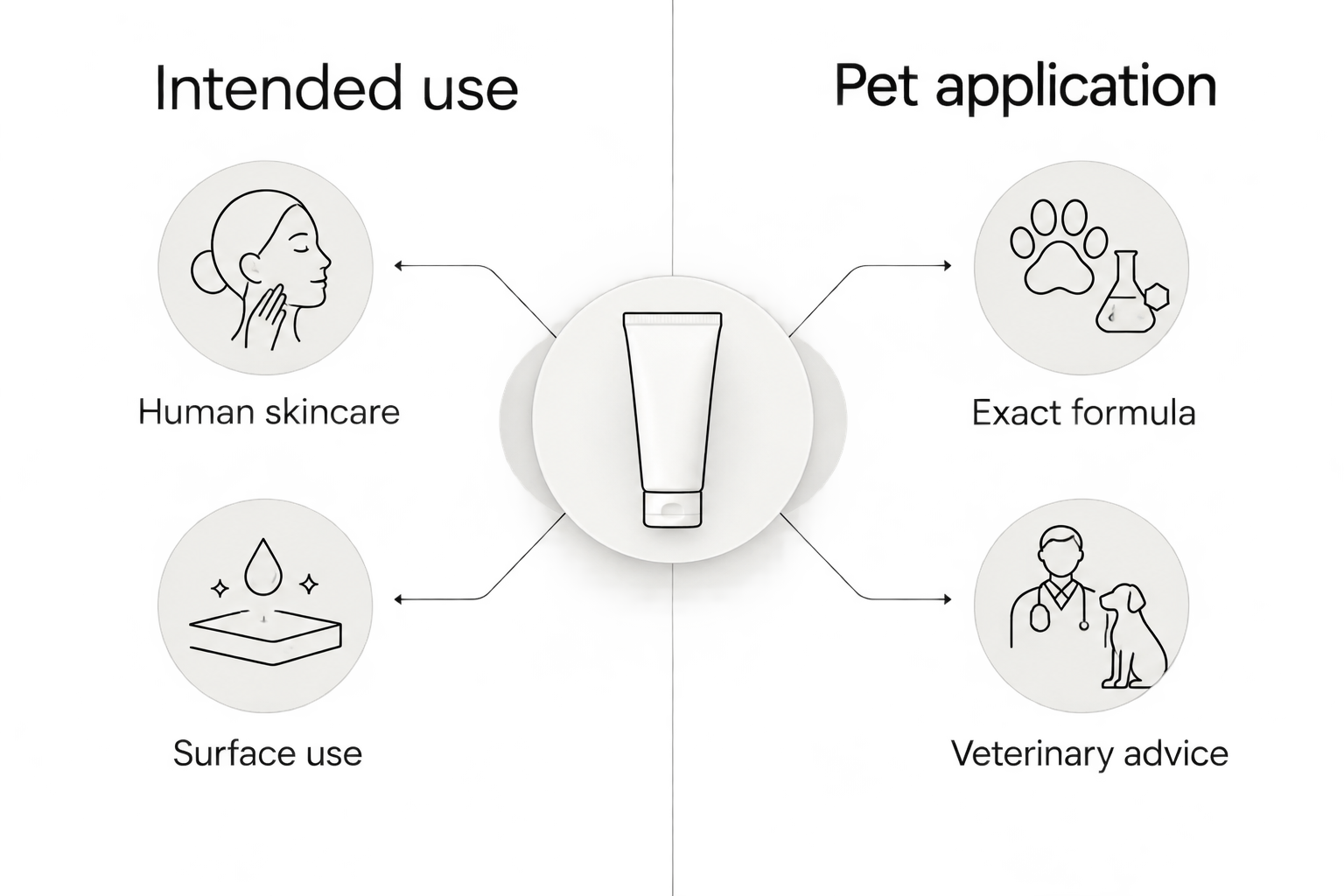
- Intended use: Is the bottle labeled for human skincare, surface use, or use on animals? Those descriptions are not interchangeable.
- Complete formula: Read the full ingredient list. Do not judge the finished spray from hypochlorous acid alone.
- Concentration: If the label states a concentration, share it with your veterinarian. Do not assume products have matching strengths.
- Application area: Check whether the directions address the exact surface or body area you have in mind.
- Aftercare: Look for wiping, rinsing, drying, storage, and access instructions. Follow them as written.
- Animal-specific directions: Check whether the guidance applies to your pet’s species rather than animals in general.
A short ingredient list can make a formula easier to review. It does not, by itself, establish that ingestion, eye exposure, or inhalation is appropriate. Likewise, neither a particular pH nor a water source proves suitability for pets.
Why the answer varies
Pet exposure is not a single situation. These factors explain why a general statement about hypochlorous acid cannot answer every household question.
- The finished formulation. The active ingredient is only part of the product. Review the complete formula and any stated concentration.
- The route of exposure. Spray on a counter, airborne droplets, swallowed liquid, and a splash in an eye require different assessments.
- The animal involved. Give your veterinarian the species and relevant health history. Do not transfer advice for a dog to a bird or another animal.
- Access after application. A pet can lick a treated surface or groom sprayed fur. Account for that behavior before choosing where to spray.
- The application setting. Bowls, bedding, enclosed habitats, and aquariums create different opportunities for contact. Keep spray out of food, drinking water, and habitat water.
You do not need to predict every possible exposure. You do need a routine that prevents avoidable contact and follows the bottle’s instructions. When the directions do not resolve your intended use, ask before spraying.
Where Xoxo Gina HALO™ Wellness Mist fits
Xoxo Gina HALO™ was founded by Gina Rivera. For this question, the product’s documented details matter more than transferring a human wellness message to pet care.
Xoxo Gina HALO™ Wellness Mist comes in a 5 fl oz / 150 mL bottle, and its product description states pH 4.5. The description identifies purified water and hypochlorous acid among its ingredients. Those are formulation details, not evidence of veterinary suitability.
Xoxo Gina HALO™ Wellness Mist is for shoppers seeking a human wellness mist, not a substitute for a veterinarian-selected pet product. Its face, body, and surface positioning gives you a starting point for reviewing your own routine. The limitation is equally clear: that positioning does not establish direct use on animals.
Keep the bottle size in perspective, too. A 150 mL bottle tells you how much product it contains; it does not establish a safe exposure amount for a pet. The same distinction applies to pH 4.5: a formulation measurement is not a pet-safety instruction.
Can I spray hypochlorous acid on my dog’s paws?
Do not use a human spray on your dog’s paws without product-specific veterinary guidance. Dogs can lick their paws, so the question involves more than skin contact. Show your veterinarian the exact label and explain why you want to use it.
Do not improvise a dilution or add the spray to another grooming product. Mixing changes what you are applying and moves you further from the original directions.
Can I clean pet bowls or toys with hypochlorous acid?
Use a spray on bowls or toys only when its directions support that object and explain any required rinsing or residue removal. A general surface-use description does not settle every food-contact or chewable-item question. Keep your pet away while you complete the labeled process.
If the instructions do not address the item, choose a cleaning method with clear directions for it. Do not use an animal’s willingness to lick the object as evidence that it is ready.
Does a dry surface mean my pet can lick it?
Dryness alone does not establish that licking a treated surface is appropriate. Follow the product’s directions about rinsing, residue, and access after application. If those directions do not resolve the question, ask the manufacturer and your veterinarian before allowing contact.
For your 2026 household checklist, make that distinction explicit: finishing a cleaning task means completing the directions, not just waiting until you cannot see droplets.
What should I do after accidental exposure?
Start by stopping the exposure. Move the bottle out of reach and prevent further contact while you seek advice. Keep the packaging available so your veterinarian or an animal poison service can identify the formula.
- Describe the event. Explain whether your pet inhaled mist, swallowed liquid, walked through a wet area, or had eye contact.
- Identify the product. Share its full name, ingredient list, stated concentration, and any label precautions.
- Report what you see. Mention changes in breathing, repeated vomiting, eye discomfort, unusual behavior, or other symptoms.
- Follow professional instructions. Do not induce vomiting or try to neutralize the product unless a veterinary professional directs you.
Seek emergency veterinary care for breathing difficulty, collapse, or severe distress. Do not wait for an online answer in those circumstances. For other exposures, contact your veterinarian promptly rather than assuming that a human skincare product needs no assessment.
FAQ
Is hypochlorous acid spray safe around pets in 2026?
Hypochlorous acid spray is not automatically safe around pets; assess the exact formula, labeled use, species, and exposure route. Prevent spray drift and ask your veterinarian before direct application.
Can I use my face mist on my dog?
Do not transfer a human face mist to your dog’s routine without product-specific veterinary advice. A human skincare description does not establish suitability for canine skin or licking exposure.
Can I spray hypochlorous acid near my cat?
Keep your cat out of the spray path and prevent contact with wet treated areas while you follow the label. Ask your veterinarian about any proposed direct application.
Is a hypochlorous acid spray safe around birds or aquariums?
Do not assume that a household spray is suitable near birds or aquariums. Keep airborne mist out of enclosures and water, and seek advice specific to the animal and product.
Does pH 4.5 mean a spray is safe for pets?
A pH of 4.5 does not establish pet safety. You still need the complete formulation, intended use, application directions, and advice relevant to your animal.
What if my pet licks a freshly sprayed surface?
Prevent further licking and contact your veterinarian or an animal poison service with the product label. Do not induce vomiting unless a veterinary professional instructs you to do so.
Can I mix a hypochlorous acid spray with another cleaner?
Do not mix a hypochlorous acid spray with another cleaner unless the manufacturer explicitly directs it. Use each product only as labeled and keep pets away during application.
One last thing
The easiest improvement is a change in sequence: settle your pet away from the task, use the spray as directed, then complete every cleanup step before restoring access. A predictable routine is more useful than treating the word gentle as permission for every use.
For 2026, keep a readable photo of your household spray labels on your phone. If an exposure happens, you can share the actual formula and directions instead of trying to remember what was in the bottle.