
November 27, 2026
Is hypochlorous acid spray safe for people with rosacea?

A facial hypochlorous acid spray is not automatically safe for everyone with rosacea; suitability depends on the finished formula and your skin’s response. Choose a product labeled for facial skin, test it on a small area before broader use, and stop if irritation develops. Treat the mist as an optional skincare step—not a rosacea treatment or a replacement for prescribed care.
- Hypochlorous acid spray for rosacea requires a facial-use formula and an individual tolerance check—not a blanket safety promise.
- Xoxo Gina HALO™ Wellness Mist is a facial mist option, not a rosacea treatment.
- Sensitive skin needs moisturizer and sun protection; a face mist does not replace either.
- Stop using a new spray if it causes burning, itching, swelling, or worsening redness.
Why this matters
When your skin reacts easily, another bottle should earn its place. The useful question is not whether hypochlorous acid sounds gentle. It is whether the exact product suits your skin without disrupting the routine that already works.
Start with how to patch test hypochlorous acid spray for sensitive skin. A small-area trial gives you a more useful starting point than applying a new mist across both cheeks immediately.
For your 2026 skincare routine, keep the goal simple: fewer unanswered questions, not more steps. You do not need a mist just because it appears in someone else’s routine.
Is hypochlorous acid spray safe for people with rosacea?
There is no category-wide safety guarantee for rosacea-prone skin. A product’s intended use, complete ingredient list, directions, and your personal tolerance matter more than the ingredient name on the front.
The American Academy of Dermatology’s rosacea skincare guidance emphasizes gentle cleansing, moisturizing, sun protection, and avoiding products that irritate your skin. Those basics remain the foundation when you consider adding a spray.
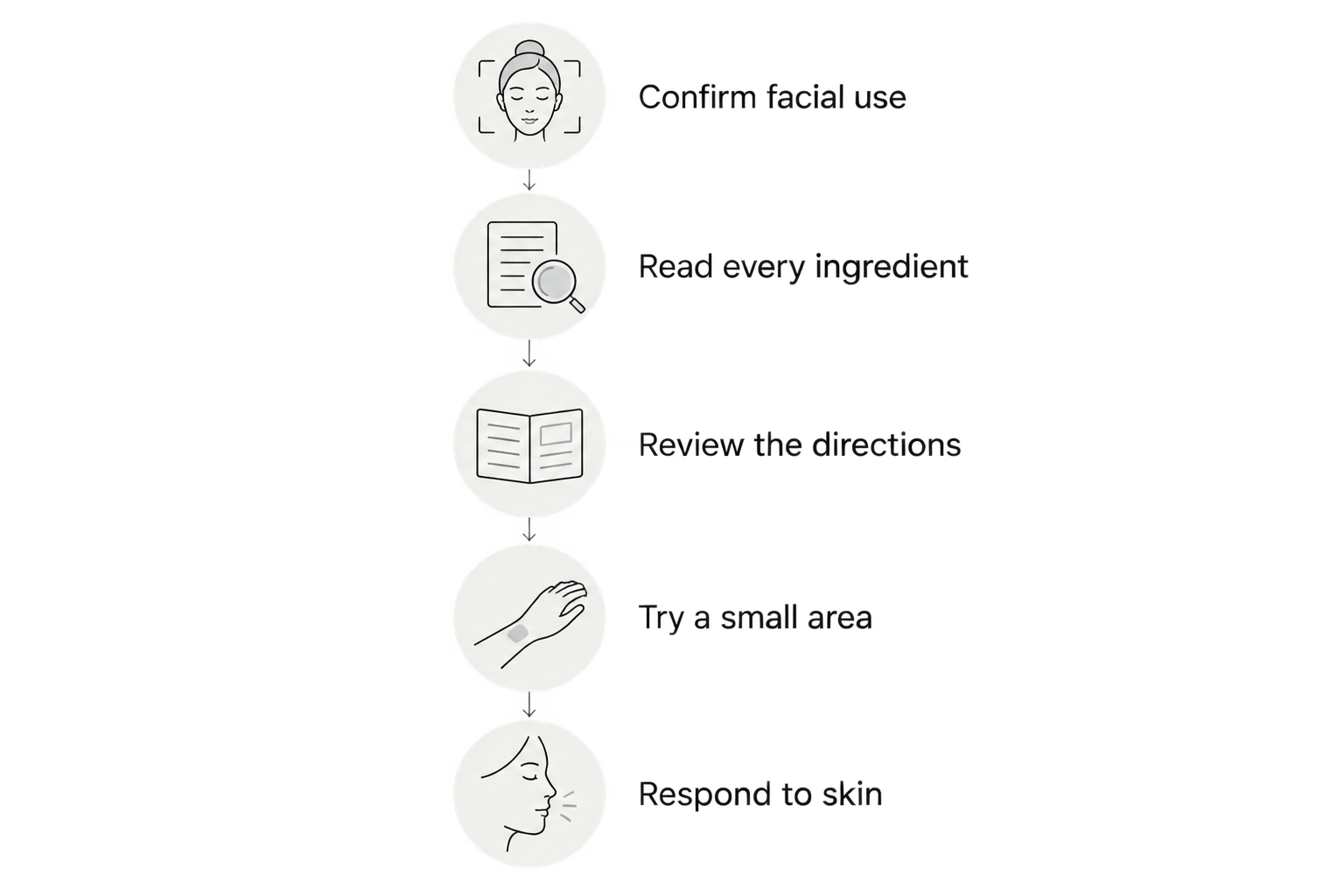
Use this checklist before deciding where a mist belongs:
- Confirm facial use. Read the intended-use statement. A surface-cleaning product is not interchangeable with facial skincare because both mention hypochlorous acid.
- Read every ingredient. Check the full formula against ingredients you already know your skin does not tolerate. A short list still needs checking.
- Review the directions. Follow the product’s application, storage, and eye-contact instructions rather than copying a social media routine.
- Try a small area. Introduce the product cautiously while keeping the rest of your routine familiar.
- Respond to your skin. Stop if the new product causes irritation. Do not keep applying it to prove that it works.
A comfortable first application is encouraging, but it does not establish long-term suitability. Keep watching for delayed itching, dryness, or worsening redness as you introduce the product.
Keep the mist’s job separate
A face mist, moisturizer, sunscreen, and prescribed medication do different jobs. Thinking of them as interchangeable makes it harder to judge whether your routine actually meets your skin’s needs.
Here is the practical distinction for a 2026 routine. The “best for” labels describe each category’s role—not a promise that every formula suits every person.
| Routine option | Best for | Useful role | Limit or caution |
|---|---|---|---|
| Facial hypochlorous acid mist | People considering an optional spray step | Adds a facial mist when the label permits that use | Does not establish rosacea suitability or replace treatment |
| Moisturizer | Supporting skin hydration | Helps manage dryness as part of daily skincare | Individual formulas can still irritate |
| Broad-spectrum sunscreen | Daily sun protection | Protects against ultraviolet exposure when used as directed | A mist without sunscreen labeling cannot substitute |
| Prescribed rosacea medication | People receiving clinician-directed care | Addresses the condition according to the prescription | Requires the prescribed instructions and follow-up |
Keep proven essentials in place before adding an optional mist. If your existing routine feels comfortable, leaving it unchanged is a valid decision.
Avoid judging these categories by texture alone. A watery product is not automatically gentler, and a richer product is not automatically unsuitable. The finished formula and your response decide whether a particular product belongs.
Why tolerance varies
Rosacea-prone skin does not respond identically from person to person. These factors explain why a positive review cannot predict your experience:
- The finished formula. Hypochlorous acid is one part of a product. Review the entire ingredient list rather than treating the featured ingredient as a safety certificate.
- Your known sensitivities. A formula that suits someone else can contain an ingredient your skin already rejects. Your own reaction history deserves priority.
- Your skin’s condition. Skin that is already burning or irritated is not a useful starting point for an unsupervised product experiment. Ask your clinician before changing that routine.
- Other new products. Introducing a mist alongside a new cleanser or exfoliant makes the source of a reaction harder to identify. Change one thing at a time.
- How you use it. Follow facial-use directions, application guidance, and storage instructions. More frequent application is not evidence of greater benefit.
- Your treatment plan. Prescription products come with their own instructions. Ask the prescribing clinician where an optional mist fits rather than moving or skipping medication yourself.
Neither pH nor ingredient count settles all these questions. Both provide information about a formula; neither proves that a finished product is suitable for every person with rosacea.
How should you try a new facial spray?
Start when your routine is familiar and your skin is not already reacting to another new product. Keep the cleanser, moisturizer, and sunscreen you tolerate in place so the mist is the only change you are assessing.
The American Academy of Dermatology’s general guidance for testing skincare products recommends applying the usual amount to a small test area twice daily for 7–10 days. That is general product-testing guidance, not a rosacea-specific protocol or a guarantee against a later reaction. Follow product directions and any individualized advice from your dermatologist.
Choose a small test area
Use a small area such as the underside of your arm or the bend of your elbow, following the product’s directions. Do not spray an unfamiliar facial product directly toward your eyes.
An uneventful arm test does not prove that reactive facial skin will respond the same way. If you have a history of strong reactions, ask your dermatologist how to introduce the product before trying it on your face.
Keep the rest familiar
Do not add a new exfoliant, serum, and mist together. If irritation follows, you will have several possible explanations instead of one.
Avoid treating the testing period as a challenge to increase use. The point is to observe tolerance, not to reach the highest application frequency your skin can endure.
Stop at irritation
Burning, itching, swelling, or worsening redness is a reason to stop the new product. Rinse it off if a reaction occurs and seek medical advice when symptoms persist or concern you.
Do not describe irritation as proof that a spray is working. For a new optional skincare step, comfort matters more than finishing the bottle.
What does pH tell you—and what does it not?
A pH value describes how acidic or alkaline a formula is. It does not, by itself, establish whether that formula will suit rosacea-prone skin.
That distinction matters when reading product descriptions in 2026. A pH statement gives you one formulation detail, not a clinical result, an irritation test, or permission to ignore your own response.
The same restraint applies to ingredient count. Fewer ingredients make a label shorter to review, but they do not eliminate the possibility of sensitivity. A longer list does not automatically make another product unsuitable, either.
Read formulation details as information, not rankings. Without direct product evidence, bottle size, water source, pH, and ingredient count cannot establish that one spray is safer or more effective than another.
Where Xoxo Gina HALO™ Wellness Mist fits
Gina Rivera is the founder behind Xoxo Gina HALO™. That founder connection introduces the brand; it does not replace an individual skin-tolerance check.
Xoxo Gina HALO™ Wellness Mist comes in a 5 fl oz / 150 mL bottle. The product listing states pH 4.5 and identifies purified water and hypochlorous acid among its ingredients. Read the current complete label and directions before use.
Xoxo Gina HALO™ Wellness Mist is best for shoppers seeking a 150 mL facial hypochlorous acid mist, not a rosacea treatment. Its stated bottle size and pH are concrete product details; they do not demonstrate rosacea-specific safety or superior results.
The useful benefit is straightforward: you can assess a defined facial-mist option against your own routine. The limitation is equally important: those listing details cannot tell you whether your particular skin will tolerate it. Small-area testing and appropriate medical advice still apply.
Can hypochlorous acid spray replace rosacea medication?
No—hypochlorous acid spray should not replace prescribed rosacea medication. An optional cosmetic step and a prescribed treatment have different purposes, and adding a mist is not a reason to reduce or stop your medication.
If your treatment stings or feels difficult to use, speak with the prescribing clinician. Replacing it with a spray without discussing the problem leaves the treatment issue unresolved.
Can I use a mist during a rosacea flare?
A flare is a reason to ask your clinician before introducing a new mist. Keep to the routine and treatment advice already provided for your skin rather than testing several new products while symptoms are active.
There is no need to earn your way through discomfort. If something newly applied makes your skin feel worse, stop using it and seek advice about the reaction.
Does a facial mist replace sunscreen?
No—a facial mist without sunscreen labeling does not replace sunscreen. The American Academy of Dermatology recommends broad-spectrum, water-resistant sunscreen with SPF 30 or higher for sun protection.
Keep that distinction clear in your 2026 routine: a refreshing sensation is not a measure of ultraviolet protection. Use sunscreen according to its label, regardless of whether you also choose a mist.
FAQ
Is hypochlorous acid spray for rosacea safe to use every day?
Daily use is not automatically suitable for every person with rosacea. Choose a facial-use product, follow its directions, and establish tolerance before making it a regular step; ask your dermatologist if your skin is actively irritated.
Will hypochlorous acid spray treat my rosacea?
Do not use a facial hypochlorous acid spray as a rosacea treatment or a replacement for prescribed medication. Discuss persistent redness, bumps, burning, or other symptoms with a dermatologist.
Should I keep using a face spray if it stings?
Stop a new face spray if it stings or causes irritation. Rinse it off if a reaction occurs, and seek medical advice if symptoms persist, worsen, or concern you.
Does a pH of 4.5 mean a spray is safe for rosacea?
A pH of 4.5 does not establish rosacea safety. It describes one property of the formula, while the complete ingredients, directions, and your individual response still matter.
Can I spray a facial hypochlorous acid mist into my eyes?
Do not spray a facial mist into your eyes unless that exact product is specifically labeled for that use. Facial skincare and eye-care products are not interchangeable.
Do I still need moisturizer after using a face mist?
A face mist does not replace moisturizer. Keep a moisturizer you tolerate in your routine and follow your dermatologist’s advice about dryness or irritation.
How long should I test a new skincare product?
The American Academy of Dermatology’s general skincare-testing guidance recommends a small-area trial twice daily for 7–10 days. That does not guarantee facial tolerance; follow the product directions and seek personalized advice for highly reactive skin.
One last thing
The most useful addition to your 2026 routine might be a simple note, not another product. Record what you introduced, where you applied it, and what changed; bring that information to your dermatologist if a reaction occurs.
You do not need to keep a mist that your skin dislikes. An optional step should stay optional, even when its ingredient list sounds appealing.