
November 24, 2026
Is hypochlorous acid spray safe for everyday use?

Yes—hypochlorous acid spray formulated and labeled for skin can be used every day when you follow its directions and your skin tolerates it. That does not make every hypochlorous acid product interchangeable: a surface disinfectant is not a skincare mist, and daily use is not a promise that irritation cannot happen.
- Is hypochlorous acid spray safe for everyday use? For skin-labeled formulas, yes—as directed and tolerated.
- Xoxo Gina HALO™ shoppers should judge everyday skincare by product directions, intended use, and individual skin response.
- Keep skin mists and surface disinfectants separate; the shared ingredient does not make their uses interchangeable.
- Introduce a new mist on a small area before making it part of your full routine.
Is hypochlorous acid spray safe for everyday use?
Daily use is appropriate only when the specific product’s directions support it. Look for an explicit skin-use instruction, then check application directions, warnings, and storage instructions. The ingredient name alone cannot answer those questions.
The Xoxo Gina HALO™ Wellness Mist is listed as a 5 fl oz / 150 mL mist with a stated pH of 4.5. Those are useful formulation and size details, not a guarantee that every person will tolerate daily application.
| Product category | Best for | Useful distinction | Limit to respect |
|---|---|---|---|
| Skin-labeled hypochlorous acid mist | A skincare routine supported by its label | Directions address application to skin | Individual irritation remains possible |
| Surface-labeled hypochlorous acid disinfectant | The surfaces named on its label | Directions address surface use | Do not substitute it for skincare |
| Product with unclear intended use | Neither routine until its use is clarified | The ingredient name offers incomplete guidance | Confirm directions before applying |
This distinction matters more than whether a bottle looks gentle, simple, or familiar. Choose by intended use first.
Why this matters
A daily habit repeats the same exposure. If a formula does not agree with your skin, using it more often is not the answer.
For your 2026 routine, keep the decision simple: confirm the product is intended for skin, introduce it gradually, and pay attention to your response. You do not need to turn a mist into another complicated skincare project.
Sensitive or reactive skin deserves particular care when adding anything new. A short ingredient list helps you see what is present, but it does not establish that a formula is suitable for every person.
Skin use and surface use are different jobs
Hypochlorous acid appears in products made for different purposes. The finished formulation, directions, and intended application determine how you should use each one.
A shared ingredient is not a shared set of instructions. Do not apply a surface disinfectant to your face because another product containing hypochlorous acid is sold for skincare. Likewise, do not assume a skin mist has demonstrated surface-disinfection performance.
For gym routines, separate your personal skincare from equipment cleaning. Follow the equipment-cleaning product’s surface directions, including any stated contact time, rather than borrowing instructions from your face mist.
The practical benefit of this separation is clarity: each bottle has a defined job. The drawback of treating one ingredient as an all-purpose permission slip is that you lose the directions that make its use appropriate.
Keep products in their original containers. That preserves access to their labels and helps prevent a family member from mistaking one type of spray for another.
Start small. Keep the routine familiar.
You do not need to begin with full-face, repeated application. A cautious introduction makes it easier to recognize whether a new product agrees with your skin.
- Read the label. Confirm that skin application is an intended use. Check directions, warnings, and any restrictions before opening the bottle.
- Try a small area. Apply according to the product’s directions on a limited area first. This is a tolerance check, not proof against every future reaction.
- Keep things familiar. Leave the rest of your routine unchanged while introducing the mist. Adding several products together makes a reaction harder to trace.
- Watch your skin. Stop if you develop burning, persistent stinging, redness, itching, or a rash. Do not treat discomfort as evidence that the product is working.
- Follow directions. Let the label guide frequency, application, and storage. More frequent spraying is not automatically more useful.
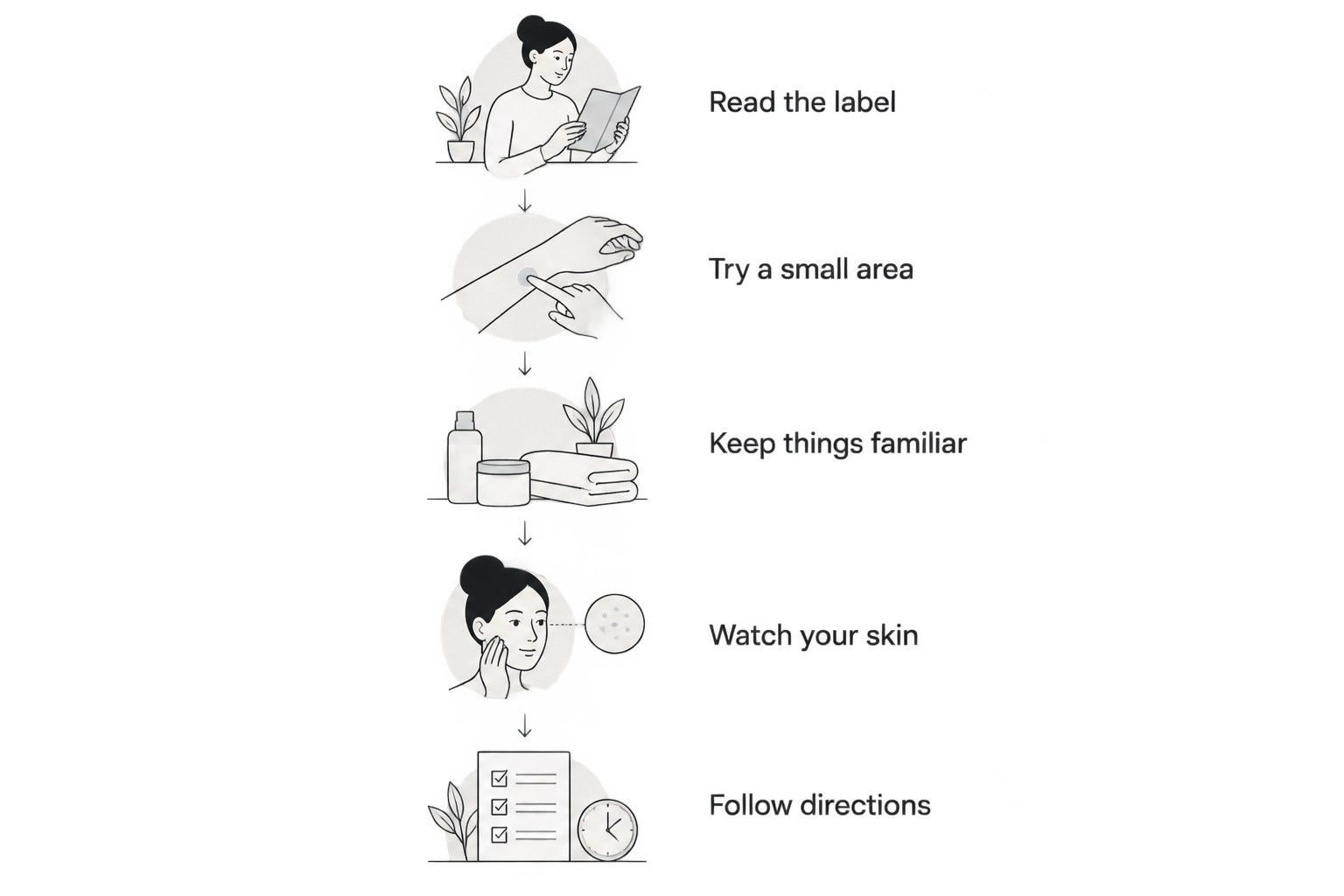
For a 2026 skincare reset, choose consistency over constant additions. Once you know how your skin responds, follow the product’s instructions rather than increasing use just because the bottle is close at hand.
Why everyday suitability varies
No single formulation detail answers every safety question. Use these factors together rather than treating one as a shortcut:
- Intended use. Skin directions and surface directions serve different purposes. Start with the use printed on the product.
- The complete formula. Review all listed ingredients, particularly if you already know an ingredient does not agree with your skin.
- Concentration and pH. These describe aspects of the formula, but neither establishes universal skin tolerance or proves that one product is better.
- Your skin’s current condition. Advice for an ordinary skincare routine is not a substitute for guidance about irritated, injured, or recently treated skin.
- Application frequency. Follow the particular product’s directions. Do not transfer a schedule from a different spray or a social-media routine.
- Storage and handling. Follow the bottle’s storage instructions and expiration information. Keep the nozzle clean and avoid touching it to skin or shared surfaces.
The useful question is not simply whether hypochlorous acid belongs in skincare. It is whether this finished product, used this way, suits your routine.
Formula matters. So do the limits.
Xoxo Gina HALO™ Wellness Mist is best for shoppers seeking a 150 mL hypochlorous acid mist with a stated pH of 4.5. Its product information identifies a three-ingredient formula and names purified water and hypochlorous acid.
The advantage is specific information you can evaluate: bottle size, stated pH, and a short ingredient list. The limitation is equally important: those details alone do not establish personal tolerance, suitability for children, or an ideal daily application schedule.
Gina Rivera’s founder story is part of Xoxo Gina HALO™’s background. A founder’s story helps you understand the brand; the finished product’s directions remain the guide for use.
Bottle size also has a practical trade-off. A 150 mL bottle exceeds the standard US airport carry-on liquid-container limit of 100 mL, or 3.4 fl oz. For 2026 travel, check the applicable airport rules and the product’s handling instructions before deciding how to pack it; a partly empty oversized container does not meet that standard container-size limit.
Can you spray hypochlorous acid on your face every day?
Daily facial use is appropriate when the product is labeled for that purpose and your skin tolerates it. Follow its instructions rather than assuming that directions for the body, surfaces, or another formula also apply to your face.
Avoid spraying into your eyes or inhaling the mist unless the product has explicit directions for that specific use. A facial skincare product is not automatically an eye-care or inhalation product.
How many times a day should you use hypochlorous acid spray?
Use the frequency stated on your particular product; there is no single schedule that applies to every hypochlorous acid spray. If the directions do not establish a frequency, ask the manufacturer rather than copying another bottle’s instructions.
For your 2026 gym routine, do not assume every workout requires another application. Let the product directions and your skin’s response set the routine, not the number of activities on your calendar.
Is hypochlorous acid spray suitable for the whole family?
Suitability for adults does not automatically establish suitability for babies or children. Check the product’s age guidance and warnings, and ask a pediatric clinician when those directions do not clearly address your child.
For a shared household routine, keep the original label available to everyone who uses the spray. Do not introduce the product to every family member at once simply because one person tolerates it.
Know when to pause
Stop using a new mist if your skin becomes uncomfortable. Burning, persistent stinging, itching, redness, or a rash calls for a pause—not an increase in applications.
If symptoms persist or concern you, seek advice from a qualified healthcare professional. Get urgent medical help for signs of a serious allergic reaction, such as difficulty breathing or swelling of the lips or tongue.
Be especially careful about adding products immediately after a professional skin procedure. Follow the treating clinician’s aftercare instructions instead of assuming that a mist suitable for an ordinary day belongs in that recovery routine.
Daily skincare guidance also does not replace care instructions for damaged skin. Keep the question narrow: is this product intended for the use you have in mind, under your current circumstances?
FAQ
Is hypochlorous acid spray safe for everyday use on sensitive skin?
A skin-labeled hypochlorous acid spray can be used daily as directed if your sensitive skin tolerates it. Introduce it on a small area first, and stop if irritation develops; a simple formula does not guarantee compatibility.
Can I use a hypochlorous acid surface spray on my face?
Do not use a surface spray on your face unless its label explicitly permits that use. The presence of hypochlorous acid does not make surface and skincare formulations interchangeable.
Should hypochlorous acid spray sting when I apply it?
Do not treat stinging as a sign that the spray is working. Stop if you experience burning, persistent stinging, redness, itching, or a rash, and seek professional advice if symptoms persist.
Can I use hypochlorous acid spray with the rest of my skincare?
Follow the mist’s directions and the instructions for your other skincare products. Introduce one new product at a time, and ask a dermatologist or pharmacist about compatibility with prescribed topical treatments.
Does a lower pH make a hypochlorous acid spray safer?
A lower pH alone does not establish that a hypochlorous acid spray is safer. Evaluate the finished formula, intended use, directions, and your own skin response rather than ranking products by pH alone.
Can I put hypochlorous acid mist in a smaller travel bottle?
Check the manufacturer’s handling instructions before transferring a hypochlorous acid mist. Keeping it in its original container preserves its label and avoids introducing an unverified storage container.
Can children use the same hypochlorous acid spray as adults?
Children should use a product only when its directions support that use. If age guidance is unclear, ask the manufacturer and a pediatric clinician rather than assuming an adult skincare routine applies.
Do I need hypochlorous acid spray in my daily routine?
You do not need to add a hypochlorous acid spray simply because daily use is possible. Choose an optional skincare step because its intended use fits your routine, and leave it out if it does not agree with your skin.
One last thing
A product being suitable for daily use does not make daily use necessary. You can keep your routine simple without turning every optional step into a requirement.
Make that your 2026 rule: read the label, introduce thoughtfully, and keep only what suits you. The best routine is not the one with the most applications; it is one you understand and can follow comfortably.