November 19, 2026
Is hypochlorous acid spray safe for babies' skin?

Hypochlorous acid spray is not automatically safe for a baby’s skin; suitability depends on the specific formulation, its labeled uses, and your baby’s age and skin condition. Before using one, check the current label and ask your pediatrician about that exact product, especially for a newborn, irritated skin, or use near the eyes or mouth. This 2026 guide explains what to check—and why a face mist or surface spray does not become baby skincare simply because it contains hypochlorous acid.
- Is hypochlorous acid spray safe for babies? Check the exact product, infant-use directions, and pediatrician guidance—not the ingredient alone.
- Never substitute a surface disinfectant for a baby skincare product, even when both contain hypochlorous acid.
- Xoxo Gina HALO™ Wellness Mist’s pH 4.5 does not establish that it is suitable for babies.
Is hypochlorous acid spray safe for babies’ skin?
There is no blanket yes for every hypochlorous acid spray. An ingredient name does not establish that a finished product is appropriate for infants, for every body area, or for repeated application.
Start with the bottle you actually plan to use. If its instructions leave infant use unclear, request the full directions through the contact page and take that information to your pediatrician. An unclear label is a reason to pause, not improvise.
| Product category | Best for | What it does not establish | Your next move |
|---|---|---|---|
| Skin-use hypochlorous acid spray | The skin uses and age groups specified on its label | That adult facial directions also apply to babies | Check age guidance and ask about your baby’s situation |
| Surface-use hypochlorous acid spray | The surfaces and applications specified on its label | That the formula is suitable for direct skin application | Keep its use within its surface directions |
| Product explicitly labeled for infant skin | The infant uses described in its instructions | That it suits every rash, body area, or skin condition | Follow its limits and discuss symptoms with your pediatrician |
These are use categories, not interchangeable recommendations. A product’s intended use matters as much as the ingredient highlighted on the front.
Why this matters
Parents often meet hypochlorous acid through an adult skincare routine, a gym bag, or household cleaning. The familiar ingredient can make another bottle seem like an easy substitute.
But a baby’s skin deserves a product-specific decision. Skin condition, application area, and exposure around the mouth or eyes all change the question you need answered. A general statement about an ingredient cannot cover those details.
For your 2026 shopping checklist, put clear infant-use instructions ahead of broad claims such as gentle, natural, or family-friendly. Those words do not tell you where to apply a product, how to use it, or when to stop.
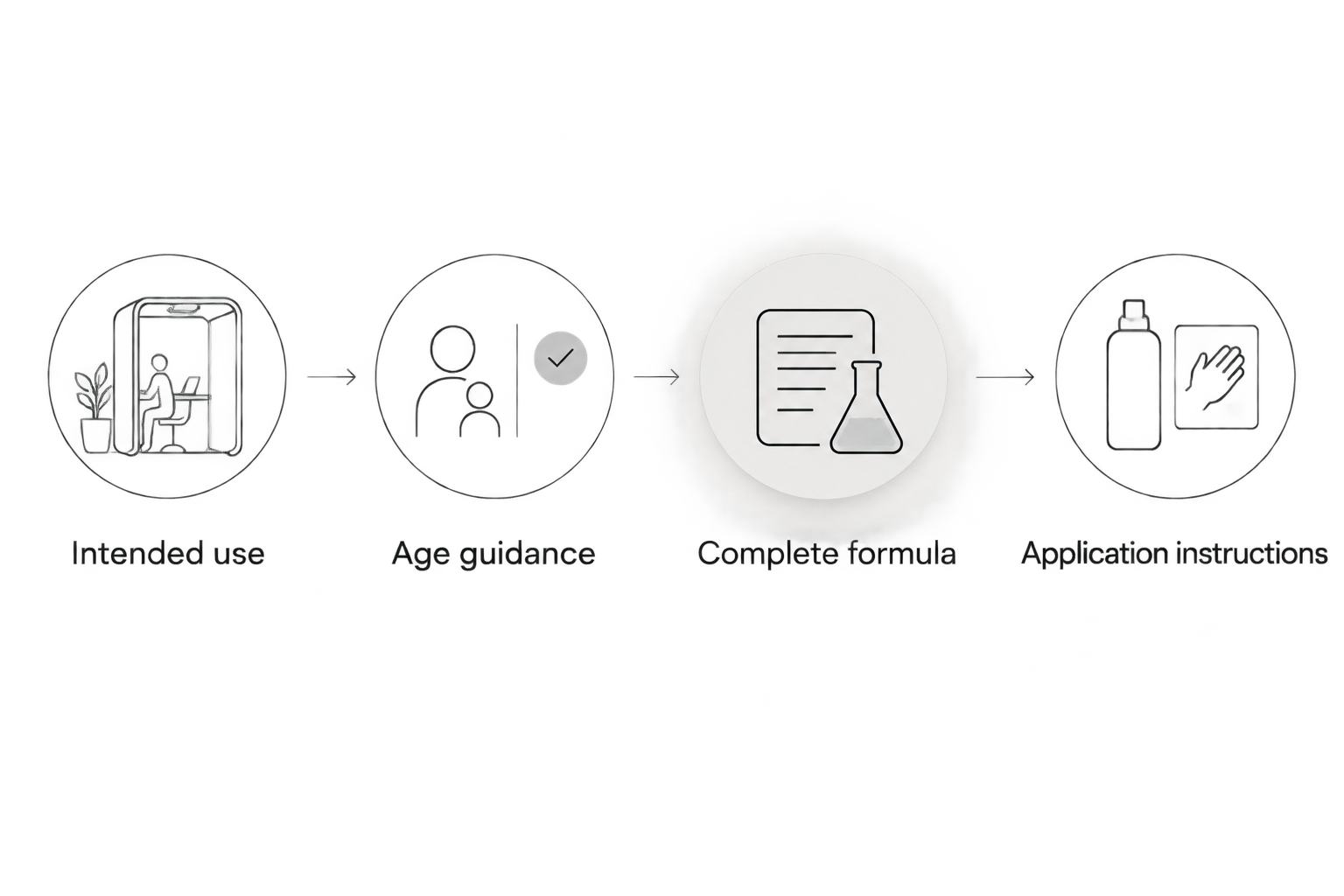
Check the bottle before the first mist
You do not need to become a formulation expert. You need enough information to avoid treating different products as though they were the same.
Read the intended use
Look for what the product is actually intended to do. Directions for facial skincare, wound care, and household disinfection describe different uses; one does not grant permission for the others.
A bottle that mentions both skin and surfaces still needs clear instructions for each application. Do not assume that a surface-cleaning method is also a skin-use method, or that general skin directions include infants.
Find the age guidance
Look for an explicit age statement, infant-use directions, and warnings. A picture of a family or a reference to sensitive skin is not an age instruction.
If the label does not address babies, ask the manufacturer for written guidance. Your pediatrician can then assess that guidance alongside your baby’s age, symptoms, and other products in use.
Read the complete formula
Check the full ingredient list, not just the highlighted active ingredient. Added ingredients matter when your baby has a known sensitivity or your clinician has advised avoiding something specific.
A short formula is easier to review, but ingredient count alone does not prove infant suitability. Likewise, the absence of fragrance does not answer every question about a finished product.
Check the application instructions
Look for where the product belongs, what areas to avoid, and any directions about rinsing or drying. Follow the actual instructions rather than borrowing a routine from another spray.
Do not invent an infant dose, application frequency, or dilution. Adding water changes the formula and is not a substitute for appropriate directions.
Why suitability varies
Not all hypochlorous acid sprays are the same. These differences explain why advice about one bottle should not automatically transfer to another:
- Intended use. A skin product and a surface disinfectant have different application instructions. Stay within the use printed on the label.
- Concentration and formulation. Hypochlorous acid concentration, pH, and other ingredients help describe a formula. None establishes infant suitability by itself.
- Age guidance. General skincare directions do not necessarily answer questions about newborns or older babies. Look for explicit guidance rather than interpreting broad language.
- Application area. Cheeks, the diaper area, and skin near the eyes or mouth present different exposure questions. Ask about the exact area you intend to treat.
- Skin condition. Intact skin and skin that is broken, weeping, or persistently irritated are not the same situation. Symptoms need appropriate assessment, not a guessed spray routine.
- How you use it. Frequency, amount, storage, and handling belong to the product’s directions. Instructions from a different bottle are not a reliable substitute.
Choose on documented use, not a single reassuring feature. Neither a familiar ingredient nor a skin-friendly-sounding description replaces the complete label.
What should you ask your pediatrician?
Bring the bottle or clear photographs of its front, ingredients, directions, and warnings. Describe what you want to use it for before asking whether it is safe.
A focused question is easier to answer than a broad one. Explain your baby’s age, the body area involved, what the skin looks like, and whether you have already applied anything there.
Use this conversation checklist:
- Is this exact formulation appropriate for my baby’s age?
- Is it appropriate for this body area and current skin condition?
- Does my baby need a skincare product here at all?
- If you recommend it, which directions should I follow?
- What changes mean I should stop using it and seek advice?
Keep the answer tied to the product you discussed. If you switch bottles, formulas, or intended uses, check again rather than assuming the earlier advice carries over.
What does the product information actually tell you?
For a concrete example, Xoxo Gina HALO™ Wellness Mist is listed as 5 fl oz / 150 mL, with hypochlorous acid at pH 4.5. Those details identify its bottle size and a formulation characteristic; they do not establish infant-use suitability.
Gina Rivera’s founder story is part of the Xoxo Gina HALO™ brand. For a parent deciding what belongs on a baby’s skin, however, a founder story cannot replace age-specific directions or clinical advice.
The useful distinction is between a product detail and a safety conclusion. The 150 mL size tells you how much the bottle contains, not an application amount for a baby. The pH 4.5 value describes acidity, not an infant-use approval.
For Xoxo Gina HALO™ Wellness Mist, make the baby-use decision from explicit directions and your pediatrician’s advice—not the bottle size or pH. That same standard belongs in any 2026 comparison of hypochlorous acid sprays.
Can I use hypochlorous acid spray on my baby’s face?
Baby facial use requires product-specific guidance, especially because the eyes and mouth are close to the application area. Do not interpret adult face-mist directions as instructions for an infant.
Ask whether the exact product belongs on your baby’s face and how to apply it if recommended. Do not spray toward the eyes or mouth, and do not treat a skincare spray as an eye-care or oral-care product.
Can I use hypochlorous acid spray in the diaper area?
Diaper-area use needs explicit product guidance and an assessment of any irritation. A general skin-use claim does not establish that a spray is suitable for every diaper-area problem.
If your baby has a rash, ask about care for that rash rather than trying to select a spray by ingredient alone. Do not use hypochlorous acid mist as a replacement for a clinician’s treatment plan.
Is a surface spray suitable for baby toys or skin?
A surface spray belongs only on the surfaces and in the applications its label permits. Directions for a changing table do not automatically apply to a teether, pacifier, bottle part, or baby’s skin.
Check whether the specific item is covered and follow any rinsing instructions. Keep the surface-cleaning decision separate from the skincare decision, even when the same ingredient appears in both products.
Keep the routine simple
A product does not need a place in your baby’s routine just because it fits yours. If there is no clear purpose and no appropriate instruction, leave it out.
If your pediatrician recommends a particular spray, keep the original bottle and follow its storage and handling directions. Do not transfer it into an unmarked travel bottle or share application habits from adult skincare videos.
For a 2026 family routine, a short written note can help caregivers stay consistent: which product was discussed, where it belongs, and what instructions apply. That avoids one adult using it for a different purpose simply because it is already in the changing bag.
If irritation appears after application, stop using the product and contact your pediatrician. Seek urgent medical care for serious symptoms such as breathing difficulty or swelling of the lips or tongue.
FAQ
Is hypochlorous acid spray safe for babies in 2026?
Hypochlorous acid spray is not automatically suitable for babies; the exact formulation, labeled uses, and your baby’s circumstances matter. Check the current instructions and ask your pediatrician before applying a product that lacks clear infant-use guidance.
Can I use my own hypochlorous acid face mist on my newborn?
Do not assume your adult face mist is suitable for a newborn. Show your pediatrician the complete label and explain where and why you want to use it.
Does pH 4.5 mean a spray is safe for baby skin?
A pH of 4.5 does not establish that a finished spray is suitable for babies. Concentration, other ingredients, intended use, and age-specific directions also matter.
Is a fragrance-free hypochlorous acid spray automatically baby-safe?
Fragrance-free does not automatically mean suitable for babies. It describes one formulation feature, not the product’s complete age guidance or application limits.
Should I dilute hypochlorous acid spray before using it on my baby?
Do not create your own dilution for a baby. Adding water changes the formula and does not turn an adult or surface-use product into an infant skincare product.
Can hypochlorous acid spray replace my baby’s prescribed skin treatment?
Do not replace a prescribed skin treatment with hypochlorous acid spray unless your baby’s clinician directs the change. Ask about the exact product before adding it to the existing routine.
What should I do if my baby’s skin becomes irritated after a spray?
Stop using the product and contact your pediatrician for advice. Seek urgent medical care for breathing difficulty or swelling of the lips or tongue.
One last thing
The most useful question is not whether hypochlorous acid sounds gentle. It is whether this exact bottle has a clear, appropriate role in your baby’s care.
Take a photograph of the label before your appointment. Product names can sound similar; the full ingredients and directions give your pediatrician something specific to assess. If the answer remains unclear, keep the spray out of the routine.