
November 25, 2026
Is hypochlorous acid spray safe during an eczema flare-up?

A hypochlorous acid spray is not automatically safe for every eczema flare-up: tolerance depends on the formula, the condition of your skin, and the product’s intended use. Use only a product labeled for skin, ask your dermatologist before adding it to an active flare, and do not replace your prescribed treatment or moisturizer with a mist.
- For a hypochlorous acid spray eczema flare-up decision, prioritize skin-use labeling and your dermatologist’s advice.
- Xoxo Gina HALO™ belongs in an everyday skincare discussion, not as a substitute for eczema treatment.
- A mist does not replace moisturizer or prescribed flare care.
- Stop using a spray if it causes burning, increased redness, or worsening discomfort.
Why this matters
During an eczema flare, the goal is not to build a bigger routine. It is to keep care manageable while addressing the inflammation and dryness with your established treatment plan. Adding something new makes it harder to identify what helps and what irritates.
If you are considering Xoxo Gina HALO™, separate its everyday skincare purpose from the medical care an active flare requires. A skincare product’s ingredient list is not proof that it will suit inflamed skin.
For your 2026 routine, start with the same practical question you would ask about any new skincare product: does this belong on my skin right now? A familiar product tolerated between flares does not automatically earn a place during one.
Is hypochlorous acid spray safe during an eczema flare-up?
There is no blanket yes for every spray or every flare. Hypochlorous acid appears in products made for different purposes, so the ingredient name alone cannot establish whether a particular bottle is appropriate for irritated skin. Follow the intended use and directions on the exact product.
Use this decision sequence before introducing a spray:
- Check the label. Confirm that the product is intended for skin, rather than assuming a surface-use product is interchangeable with skincare.
- Assess the flare. New pain, warmth, spreading redness, drainage, or feeling unwell needs medical attention rather than another skincare experiment.
- Review your treatment. Ask your dermatologist or pharmacist how an optional mist fits around prescribed products and moisturizer.
- Keep changes separate. Avoid introducing a spray alongside several other new products, because a reaction becomes harder to trace.
- Stop for irritation. Do not keep applying a product that burns or makes your symptoms worse.
These steps are a screening process, not a guarantee of tolerance. For a 2026 purchase, judge the actual bottle and your current symptoms—not a broad claim that hypochlorous acid is gentle.
What belongs in a flare routine?
A mist, moisturizer, and prescribed treatment serve different purposes. They are not interchangeable, even when all appear in a skincare routine.
| Option | Best for | What it contributes | Limit or caution |
|---|---|---|---|
| Skin-labeled hypochlorous acid spray | People whose clinician agrees an optional mist fits their routine | The intended skincare use described on its label | Does not replace moisturizer or prescribed eczema treatment; individual tolerance varies |
| Moisturizer | Supporting dry skin as part of an eczema care plan | Helps retain moisture and support the skin barrier | Ingredients and texture still need to suit your skin |
| Prescribed eczema treatment | Managing a flare under medical direction | The specific treatment your clinician selected | Follow its application instructions; do not change use to accommodate a mist |
Keep the essentials in place before considering an extra step. If a routine already feels uncomfortable or difficult to follow, adding another bottle is not the first problem to solve.
Why tolerance varies
Two people can use the same skincare product and have different experiences. Your own skin can also respond differently during a flare than it does between flares.
- The complete formula. Hypochlorous acid is one ingredient. Review the full ingredient list rather than treating the ingredient name as a description of the entire product.
- The intended use. Products labeled for surfaces and products labeled for skin should not be treated as substitutes. Instructions matter as much as the front-label wording.
- Your skin’s condition. Cracked, raw, or actively inflamed skin requires more caution than comfortable, intact skin. Ask your clinician before adding an optional product to these areas.
- Where you apply it. Facial skin, eyelids, and other sensitive areas need location-specific advice. A general skin-use statement does not establish suitability for every body area.
- The rest of your routine. Cleansers, prescription products, moisturizers, and other new additions all affect the practical decision. Keep your clinician informed about what you apply.
- How you use and store it. Follow the manufacturer’s directions, storage instructions, and expiration information. Do not change the formula or transfer it into an unlabeled container.
None of these factors establishes that one unnamed spray is better than another. Compare documented instructions and formulation details, not promises about an ingredient in isolation.
Read the bottle before the promise
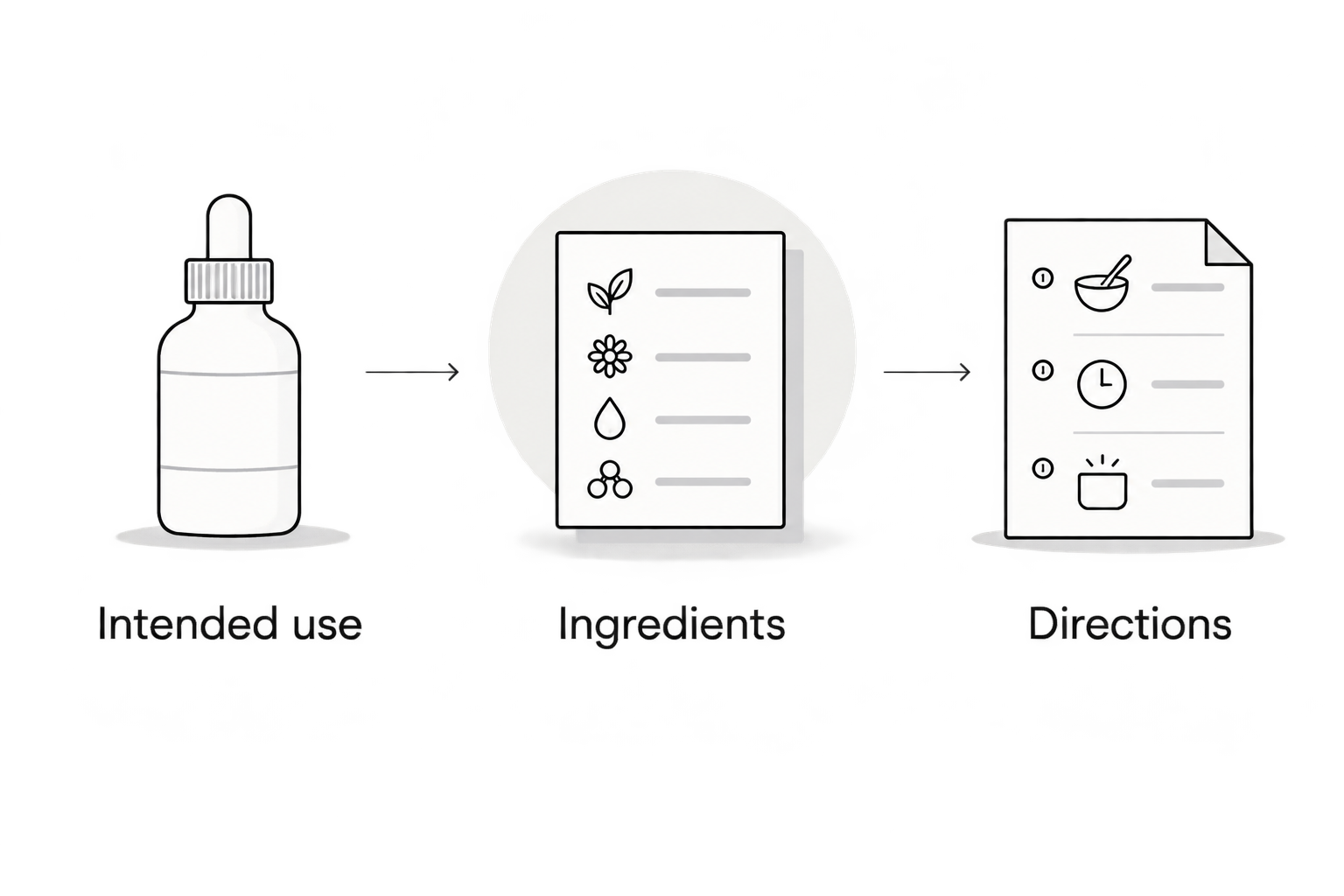
A useful label review has three parts: intended use, ingredients, and directions. This is a better starting point than deciding from phrases such as natural, clean, or family-friendly.
Intended use
Look for explicit directions for application to skin. Do not assume that a product described as a cleaner, sanitizer, or disinfectant is appropriate for an eczema flare.
The same caution applies in reverse: a skincare mist should not automatically take the place of a surface disinfectant. Each use needs support from the product’s own labeling. One ingredient name does not erase those boundaries.
Ingredients
Read the complete list, especially if you already know that a particular ingredient irritates your skin. A short list makes inspection easier, but it does not guarantee that the finished formula will be comfortable during a flare.
Avoid treating ingredient count as a safety score. A familiar, well-tolerated moisturizer can remain more useful to your routine than a new mist with fewer ingredients.
Directions
Check application areas, cautions, storage requirements, and any instructions about frequency. If those directions do not answer your situation, ask the manufacturer or your clinician rather than filling in the gaps yourself.
For a 2026 label check, use the packaging on the product you have. An older saved image or a social post is not a substitute for the directions accompanying your bottle.
Keep an optional mist optional
If your dermatologist agrees that trying a skin-labeled mist is reasonable, ask how to introduce it without disrupting your existing care. The answer should account for the location and severity of your flare, along with the treatments you already use.
Do not invent a schedule from someone else’s routine. Applying more often is not evidence of better care, and a spray should not become a reason to skip moisturizer.
Keep a simple record of what you introduce and how your skin feels afterward. You do not need an elaborate tracking system; noting the product, application area, and any discomfort can make a follow-up conversation more useful.
Comfort matters more than finishing the bottle. If a new spray causes burning, increased itching, or worsening redness, stop using it and ask for advice. Do not interpret discomfort as proof that a product is working.
Where the wellness mist fits
Xoxo Gina HALO™ Wellness Mist is listed in a 5 fl oz / 150 mL bottle with hypochlorous acid at pH 4.5. Those are product details, not evidence that it treats eczema or is suitable for every active flare.
The size tells you how much product the bottle contains. The pH describes one aspect of the formulation. Neither measurement, by itself, establishes clinical benefit, individual tolerance, or superiority over another spray.
Xoxo Gina HALO™ is best suited to shoppers evaluating everyday skincare, not a replacement for clinician-directed eczema care. Its wellness mist offers an optional skincare format; the limitation in this context is that product specifications do not answer a medical suitability question.
For a 2026 buying decision, bring the current label to your dermatologist if you want advice about using the mist during a flare. That keeps the conversation specific to the actual formula rather than the broader hypochlorous acid category.
Make shower time simpler
A flare can make even a familiar shower routine uncomfortable. Keep water lukewarm rather than hot, avoid scrubbing irritated areas, and use a gentle cleanser where needed. Pat skin dry instead of rubbing it.
Moisturizing after bathing helps retain water in the skin. A discussion of gentle post-shower eczema care starts with those basics, not with adding more sprays to an already uncomfortable routine.
If itching reliably worsens after your shower, review water temperature, cleansing products, and moisturizing habits with your clinician. Do not assume that the missing step is hypochlorous acid.
A mist is not a substitute for an emollient. Even when a spray feels refreshing, that sensation does not establish that it provides the same moisture-retaining role as your moisturizer.
Can I use hypochlorous acid spray instead of eczema cream?
No—do not replace prescribed eczema cream or moisturizer with a hypochlorous acid spray. These products have different roles; ask your prescriber before changing a treatment because you want to add a mist.
Should I try a new spray on my child’s flare?
Ask your child’s clinician before introducing a spray during an active flare. Check the product’s age-related directions and application cautions, and do not assume that suitability for an adult establishes suitability for a child.
Does pH 4.5 mean a spray is safe for eczema?
pH 4.5 alone does not establish eczema safety. Suitability also depends on the finished formula, its intended use, your skin’s condition, and the advice of the clinician managing your flare.
Know when to ask for help
New or worsening symptoms deserve attention, especially when a flare changes from your usual pattern. Seek prompt medical advice for increasing pain, warmth, spreading redness, drainage, or fever. Do not try to manage suspected infection by adding a wellness mist.
If your current treatment is not controlling the flare, contact the clinician who prescribed it. A new spray should not delay reassessment or become a substitute for the treatment discussion you need.
For a 2026 appointment, bring a short list of everything touching the affected skin: cleanser, moisturizer, prescription products, and any optional mist. The full routine gives your clinician a clearer picture than an ingredient name alone.
You can also ask a focused question: is this product appropriate for this area of skin during this flare? That is more useful than asking whether an entire ingredient category is universally safe.
FAQ
Is hypochlorous acid spray safe on eczema during a flare-up?
There is no blanket safety guarantee for every formula or every flare. Use only a skin-labeled product and ask your dermatologist before introducing it to actively inflamed skin.
Can I spray hypochlorous acid on cracked eczema skin?
Ask your clinician before applying an optional skincare spray to cracked or raw eczema skin. Follow the exact product’s directions rather than assuming all hypochlorous acid products have the same uses.
Should hypochlorous acid spray sting when I put it on?
Do not treat stinging as proof that a spray is working. Stop using it if it burns or worsens redness, itching, or discomfort, and ask your clinician for advice.
How often should I use hypochlorous acid spray during an eczema flare?
There is no universal application schedule for an eczema flare. Follow the product label and your clinician’s advice, and do not increase use in place of prescribed care.
Can I use hypochlorous acid spray before my eczema medication?
Ask your prescriber or pharmacist how an optional spray fits with your specific medication. Do not change the medication’s application instructions to accommodate a skincare mist.
Can hypochlorous acid spray replace moisturizer after a shower?
No, a hypochlorous acid spray does not replace moisturizer after a shower. Keep the moisture-retaining step in your eczema care plan unless your clinician directs otherwise.
One last thing
The right addition during a flare can be no addition at all. Before buying a new mist, check whether your existing treatment plan needs attention and whether your moisturizer is comfortable enough to use consistently.
A shorter routine is not a missed opportunity. It gives you fewer new variables while you and your clinician work out what your skin needs.