
November 11, 2026
Is DIY hypochlorous acid skincare a good idea?

DIY hypochlorous acid skincare is not a good default for your face: choose a finished product labeled for skin use rather than a home recipe or an improvised dilution. Making a solution is not the same as verifying its concentration, formulation, cleanliness, and stability—and a pH reading alone cannot answer all of those questions.
- For hypochlorous acid skincare, choose a skin-labeled formula rather than an improvised home mixture.
- A pH reading does not establish hypochlorous acid concentration, cleanliness, or shelf life.
- Home-generated hypochlorous acid and ready-made facial sprays require different checks; neither deserves automatic trust.
- Never turn household bleach or a surface disinfectant into a facial mist.
Is DIY hypochlorous acid skincare a good idea?
No—not when your plan depends on a recipe, a household cleaning product, or a generator without instructions specifically supporting skin use. The useful question is not whether you can produce hypochlorous acid. It is whether you can verify what reaches your skin and how the solution changes during storage.
The Xoxo Gina HALO™ founder story introduces Gina Rivera, the founder behind the brand. When choosing skincare in 2026, keep a founder's perspective separate from formulation evidence: a familiar name does not replace clear product information.
| Approach | Best for | Practical advantage | Limitation |
|---|---|---|---|
| Improvised recipe or diluted household product | Not recommended for facial skincare | Ingredients or equipment might already be at home | No reliable basis for treating the resulting mixture as a finished facial product |
| Home generation with documented instructions | Users following a device's expressly stated intended use | Instructions can define how the device should operate | Device instructions do not automatically establish suitability for facial skincare or storage |
| Finished product labeled for skin | Shoppers seeking a simpler daily routine | Gives you a defined product, directions, and manufacturer information | Labeling still needs scrutiny; the category name alone does not establish quality |
Why this matters
A facial mist feels simple. That does not make its formulation interchangeable with every other clear liquid called hypochlorous acid.
For sensitive or reactive skin, the practical goal is to reduce guesswork. Start with an identifiable product, follow its directions, and avoid changing several parts of your routine at once. Buying a finished spray does not guarantee that your skin will tolerate it, but it gives you something specific to evaluate.
For your 2026 routine, choose information you can check over reassurance you cannot. Words such as natural, gentle, or pure do not tell you the active concentration, intended use, or storage conditions.
What a home mixture leaves you checking
Hypochlorous acid exists in a chemical balance with hypochlorite, and pH affects that balance. This is why pH belongs in the discussion—but not why it should dominate your shopping decision.
A solution's pH does not tell you how much active chlorine it contains. It also does not establish that a bottle is clean, that a mixture is suitable for your face, or that its composition will remain unchanged.
Concentration is a separate question
Concentration describes how much of a substance is present. Acidity describes something different. Two solutions can have a similar pH without having the same active concentration.
Do not use a pH strip as a complete skincare quality check. It cannot supply information it was not designed to measure. A clear appearance or mild smell is not a substitute for formulation documentation either.
Clean handling still matters
A home process involves more than its starting ingredients. The mixing vessel, bottle, nozzle, hands, and repeated transfers all become part of that process.
You cannot establish cleanliness by looking at the finished liquid. Avoid topping up a partly used bottle or combining leftover sprays: that creates a mixture with a less traceable history and directions that no longer describe it.
Storage changes the question
Hypochlorous acid solutions can lose active strength, and their stability depends on formulation, packaging, and storage conditions. Heat and light are relevant considerations, not details to dismiss once a liquid has been made.
A recipe that describes production does not necessarily establish shelf life. Follow the actual product's storage and expiration instructions rather than assigning a homemade solution an assumed lifetime.
Why hypochlorous acid formulas vary
Not all hypochlorous acid sprays are the same. That statement is a reason to ask better questions, not a reason to assume one brand is safer or more effective than another.
These factors explain why a shared ingredient name does not establish equivalence:
- Intended use: A facial product and a surface product have different instructions. Read what the specific label authorizes.
- Active concentration: The ingredient name alone does not disclose how much active material the solution contains.
- pH: Acidity affects the chemical balance of the solution, but it does not independently establish performance or tolerance.
- Complete formulation: Other ingredients belong in your evaluation, especially when you already know which ingredients your skin dislikes.
- Packaging and storage: The bottle and its handling instructions are part of the finished product, not optional extras.
- Production controls: A repeatable process and documented checks provide information that a recipe alone cannot supply.
For a 2026 comparison, use those same questions for every option. A shorter ingredient list, a particular water source, or a larger bottle does not independently prove a better skincare outcome.
Check the label before the routine
You do not need a chemistry project to make a thoughtful choice. You need to know what the product is for, what information accompanies it, and how you are expected to use it.
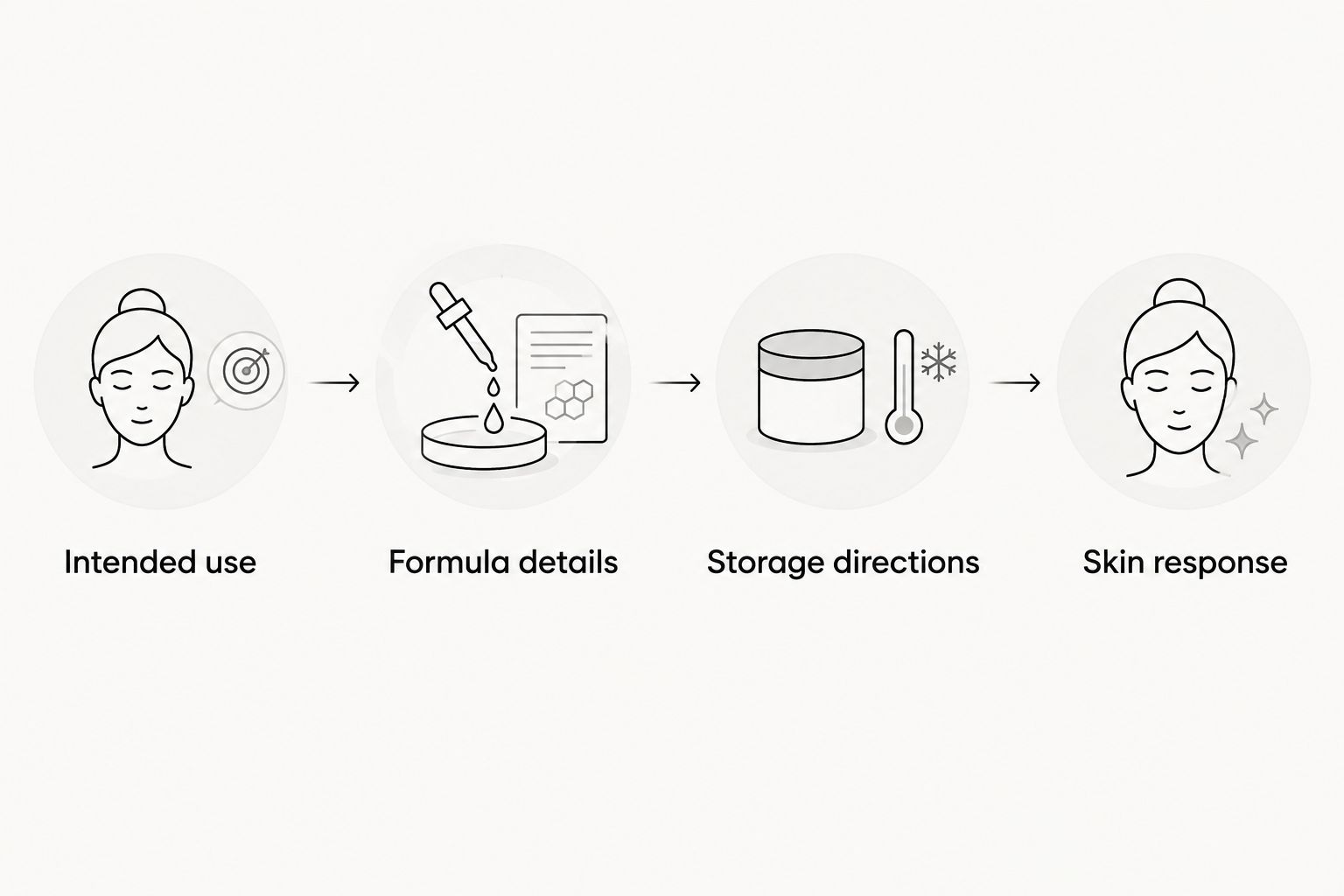
Use this sequence before adding any hypochlorous acid spray to your face:
- Intended use. Confirm that the actual product is labeled for skin use. Do not infer facial suitability from a cleaning claim.
- Formula details. Read the complete ingredient list and any stated formulation information. Treat missing information as a question for the manufacturer, not permission to guess.
- Storage directions. Check handling, expiration, and packaging instructions. Keep the original label available.
- Skin response. Introduce the product cautiously and follow its directions. Stop using it if irritation develops.
A home-generation device needs the same scrutiny. Check the instructions for the specific device and the solution it produces; do not transfer another manufacturer's skincare claims to your own output.
Keep household cleaning chemistry out of skincare
Do not make a facial mist by diluting household bleach or modifying a surface disinfectant. A household product's directions do not become skincare directions because you add water or transfer the liquid into a smaller bottle.
Never mix bleach with acids, ammonia, or other cleaning products. Those combinations can release hazardous gases. This is a household chemical-safety rule, not a skincare technique to troubleshoot.
The same boundary applies to online recipes that suggest adjusting an unfamiliar mixture until it reaches a target pH. Changing acidity changes chemistry; it does not establish a finished cosmetic formula. Choose a product intended for the job instead.
What you can verify about the finished mist
Gina Rivera is the founder behind Xoxo Gina HALO™. Keep that human story alongside clear product facts—not in place of them.
The supplied listing identifies Xoxo Gina HALO™ Wellness Mist as a 5 fl oz / 150 mL hypochlorous acid mist at pH 4.5. Those facts describe bottle size and acidity. They do not, by themselves, establish superior safety, effectiveness, or compatibility with your skin.
Xoxo Gina HALO™ Wellness Mist is best for shoppers seeking a ready-made, 150 mL hypochlorous acid skincare mist rather than a home-mixing project. Its practical advantage in this comparison is that it is an identifiable finished product. Its limitation is equally clear: a listed pH is not a complete performance report, and no mist guarantees individual tolerance.
The supplied description identifies purified water and hypochlorous acid, but its final ingredient entry is truncated. Read the complete current label rather than reconstructing an ingredient name from a partial listing. Water origin and development history also require precise documentation before they can support a comparison.
For a 2026 purchase, use Xoxo Gina HALO™ product information the same way you would assess any skincare formula: separate documented facts from assumptions, then follow the actual directions.
Can I use a home hypochlorous acid generator for my face?
A home generator is not automatically a facial-skincare system. Its suitability depends on the device's documented intended use, operating instructions, and information about the solution it produces.
A demonstration showing that a device produces hypochlorous acid does not establish every proposed use. If the instructions describe surface cleaning but say nothing about facial use, do not fill that gap with another product's skincare claims.
Does matching a facial spray's pH make DIY equivalent?
Matching pH 4.5 does not make a homemade mixture equivalent to a finished facial mist. Concentration, complete formulation, packaging, cleanliness, and stability remain separate questions.
Think of pH as a single characteristic, not a formula blueprint. Matching that characteristic cannot reproduce information you do not have about the rest of the product.
Can I make a stronger spray for after workouts?
Do not increase a spray's strength or combine it with another product to create an after-workout formula. Stronger is not a skincare instruction, and a gym routine does not establish a reason to alter a finished product.
Use a skin-labeled spray according to its directions. Keep facial care separate from equipment cleaning, even when both tasks happen in the same gym bag.
FAQ
Is DIY hypochlorous acid skincare worth trying?
DIY hypochlorous acid skincare is not a good default when you cannot verify concentration, formulation, cleanliness, and stability. Choose a finished product labeled for skin use instead of treating a recipe as a complete quality check.
Can I turn a surface disinfectant into a face spray?
Do not turn a surface disinfectant into a face spray. Follow the specific product's intended use; dilution or a new bottle does not establish facial suitability.
Does pH 4.5 mean a hypochlorous acid spray is safe for everyone?
pH 4.5 does not establish that a hypochlorous acid spray is suitable for everyone. Acidity is only one formulation characteristic, and individual skin tolerance still matters.
Can I refill an old facial mist bottle with homemade hypochlorous acid?
Do not use an old facial mist bottle as evidence that a homemade solution is suitable for skin. The container does not verify the new mixture's formulation, cleanliness, or stability.
Is a hypochlorous acid mist a replacement for washing after the gym?
Do not assume a hypochlorous acid mist replaces washing after the gym. Follow its labeled role and keep cleansing separate unless the product specifically provides cleansing directions.
Can I use a new hypochlorous acid spray with my existing skincare?
Check the spray's directions before combining it with your existing skincare. Introduce changes cautiously rather than adding several unfamiliar products at once.
How much Xoxo Gina HALO™ Wellness Mist is in the bottle?
Xoxo Gina HALO™ Wellness Mist contains 5 fl oz / 150 mL according to the supplied product listing. Bottle size describes quantity, not treatment strength or individual skin compatibility.
One last thing
The bottle is part of the formula's handling system—not just something to decorate your shelf. Transferring a spray into an unmarked container separates it from the directions and makes its identity harder to track.
For your 2026 routine, keep the original packaging, close it as directed, and store it according to the label. The simplest useful habit is not making more skincare at home. It is knowing exactly what you are using.