
November 10, 2026
Hypochlorous acid vs micellar water: different skincare roles

Hypochlorous acid skincare and micellar water do different jobs: micellar water cleanses, while a hypochlorous acid mist is not a replacement for removing makeup, sunscreen, or accumulated oil. Choose micellar water when you need a cleanser; consider a skin-labeled hypochlorous acid mist only as a separate, optional step used according to its directions.
- Hypochlorous acid skincare does not replace micellar water for makeup removal or cleansing.
- Micellar water uses surfactants to help lift makeup, oil, and everyday residue.
- Xoxo Gina HALO™ offers a hypochlorous acid mist; assess it as a mist, not a cleanser.
- Sensitive skin routines need suitable formulas and clear directions, not more steps.
Hypochlorous acid vs micellar water: what’s the difference?
Micellar water removes material from your skin; a hypochlorous acid mist does not perform that same cleansing job. Their watery appearance does not make them interchangeable.
| Category | Best for | What it does | Main limitation |
|---|---|---|---|
| Micellar water | Removing makeup and everyday oily residue | Uses surfactants that help lift oil and debris during cleansing | Formula suitability and rubbing matter, particularly for reactive skin |
| Hypochlorous acid skincare mist | An optional mist step after cleansing | Applies a hypochlorous acid formulation according to its skin-use directions | Does not replace makeup removal, moisturizer, or sunscreen |
Xoxo Gina HALO™ Wellness Mist belongs in the second category. Its documented bottle size is 5 fl oz / 150 mL, and its stated formulation pH is 4.5; neither detail turns it into a cleanser.
Why this matters
For your 2026 routine, choose the job before choosing the bottle. If your face still has makeup or sunscreen on it, adding a mist does not complete the cleansing step.
This distinction matters when your skin feels reactive and you want fewer decisions. Adding another product can complicate your routine without solving the reason you started shopping. First ask whether you need to remove something, moisturize your skin, or add an optional mist.
You do not need both products simply because both look like water. Keep each step only when it has a clear purpose and suits your skin.
Micellar water: the cleansing step
Micellar water contains surfactants, ingredients that help water interact with oils and other material that plain water does not remove as easily. In suitable formulations, those surfactants form structures called micelles. The practical point is simple: micellar water is formulated for cleansing.
Typically, you apply it using the method on its label and wipe away loosened residue. Follow the specific directions for rinsing and for use around your eyes. A face-cleansing label does not automatically authorize every use on every area.
Best for removing what you put on
Micellar water makes sense when your immediate goal is removing makeup or everyday oily residue. Its usefulness depends on the formula and what you are trying to remove. Do not assume every micellar water handles every waterproof cosmetic equally well.
Its limitation is equally practical: wiping can create friction. If removal takes repeated rubbing, pause rather than pressing harder. Check whether the cleanser is intended for the product you are removing, especially around the eyes.
For sensitive skin, the category name is not enough. Read the ingredient list and directions, then judge the product by how your skin responds. A familiar format does not guarantee a suitable formula.
Hypochlorous acid skincare: a separate mist step
Hypochlorous acid, often abbreviated HOCl, is chemically different from the surfactants used to formulate micellar cleansers. A hypochlorous acid skincare mist is not a substitute for the oil-lifting and removal process of cleansing.
Choose a formulation explicitly labeled for skin. Products described for surface use should not be treated as facial skincare unless their own labeling includes that use. The ingredient name alone does not establish that two finished products have the same instructions.
Best for an optional, clearly defined step
A skin-labeled mist belongs in your routine only if its intended use matches what you want from it. Follow its directions for application, storage, and any restrictions. Do not borrow instructions from another bottle just because both contain hypochlorous acid.
The limit is important: misting does not carry away makeup or accumulated oil. It also does not provide a reason to skip moisturizer or sunscreen. A mist is an addition, not permission to leave another job unfinished.
Avoid choosing a spray on the basis of broad promises about treating skin conditions. Persistent redness, discomfort, or recurring skin concerns deserve advice from a qualified clinician rather than a longer shopping list.
Why your choice varies
The useful comparison is not which category wins overall. It is which category matches the task in front of you.
- Removal needs: Makeup and oily residue call for a suitable cleanser, not another layer of mist.
- Application method: Micellar cleansing commonly involves wiping; a spray has a different application process. Follow each label rather than treating the methods as interchangeable.
- Formula details: Ingredients and intended use matter more than a shared watery texture. Read the full label before making a substitution.
- Skin response: A product that leaves your skin uncomfortable is not a useful routine step, regardless of its category.
- Routine purpose: Cleansing, moisturizing, and sun protection have separate roles. An optional mist should not displace them.
For a 2026 product comparison, start with those factors rather than claims that one bottle does everything. A clear role is more useful than a long list of possible uses.
Build the routine around the job
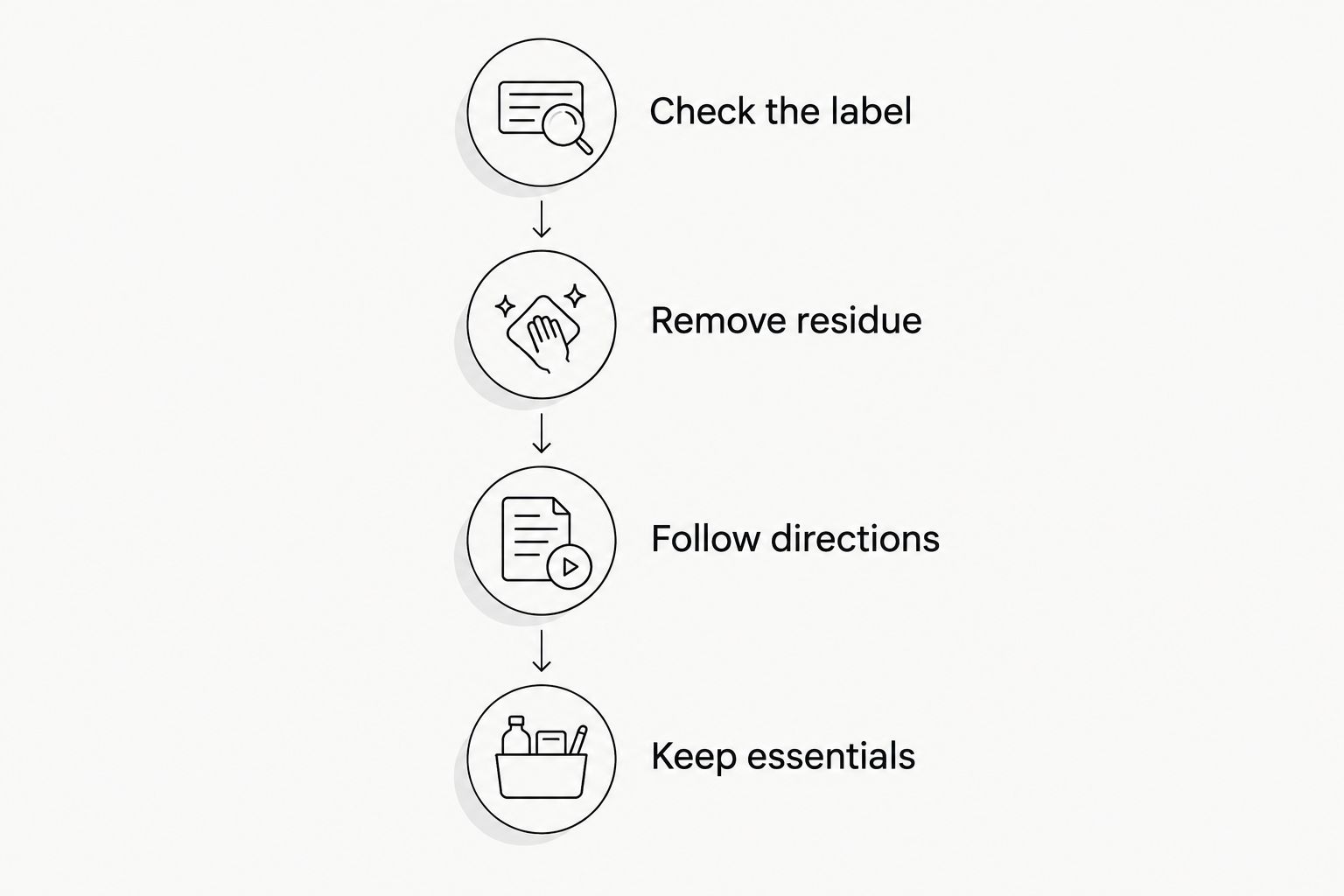
Use this sequence to decide where either category belongs. It is a decision guide, not a replacement for the directions on your own products.
- Check the label. Confirm that the product is intended for the area where you plan to use it. Read any eye-use, rinsing, and application instructions before starting.
- Remove residue. If you have makeup, sunscreen, or oily buildup to remove, use a suitable cleansing method. A mist does not replace this step.
- Follow directions. If you choose to add a hypochlorous acid skincare mist, apply it according to that product’s label. Do not invent a frequency or layering interval.
- Keep essentials. Continue the moisturizer and daytime sun-protection steps appropriate to your routine. Do not assume a mist performs either function.
If you are introducing a new product to reactive skin, keep the surrounding routine familiar. Changing several products together makes it harder to identify which change caused discomfort. Stop using a product that irritates your skin and seek professional guidance when symptoms persist.
Read the formula, not just the front label
Your 2026 label check should separate documented facts from conclusions those facts do not support. Bottle size tells you how much product the container holds. It does not tell you whether the formula will suit your skin.
The same discipline applies to pH and ingredient count. Those are useful formulation details, but neither one independently proves better tolerance, greater effectiveness, or suitability for everyone. A short ingredient list is still an ingredient list you need to read.
Xoxo Gina HALO™ was founded by Gina Rivera. When considering the brand’s skincare offering, distinguish the founder story from the specific evidence on the product label; one explains who created the brand, while the other helps you decide how to use the formula.
Xoxo Gina HALO™ is best for shoppers seeking a 150 mL hypochlorous acid skincare mist, not a makeup remover. The documented formulation includes purified water and hypochlorous acid, states three ingredients, and has a stated pH of 4.5.
Those details help define the offering without making it a substitute for micellar water. They also do not establish that every other hypochlorous acid spray shares the same formula. Compare finished products by their actual labels, not assumptions about the category.
Can you use hypochlorous acid and micellar water together?
Yes, micellar water and a skin-labeled hypochlorous acid mist can have separate roles in the same routine. Use the micellar water for cleansing and follow its rinsing directions; use the mist only as directed on its own label.
You do not need to add the second product to make the first one work. If your current routine already meets your needs, the existence of another category is not a reason to expand it.
Keep the products in their original containers. Do not mix them together or pour a mist into your micellar water bottle; combining finished formulas changes the conditions under which they were formulated and labeled.
Can a hypochlorous acid mist replace washing your face?
No. A hypochlorous acid mist does not replace a cleansing method suited to removing makeup, sunscreen, and accumulated oil.
After exercise, decide what your skin needs rather than automatically reaching for a spray. If you need to remove residue, cleanse appropriately. A quick mist and a completed cleansing step are not the same thing.
Avoid repeatedly spraying over discomfort as a substitute for working out its cause. Simplify the routine and seek qualified advice if irritation continues.
Which one belongs in your travel bag?
Choose your travel skincare by function first: bring an appropriate cleanser if you need makeup removal, and treat a mist as optional. Packing fewer categories can be simpler than bringing products with overlapping or unclear roles.
For US airport screening in 2026, the TSA’s standard carry-on liquids rule limits individual containers to 3.4 fl oz / 100 mL. A 150 mL bottle exceeds that standard container limit even when partly empty; check current TSA guidance and applicable exceptions before packing.
That travel distinction does not say anything about skincare quality. It simply affects where a bottle belongs in your luggage. Also follow the product’s storage directions rather than assuming every travel environment is suitable.
FAQ
Is hypochlorous acid skincare the same as micellar water?
No. Hypochlorous acid skincare and micellar water have different roles: micellar water cleanses using surfactants, while a hypochlorous acid mist is not a replacement for makeup removal or cleansing.
Can I use hypochlorous acid spray to remove makeup?
Do not rely on a hypochlorous acid spray to remove makeup. Use a cleanser intended for the makeup you wear and follow its directions, including any instructions for eye-area use.
Should I use micellar water before a hypochlorous acid mist?
Complete your cleansing step before considering an optional mist. Follow the micellar water’s rinsing directions and the mist’s own application instructions rather than assuming a universal layering rule.
Do I have to rinse off micellar water?
Follow the directions on your specific micellar water. Rinsing instructions vary by formulation, so the category name alone does not answer that question.
Is a hypochlorous acid mist a moisturizer?
No. A hypochlorous acid mist should not be treated as a replacement for moisturizer. Choose moisturizing products separately according to your skin’s needs.
Is a formula with fewer ingredients always better for sensitive skin?
No. Ingredient count alone does not establish whether a formula suits sensitive skin. The ingredients themselves, intended use, and your skin’s response matter.
Can I pack a 150 mL face mist in my US carry-on in 2026?
A 150 mL bottle exceeds the TSA’s standard 100 mL individual-container limit for carry-on liquids in 2026. Check current TSA guidance and applicable exceptions before you travel.
One last thing
Your simplest 2026 skincare decision is to ask what needs removing before asking what to apply. If the answer is makeup, sunscreen, or oily residue, start with cleansing—not misting.
Keep the cleanser for cleansing. Keep the mist optional. That distinction lets you compare products without expecting either category to do a job it was not designed to do.