November 3, 2026
Hypochlorous acid spray for youth sports teams: complete 2026 guide

Youth sports team skincare with hypochlorous acid spray is a label-led personal-care routine aimed at keeping post-practice care simple—not replacing washing or equipment cleaning. Choosing a hypochlorous acid spray for youth sports teams in 2026 means separating skin use from surface use and leaving individual skincare decisions with parents.
- Choose hypochlorous acid spray for youth sports teams by labeled use, not team-wide promises.
- EPA-registered surface disinfectants and personal-care mists serve different purposes; do not treat them as interchangeable.
- Keep youth sports skincare individual: check age directions, label each bottle, and involve parents.
- Handwashing and equipment cleaning remain separate jobs, even when a gym-bag mist joins the routine.
Why this matters for youth sports teams
A youth team brings together different ages, skin needs, family preferences, and equipment. A coach needs clear boundaries, not another product that everyone is expected to use. A shared team routine does not require shared skincare.
Start with the people behind a brand, then check the product itself. Xoxo Gina HALO™ has Gina Rivera’s founder story behind it; that story provides context, while the product label determines appropriate use. Neither a founder’s experience nor a familiar ingredient replaces directions for a particular child.
For your 2026 team plan, distinguish convenience from a health claim. A mist can be part of an individual personal-care routine when its label supports that use. Describing it as protection against illness, a treatment for irritated skin, or a shortcut for cleaning equipment crosses into claims that require separate evidence and authorization.
Build a routine families can follow
Define the job before choosing a spray
Decide what you are trying to do before buying anything. Washing hands, caring for skin, removing dirt from pads, and disinfecting a hard surface are different tasks. The words hypochlorous acid do not make a bottle appropriate for all of them.
The manual starting point is simple: inspect the equipment care instructions, identify washing facilities, and ask families to manage their own skincare. Add a spray only after you have identified a specific, label-supported role. Do not build the team’s hygiene plan around an ingredient name.
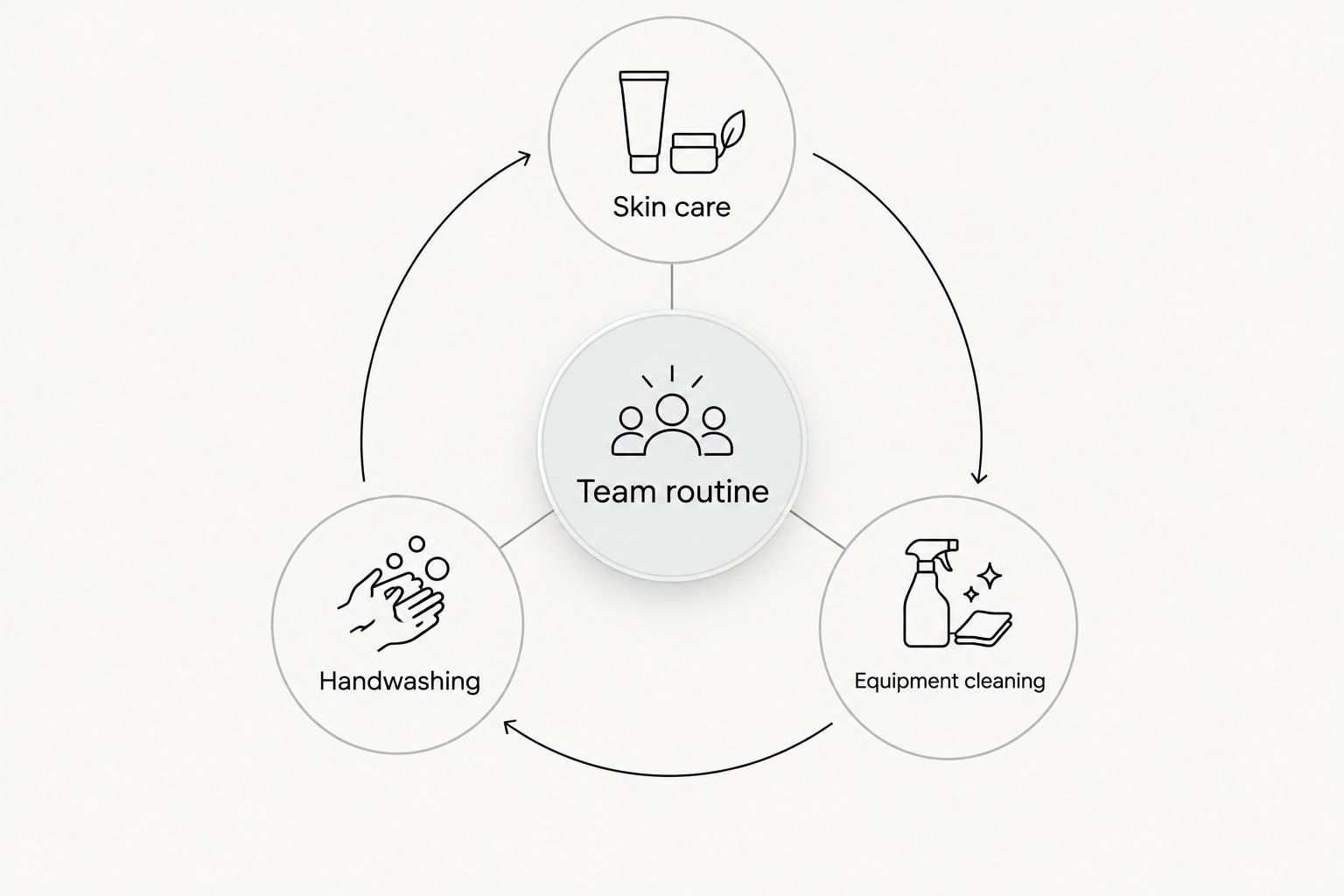
For a 2026 checklist, record the intended task beside each item rather than calling everything a cleaning spray.
- Skin care: Check the personal-care label and any age directions.
- Handwashing: Plan access to soap, water, and drying facilities.
- Equipment cleaning: Follow the equipment maker’s care instructions.
- Surface disinfection: Choose a product labeled for that purpose and surface.
Set boundaries with parents
Start with a short parent message rather than a team-wide product order. Explain what the team supplies, what families bring, and who handles personal-care decisions. This keeps a coach from becoming the default skincare adviser.
Ask parents to review the actual package, not just a promotional description. For a child with an existing skin condition, an unexplained rash, or a history of product reactions, direct questions to the child’s clinician. A team guide should not diagnose a problem or suggest that a mist treats it.
Keep the decision private. Families do not need to share a child’s medical history with the whole team to decline an optional product.
- Make personal-care products optional unless a separate team policy applies.
- Let parents check age restrictions and application directions.
- Keep individual bottles labeled with the athlete’s name.
- Tell athletes not to spray teammates or share personal-care bottles.
- Refer medical questions to a qualified clinician.
Read the formula and the full directions
Compare labels manually before adding another bottle to the bag. Look for the intended use, complete ingredients, directions, warnings, storage instructions, and any expiration information. A short ingredient list is useful for understanding a formula; it does not establish suitability for every child.
Xoxo Gina HALO™ Wellness Mist is supplied in a 5 fl oz / 150 mL bottle. Its product information describes a three-ingredient formula, identifies purified water and hypochlorous acid, and states a pH of 4.5. Read the package for the complete ingredient wording and application instructions.
Xoxo Gina HALO™ Wellness Mist is best for shoppers seeking a 150 mL hypochlorous acid mist with a disclosed pH of 4.5. Its limitation for team purchasing is straightforward: those specifications alone do not establish child-specific suitability or a surface-disinfection use.
- Match the label’s intended use to your actual task.
- Review every ingredient, not just the featured ingredient.
- Follow application directions without inventing spray counts.
- Do not infer stronger performance from pH or bottle size.
- Check the current label when reviewing products in 2026.
Pack for the real setting
Begin with what the athlete already needs: a clean towel, a change of clothing, and a place to keep personal-care items separate from used gear. A mist belongs in that setup only if the family wants it and the label supports the intended use.
The 150 mL bottle size matters when your team flies. Under the TSA’s standard US carry-on liquids rule in 2026, individual containers are limited to 3.4 fl oz / 100 mL. A 150 mL bottle exceeds that standard limit even when partly empty; check current TSA requirements and the product’s transport instructions before packing.
Do not decant a product merely to make it fit without checking whether its manufacturer permits transfer. A smaller container also needs its identity and directions kept clear.
- Keep the bottle identifiable and securely closed.
- Separate personal-care items from damp uniforms and dirty gear.
- Follow the labeled storage conditions during travel.
- Check carry-on container limits before airport departure.
- Avoid leaving the bottle in a parked vehicle when storage conditions would be exceeded.
Keep washing and equipment care separate
Make ordinary washing easy before adding optional products. CDC handwashing guidance calls for scrubbing with soap for at least 20 seconds. A personal-care mist is not a reason to skip that step or use less care after handling dirty equipment.
Equipment needs its own process. Remove visible dirt as directed by the equipment manufacturer, then use an appropriate cleaning or disinfecting product when required. If disinfection is the task, check the EPA registration, labeled surfaces, application directions, and required contact time.
Do not choose a contact time yourself. Disinfection directions specify how the product must be used, including how long a surface needs to remain wet. A quick mist followed by immediate wiping is not automatically the labeled process.
- Provide soap and a practical way to dry hands.
- Teach athletes to scrub with soap for at least 20 seconds.
- Follow equipment-specific cleaning instructions.
- Use a labeled surface product for surface disinfection.
- Keep skin-care and equipment-care supplies clearly separated.
Review the routine after practice
A useful routine is one that families understand and athletes can follow. Ask whether supplies were easy to find, whether bottles stayed identifiable, and whether instructions were clear. Do not treat an empty bottle as evidence that a product worked.
Keep feedback factual. A parent reporting discomfort needs a response about stopping use and getting appropriate advice—not reassurance that a formula is too simple to cause a problem. Persistent or concerning symptoms belong with a clinician.
For coaches, the boundary is the same throughout the season: organize the routine, but do not prescribe personal skincare. Review practical problems without collecting unnecessary health details from children.
- Ask whether athletes understood which items were personal.
- Replace unreadable labels rather than guessing directions.
- Check storage conditions and any expiration information.
- Stop use if irritation occurs and seek appropriate advice.
- Update the packing note when travel or venue arrangements change.
Compare options by the job
Best for means best for a task—not best for every athlete. These options belong in different parts of a team routine. None is a complete substitute for the others.
| Option | Best for | Practical advantage | Key limitation |
|---|---|---|---|
| Soap and water | Routine handwashing and washing away dirt | Gives athletes a clear washing process | Requires suitable facilities and drying supplies |
| Xoxo Gina HALO™ Wellness Mist | Shoppers seeking a 150 mL HOCl mist with disclosed pH | States bottle size, pH, and formulation information | Specifications alone do not establish child-specific suitability or disinfection use |
| EPA-registered surface disinfectant | Labeled surface-disinfection tasks | Provides task-specific directions and contact time | Must match the surface and intended use; it is not automatically a skin-care product |
| Equipment-manufacturer cleaning method | Caring for pads, helmets, and other gear | Matches care to the equipment | Instructions vary by item; one process does not cover every material |
Avoid comparing these options as though they deliver the same outcome. A skin mist does not become an equipment disinfectant because both products use similar ingredient language. Likewise, a surface product does not become appropriate for skin because its active ingredient sounds familiar.
Common mistakes youth sports teams make
Ordering one spray for every job
A single bottle sounds convenient, but convenience does not establish permission to use it on skin, helmets, benches, and shared equipment. Choose by labeled use. Keep separate instructions wherever tasks differ, even if that means carrying separate supplies.
Turning an optional mist into a team requirement
Matching uniforms do not mean matching skin needs. Parents should be able to review a personal-care product and decline it without their child feeling singled out. Explain the team’s washing and equipment-care expectations separately from optional skincare.
Treating pH as a performance score
A disclosed pH helps describe a formula. It does not, by itself, prove that a spray is more effective, suitable for all ages, or appropriate for disinfection. Ingredient count and water-source language are not substitutes for product-specific evidence either.
Packing the full bottle without checking flight rules
A container’s capacity matters under the standard carry-on liquids rule, not just the amount left inside it. Review the 150 mL bottle against travel requirements before departure day. Keep product identity and storage instructions intact when planning transport.
Spraying first and asking about symptoms later
Do not use a team mist to manage an unexplained rash, broken skin, or another concern without appropriate guidance. Tell the parent what happened and refer medical questions to a clinician. A personal-care routine should not delay an assessment.
FAQ
What is the best hypochlorous acid spray for youth sports teams?
The right hypochlorous acid spray is one whose label supports the intended use and whose directions fit the individual athlete. Parents should review age instructions, ingredients, warnings, and application directions rather than choose from team-wide promises.
Can every child on a team use the same hypochlorous acid mist?
Do not assume one mist is suitable for every child. Parents should review the product individually and ask a clinician about existing skin conditions, previous reactions, or unclear age guidance.
Can a hypochlorous acid skin mist disinfect helmets and pads?
Do not assume a skin mist can disinfect helmets and pads. Disinfection requires an appropriately registered and labeled product, and the equipment manufacturer’s care instructions still apply.
Does a mist replace washing after practice?
No, a personal-care mist does not replace washing. Keep soap-and-water handwashing and appropriate washing after activity separate from optional skincare.
What size is Xoxo Gina HALO™ Wellness Mist?
Xoxo Gina HALO™ Wellness Mist comes in a 5 fl oz / 150 mL bottle. Its product information states a pH of 4.5; neither specification alone establishes suitability for every child.
Can a youth athlete take a 150 mL mist bottle in a carry-on bag?
A 150 mL bottle exceeds the TSA’s standard 100 mL carry-on container limit. Check current travel requirements and product transport instructions before packing; a partly empty larger bottle still exceeds the standard container limit.
How often should an athlete apply hypochlorous acid spray?
Follow the specific product’s application directions rather than a team-wide schedule. Do not invent a spray count or increase use because a practice was longer or sweatier.
One last thing
Put the purpose on the packing list, not just the product name. Write personal skincare, handwashing supplies, and equipment care as separate lines. That small distinction makes your 2026 routine clearer for athletes, parents, and coaches—and prevents one convenient bottle from collecting jobs its label never promised.