
November 5, 2026
How to patch test hypochlorous acid spray for sensitive skin

To patch test hypochlorous acid spray for sensitive skin, apply a small amount to a clear area on your inner arm or elbow crease, follow the product’s directions, and watch for irritation before using it more widely. The American Academy of Dermatology recommends testing new skincare products twice daily for 7–10 days; do not exceed the spray’s labeled frequency, and stop if itching, burning, swelling, or a rash develops.
- Test hypochlorous acid spray for sensitive skin on a small area before adding it to your facial routine.
- American Academy of Dermatology guidance recommends testing new skincare twice daily for 7–10 days; respect product directions.
- Stop testing if itching, burning, swelling, or a rash develops. Do not push through discomfort.
- Xoxo Gina HALO™ shoppers should assess the finished formula, not assume ingredient count guarantees skin compatibility.
Xoxo Gina HALO™ Wellness Mist fits shoppers seeking a 150 mL hypochlorous acid spray who will test it before facial use. Its bottle size does not predict how your skin will respond.
How do you patch test hypochlorous acid spray for sensitive skin?
Use a small-area home test before putting a new spray across your face. For your 2026 routine, the useful starting point is the American Academy of Dermatology’s consumer guidance, How to test skin care products: apply a product to a small test area twice daily for 7–10 days and watch for a reaction.
That is general skincare guidance, not a product-specific instruction for every hypochlorous acid formula. Read the bottle first, and do not increase the application frequency beyond its directions to match a general testing schedule.
-
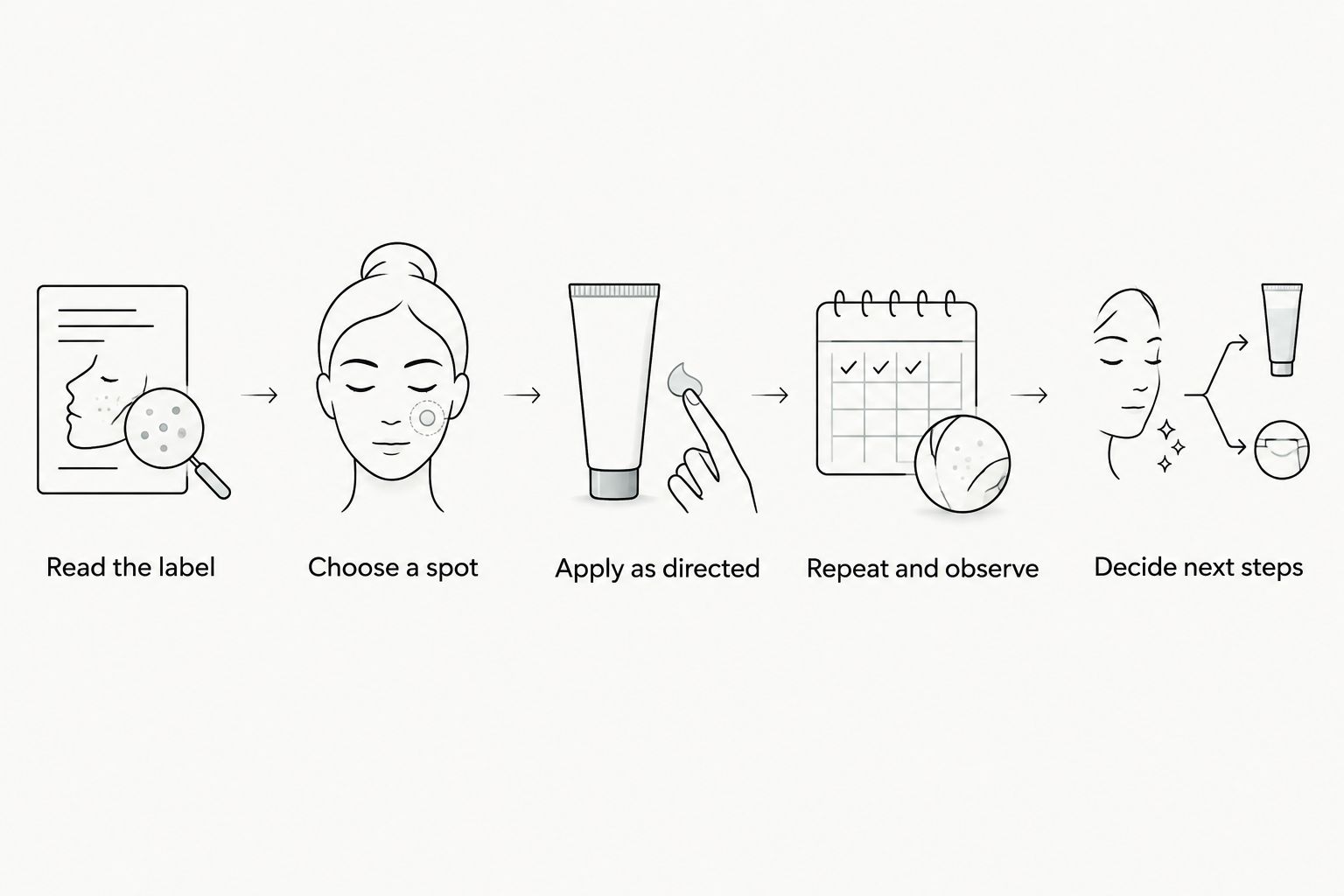
Read the label. Check the intended application area, directions, warnings, and storage instructions. Use a skin product according to its skin-use directions; a reference to hypochlorous acid alone does not make a surface-cleaning product suitable for your face. If the instructions are unclear, ask the manufacturer before testing.
-
Choose a spot. The American Academy of Dermatology suggests an area about the size of a quarter on the underside of your arm or at the bend of your elbow. Choose skin without an active rash, cuts, or irritation. Keep the test away from your eyes, lips, and other areas the label excludes.
-
Apply as directed. Use the amount and application method the manufacturer recommends, limited to the chosen area. Leave a leave-on product on as directed rather than immediately rinsing it away. Do not deliberately soak the area, add a bandage, or combine the spray with another new product during the test.
-
Repeat and observe. Keep using the same test area and watch it throughout the 7–10 days. Check for itching, burning, redness, swelling, a rash, or changes that feel unusual for your skin. Take a simple note after applications so you can distinguish a developing pattern from a vague memory.
-
Decide next steps. If irritation appears, stop applying the product and gently wash it off. If the area stays comfortable through the testing period, introduce the spray cautiously in its intended skincare role. A clear arm test is useful information, but it does not guarantee that your face will tolerate every application.
Keep the process ordinary. A home test is meant to show how your skin responds under the product’s intended conditions, not under extra layers, heavy application, or an improvised challenge.
Why this matters
Sensitive skin is a reason to introduce products carefully, not a reason to assume that every short ingredient list will suit you. A home test gives you a limited area to observe before you make a new spray part of your usual routine.
It also makes your observations easier to interpret. If you start a spray, cleanser, and exfoliant together, you lose the clean comparison that comes from changing one thing at a time.
For a 2026 skincare reset, keep the rest of your routine familiar while you assess one new product. That is more useful than building an elaborate routine and trying to identify the cause of discomfort afterward.
A home test is not a dermatologist’s patch test
The phrase patch test describes two different activities in everyday conversation. Testing a finished skincare product at home is not the same as medical patch testing used to investigate allergic contact dermatitis.
| Approach | Best for | What it helps you assess | Limitation |
|---|---|---|---|
| Small-area home product test | Checking a new skincare product before broader use | Whether the finished product causes a noticeable reaction at the tested site | Cannot diagnose an allergy or guarantee facial tolerance |
| Dermatologist-supervised patch testing | Investigating suspected contact allergy | Whether selected substances trigger a delayed allergic skin reaction | Requires clinical interpretation and does not replace ordinary product-use instructions |
Use a home test as a screening step, not as a diagnosis. A comfortable result does not prove that you are free from contact allergies, and a reaction does not identify which ingredient caused it.
If you have recurring reactions, bring the product and its complete ingredient list to a dermatologist. Repeatedly testing products on already irritated skin is not a substitute for finding out why the reactions keep happening.
Why skin responses vary
A shared ingredient name does not establish that two finished sprays are interchangeable. For a useful 2026 product check, focus on the formula you actually have and the conditions in which you use it.
- Finished formulation. Review the complete ingredient list and intended use. The presence of hypochlorous acid does not tell you everything about the finished product.
- Application instructions. Amount, frequency, and whether the product is left on or rinsed off define the exposure you are testing. More product is not a better test.
- Condition of your skin. An active rash or irritated patch is a poor starting point for assessing a new cosmetic. Ask a clinician about testing when your skin is already uncomfortable.
- Other products. Applying another new formula to the same spot makes a reaction harder to interpret. Keep the test area free of new combinations.
- Application site. Comfortable inner-arm skin does not establish how every part of your face will respond. Treat broader use as a separate introduction, not an automatic all-clear.
These factors explain why your own observations matter. They do not justify ranking sprays by ingredient count, bottle size, or pH alone.
Read the formula, not just the headline
Gina Rivera founded Xoxo Gina HALO™, but a founder story and a skin-compatibility check answer different questions. You can value the person behind a brand while still checking the label and testing the finished formula for yourself.
The supplied product information lists a 5 fl oz / 150 mL bottle, pH 4.5, and a three-ingredient formula. It explicitly identifies purified water and hypochlorous acid. Use the complete on-bottle ingredient list when checking your own known sensitivities rather than relying on a shortened online description.
Those details give you specific information to review. They do not establish that the product will suit every sensitive-skin shopper, and pH 4.5 is not a guarantee against irritation.
The practical advantage is having stated formulation details to assess. The limit is equally clear: a label cannot predict your individual response. Keep both points in view when choosing a spray in 2026.
If you already know you react to a particular ingredient, check the complete label before applying anything. A home test is not a reason to deliberately retry a known trigger without medical guidance.
Keep your routine steady during the test
Choose a testing period when you can follow the directions consistently. Do not begin immediately before an important event if the timing would tempt you to skip observation and move straight to full-face use.
Keep a brief record of the application site, the product used, and any skin changes. A photo in consistent lighting can help you remember what the area looked like, but it cannot diagnose a reaction.
For a gym routine, avoid making a sweaty post-workout moment your only observation point. Heat, rubbing, and other products can complicate what you notice. Follow the label and check the test area when you can see and assess it clearly.
For travel, separate packing decisions from skin decisions. Test a new skincare product before making it part of your trip routine; do not treat the first application in an airport or hotel as evidence that repeated use will suit you.
Parents should check age-related directions rather than treating an adult’s comfortable result as permission to use the same product on a child. Ask the child’s clinician when age suitability or an existing skin condition makes the instructions unclear.
Can you use the spray on your face after one comfortable application?
One comfortable application is not the same as completing the American Academy of Dermatology’s 7–10 days of testing. A single use tells you only that you did not notice a reaction at that site at that time.
After completing the test without irritation, follow the product’s directions for facial use and introduce it without adding other new products at the same time. Stop if discomfort develops, even if the arm test was uneventful.
What should you do if the test area starts to sting?
Stop applying the product and gently wash it off if stinging or irritation develops. You do not need to finish the testing period to earn a useful result, and discomfort is not evidence that the product is working.
Get medical advice for a severe, persistent, or worsening reaction. Seek urgent medical care for breathing difficulty or swelling involving the lips, tongue, or throat; do not continue a home test while waiting to see whether those symptoms pass.
FAQ
How long should I patch test hypochlorous acid spray for sensitive skin?
The American Academy of Dermatology recommends testing new skincare products for 7–10 days, generally twice daily. Follow the spray’s own directions, do not exceed its labeled frequency, and stop if irritation develops.
Where should I test a new hypochlorous acid spray?
Use a small area on the underside of your arm or at the bend of your elbow, consistent with American Academy of Dermatology guidance. Choose intact skin without an active rash or irritation, and respect the label’s application restrictions.
Should I cover the test area with a bandage?
Do not add a bandage to an ordinary home skincare test unless the product instructions or your clinician specifically direct it. Test the spray under its intended use conditions rather than improvising an occluded test.
Does a clear patch test mean the spray cannot irritate my face?
A clear home test does not guarantee that your face will tolerate the spray. Introduce facial use cautiously according to the label and stop if a reaction develops.
Can I patch test several new skincare products on the same spot?
Do not apply several new skincare products to the same test spot. If a reaction occurs, overlapping formulas make it harder to determine which product was involved.
What should I check before testing Xoxo Gina HALO™ Wellness Mist?
Check the complete ingredient list, skin-use directions, warnings, and storage instructions before testing. The supplied product information states a 5 fl oz / 150 mL size and pH 4.5; neither detail guarantees individual skin tolerance.
Can a home patch test tell me which ingredient I am allergic to?
A home product test cannot identify a specific contact allergen. A dermatologist can assess recurring reactions and determine whether medical patch testing is appropriate.
One last thing
A test that makes you stop is still a useful test. You have learned something before applying the product more widely; there is no benefit in pushing through a reaction just to finish the schedule.
For your 2026 routine, keep the decision simple: read the directions, test on a small area, and let your skin’s response guide whether you continue. If the result is confusing, pause instead of adding more products to explain it away.