
November 6, 2026
How should you store hypochlorous acid spray for face?

Store your hypochlorous acid spray for face in its original, tightly closed bottle, away from direct sunlight and heat, and follow the storage directions on its label. Refrigeration is not a universal requirement, and a bottle that looks unchanged does not confirm that its formula has retained its labeled strength.
- Keep hypochlorous acid spray for face in its original bottle, protected from heat and direct sunlight.
- Xoxo Gina HALO™ Wellness Mist comes in a 5 fl oz / 150 mL bottle; keep the original packaging.
- Follow the product label for refrigeration, expiration, and handling instructions.
- Do not dilute facial mist, mix it with skincare, or refill another spray bottle.
How should you store hypochlorous acid spray for face?
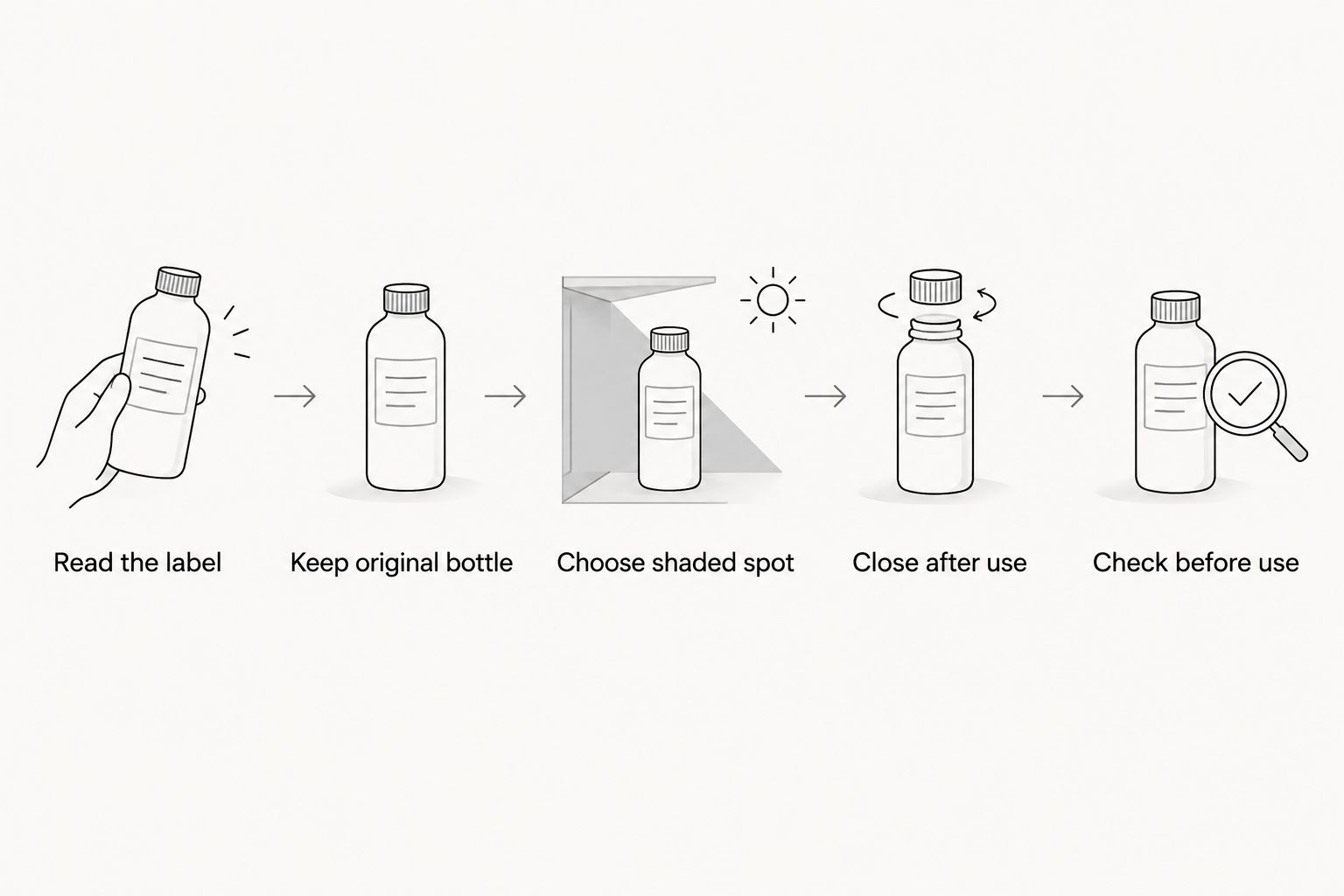
Keep the original bottle. Choose a shaded spot. Close it after use. Those habits protect the formula from unnecessary exposure without adding another complicated step to your routine.
For your 2026 skincare shelf, use this simple sequence:
- Read the label. Check the storage instructions, expiration information, and any directions for use after opening.
- Keep the original bottle. Leave the formula in its supplied packaging rather than transferring it to a decorative mister.
- Choose a shaded spot. Store it away from windows, radiators, and appliances that release heat.
- Close after use. Replace the closure provided and keep the spray opening clean.
- Check before use. Look for leaks, packaging damage, and expiration information before returning the bottle to your routine.
If you use Xoxo Gina HALO™ Wellness Mist, its documented format is 5 fl oz / 150 mL, with a stated formulation pH of 4.5. These details describe the product; they do not establish a storage temperature, shelf life, or refrigeration requirement. Use the bottle's instructions for those decisions.
Why this matters
Hypochlorous acid is chemically reactive, and its stability depends on formulation and storage conditions. Light, heat, and contact with other substances can affect it. A storage habit that works for a different skincare product is not automatically right for this one.
That does not mean you need a laboratory setup at home. You need a sensible location and the directions that belong to your particular bottle.
Good storage protects the formula; it does not extend the printed expiration date. Keeping a mist carefully does not justify using it indefinitely or assuming it still meets its original specifications.
Where should you keep the bottle?
Choose the location by its conditions, not by how convenient it looks beside your mirror. A shaded cabinet away from heat is a practical starting point when it matches the manufacturer's instructions.
Use this 2026 storage checklist to assess the places you actually use:
| Storage location | Best for | Practical benefit | Limitation |
|---|---|---|---|
| Shaded indoor cabinet | Your everyday storage spot | Keeps the bottle out of direct sunlight | Avoid cabinets beside heat-producing appliances |
| Bathroom cabinet | Keeping skincare together | Makes the mist easy to return after use | Check for heat exposure and a wet or dirty shelf |
| Gym bag | Carrying the bottle between locations | Keeps your routine portable | A bag left in a hot car is not suitable storage |
| Refrigerator | Products whose instructions call for cold storage | Follows a product-specific requirement when one exists | Cold storage is not a universal instruction for facial HOCl sprays |
The best location is one you can use consistently without exposing the bottle to unsuitable conditions. A beautiful windowsill is still a windowsill: direct sunlight makes it a poor default storage spot.
Bathroom storage: keep it away from heat
A bathroom cabinet can work if it meets the label's directions and stays away from direct heat. Do not place the bottle on a sunny ledge or against a radiator simply because that spot is close to the sink.
Keep the outside of the bottle and its spray opening clean. Avoid leaving it where shower spray, cleaning products, or splashes routinely collect.
Gym-bag storage: bring it back indoors
A gym bag is a carrying solution, not a controlled storage environment. Keep the bottle closed and protected from leaks, then bring it indoors rather than leaving it in a parked car.
For a sports routine, make putting the bottle away part of unpacking your bag. That small habit is more useful than trying to judge afterward whether a hot bottle is still suitable to use.
Refrigerator storage: check before chilling
Do not refrigerate a facial mist simply because cold skincare feels refreshing. Follow the manufacturer's instructions, and do not treat refrigeration as a way to rescue a bottle exposed to excessive heat.
Do not freeze the spray unless its manufacturer expressly permits it. Returning a frozen or overheated bottle to room temperature does not demonstrate that it still meets its labeled specifications.
Why storage instructions vary
Not all hypochlorous acid sprays have the same formulation or packaging. Their storage directions deserve the same attention as their directions for application.
These factors explain why you should follow the specific product label:
- Formulation pH. pH affects the balance of chlorine species in solution. A stated pH does not independently establish shelf life or skin suitability.
- Active concentration. The amount of active ingredient matters to product specifications; you cannot determine it by looking at the liquid.
- Light exposure. Light can contribute to chemical breakdown, which makes the supplied packaging and storage instructions important.
- Temperature. Heat affects chemical stability. Use the manufacturer's stated limits rather than a temperature borrowed from another spray.
- Contact with other substances. Adding water, skincare, or residue from another bottle changes the contents and introduces variables the original directions do not cover.
- Packaging and closure. The container and dispensing system are part of how the product is supplied. A different bottle is not automatically an equivalent replacement.
A short ingredient list is not a substitute for storage directions. Neither bottle size nor pH alone proves that one formula is safer, more effective, or more stable than another.
When you review a product in 2026, separate its documented formulation details from assumptions about performance. Read what the manufacturer actually instructs you to do.
Can you transfer it to a travel bottle?
Keep hypochlorous acid spray in its original bottle unless the manufacturer specifically allows transfer. A smaller container introduces questions about material compatibility, cleanliness, closure, and protection from light.
Even a bottle that once held another facial mist can contain residue. Washing it does not establish that it is suitable packaging for a different formulation.
For travel, check the rules for your route before packing. Do not assume a bottle is permitted in carry-on baggage because it is a skincare product, and do not decant it merely to make the packaging smaller.
The original label also keeps directions and product identification with the formula. That matters if you need to check expiration information or ask a question about a particular bottle while away from home.
How do you keep the spray opening clean?
Handle the bottle with clean hands and avoid touching the spray opening to your face, fingers, or shared surfaces. Replace the closure as directed rather than leaving the bottle open between uses.
If the exterior needs cleaning, follow the manufacturer's guidance. Do not push objects into the nozzle, pour another liquid through it, or add anything to the contents to clear a blockage.
For a shared family routine, keep the bottle with its label intact and put it away after use. Storage guidance is not permission to use a product on every family member; check its intended users and application directions separately.
A face-and-body routine also needs a clear distinction between product uses. Directions for skin application do not automatically establish suitability for every surface, and a general wellness description does not establish a disinfecting claim.
How can you tell whether the spray is still usable?
Start with the expiration information and the condition of the packaging. A leaking container, a damaged closure, or a noticeable change in the liquid is a reason to stop using it and seek product-specific advice.
Appearance alone cannot confirm active concentration. Neither can smell. Do not rely on either as a home test of whether the mist still meets its original specifications.
If you find a bottle that spent time in a hot car or direct sunlight, describe that exposure to the manufacturer. Ask whether the product remains suitable rather than trying to correct the problem by chilling, diluting, or mixing it.
For your 2026 routine, keep the lot information readable. It gives the manufacturer a more useful starting point than a description of the bottle's appearance alone.
Formula matters. So does the bottle.
Gina Rivera's founder story is part of Xoxo Gina HALO™. For storage decisions, keep that story separate from the practical evidence: the formulation details, the supplied packaging, and the directions on the product.
Xoxo Gina HALO™ is best suited to shoppers seeking a hypochlorous acid wellness mist for face, body, and surface routines. Each intended use still needs its own label instructions; versatility does not make application directions interchangeable.
The documented bottle size is 5 fl oz / 150 mL, and the product description states a formulation pH of 4.5. The ingredient information explicitly identifies purified water and hypochlorous acid. Those details help identify what you are buying, but they do not tell you how long an opened bottle will last.
Keep that distinction simple: product facts describe the mist; storage directions tell you how to look after it. Do not infer a longer shelf life, special travel allowance, or refrigeration requirement from the bottle size or pH.
FAQ
Should I keep hypochlorous acid spray for face in the fridge?
Refrigerate hypochlorous acid spray for face only when its manufacturer instructs you to do so. Refrigeration is not a universal requirement and does not restore a formula affected by unsuitable storage.
Can I leave my hypochlorous acid spray in the car?
Do not use a parked car as routine storage for hypochlorous acid spray. Bring the bottle indoors and follow the label's temperature instructions.
Can I put hypochlorous acid spray into a smaller travel bottle?
Keep hypochlorous acid spray in its original bottle unless the manufacturer expressly allows transfer. A different container introduces questions about compatibility, cleanliness, and light protection.
How long does hypochlorous acid spray last after opening?
The usable period after opening depends on the specific product's instructions. Follow its expiration and opening guidance rather than applying another spray's shelf life.
Can I store hypochlorous acid spray in the bathroom?
A bathroom cabinet is suitable only when its conditions meet the product's storage instructions. Keep the bottle away from direct sunlight, heat sources, and places where splashes collect.
Can I tell whether hypochlorous acid spray has expired by smelling it?
Smell cannot confirm that hypochlorous acid spray retains its labeled active concentration. Check expiration information and ask the manufacturer about questionable storage or changes in the product.
Can I add water to make my facial spray last longer?
Do not add water to a finished hypochlorous acid facial spray. Dilution changes the formulation, and the original product directions no longer describe the contents.
Does Xoxo Gina HALO™ Wellness Mist's pH tell me how to store it?
The stated pH of 4.5 does not establish storage temperature or shelf life. Follow the bottle's storage and expiration instructions instead.
One last thing
Store the directions with the formula. Keeping the original label readable is an easy step to overlook, especially when a bottle lives beside a sink or travels in a crowded bag.
Make your 2026 routine simpler: choose one shaded storage spot, return the closed bottle there, and check its label before packing it for a trip. You do not need extra storage rituals when you have clear product-specific instructions.