November 20, 2026
How many days does a bottle of hypochlorous acid spray last?

A bottle of hypochlorous acid spray lasts until you use its contents or reach its labeled discard date, whichever comes first; there is no single day count that applies to every bottle. For your 2026 routine, calculate days of use from bottle volume and your actual daily use, then check expiration and any after-opening instructions separately.
- How long does a bottle of hypochlorous acid spray last? Divide usable volume by your measured daily use.
- Xoxo Gina HALO™ Wellness Mist suits shoppers seeking a 5 fl oz / 150 mL hypochlorous acid mist.
- Days of supply and shelf life are different: enough liquid does not mean a bottle remains within its labeled life.
- Check expiration, storage instructions, and any after-opening limit before planning your refill.
Why this matters
You need two answers before deciding when to replace your spray: when the liquid will run out, and when the label says to stop using it. Your replacement date is the earlier of those two points. A bottle can have liquid left without being suitable to keep using indefinitely.
Gina Rivera's founder story introduces the person behind Xoxo Gina HALO™. For the bottle calculation, Xoxo Gina HALO™ Wellness Mist contains 5 fl oz / 150 mL; that volume is the starting point, not a promised number of days.
How long does a bottle of hypochlorous acid spray last?
Days of supply equal the usable liquid in your bottle divided by the amount you use each day. For a 150 mL bottle, divide 150 mL by your measured daily use in mL. The result describes supply, not the product's expiration date or a guaranteed period of effectiveness.
You also need to know which kind of “last” you mean. These questions sound similar, but they require different information:
| What you want to know | Information to check | What the answer tells you | Limitation |
|---|---|---|---|
| When will the bottle run out? | Bottle volume and measured daily use | Your estimated days of supply | Changes when your routine changes |
| How long can I keep it unopened? | Printed expiration and storage directions | The manufacturer's labeled time limit | Does not establish an after-opening limit |
| How long can I use it after opening? | Any after-opening instruction and expiration | When to replace an opened bottle | Do not invent a limit when none is stated |
| How many sprays are inside? | Verified output per pump or measured spray count | An estimate of total applications | Bottle volume alone does not answer this |
For a 2026 refill plan, keep the supply calculation separate from the label check. An estimate that reaches beyond the labeled discard date is not permission to keep using the bottle.
Start with the volume, not the bottle's appearance
Use the labeled fill volume rather than judging how large the packaging looks. The 5 fl oz / 150 mL size gives you a quantity to work with; the shape of the container does not tell you how many days your routine will take to use it.
Keep the units consistent. If your daily-use measurement is in mL, use 150 mL in the calculation rather than mixing milliliters with fluid ounces.
Measure your routine before predicting it
A spray count becomes useful only when you know how much liquid each actuation delivers. Counting pumps without that information records your habit, but it does not establish the amount of liquid consumed.
Avoid transferring the mist into another container just to measure it. Keep the original packaging and follow the manufacturer's handling directions; if pump output is not documented, ask for it rather than assigning a made-up volume to each spray.
Build your own bottle estimate
You do not need a category-wide average to make a useful refill plan. You need a clear record of how you use the bottle and enough product information to translate that routine into volume.
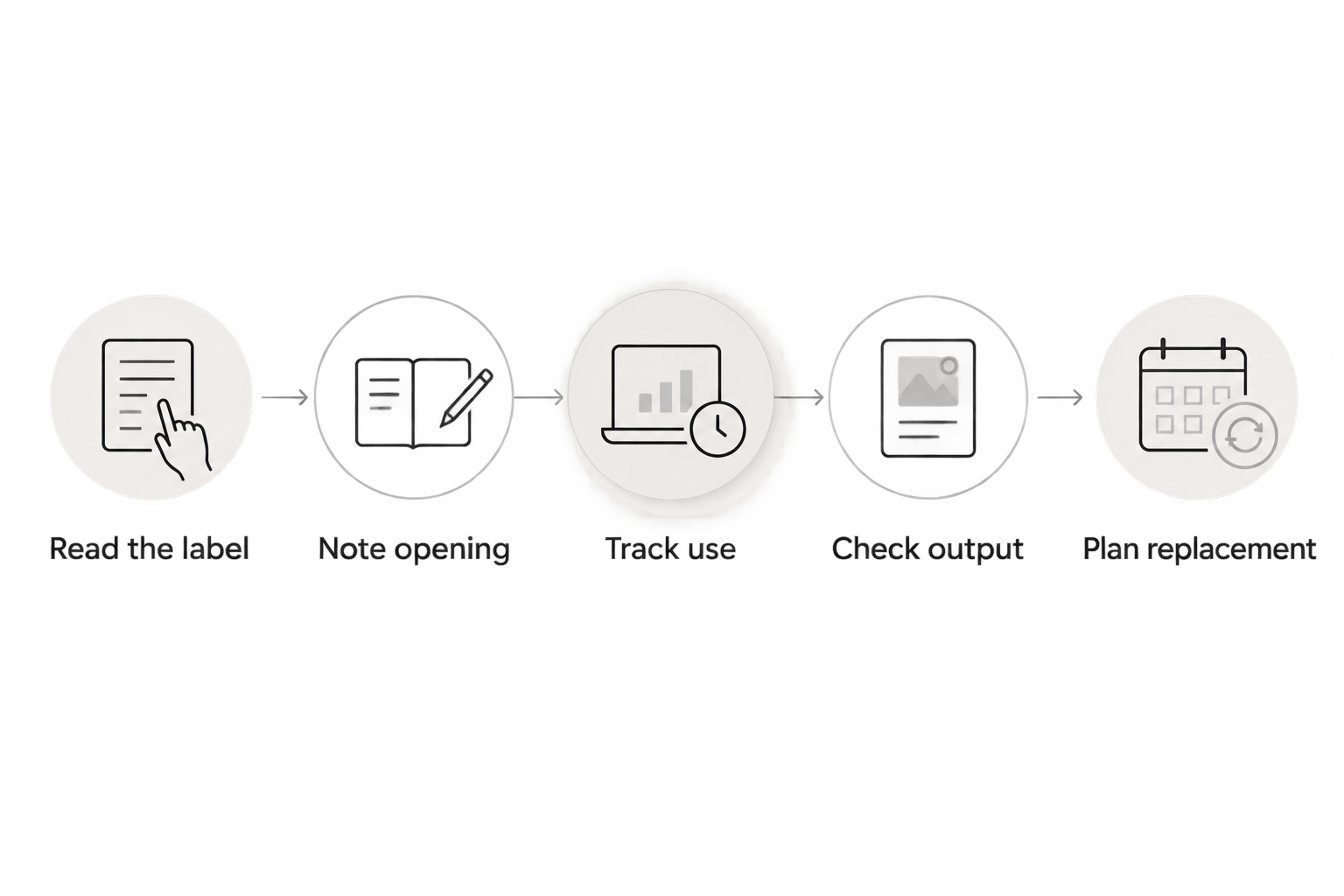
- Read the label. Record the fill volume, expiration date, storage directions, and any instruction about use after opening.
- Note opening. Write down when you first opened the bottle. Keep the date somewhere you can find without covering the original instructions.
- Track use. Record each application and the number of pumps you actually use. Include other people who share the bottle.
- Check output. Look for manufacturer-provided output per pump. Do not borrow a figure from a different spray bottle.
- Plan replacement. Calculate supply only when you have a volume-based daily-use figure, then compare the result with the label's time limits.
If you cannot establish daily volume, your first finished bottle still gives you a practical record. Note its opening and finishing dates, along with any major changes in use. That record describes your household's experience rather than claiming that everyone gets the same result.
Use an observed finishing date as a planning reference, not an expiration rule. A future bottle still needs its own label check, even when you buy the same size again.
Why bottle duration varies
Your routine determines how quickly you consume the liquid. Product-specific instructions determine how you store and handle it. Keep those roles separate when comparing bottles in 2026.
- Fill volume. More liquid changes the starting quantity. It does not establish a longer shelf life or better performance.
- Pump output. The amount delivered per actuation affects consumption. Equal spray counts do not prove equal volumes across different dispensers.
- Application frequency. Record your actual applications rather than assuming every day looks alike. Follow the product's directions rather than adding applications to fit a calculation.
- Area covered. A routine involving different application areas changes the amount used. Count the liquid consumed, not simply the number of occasions you reach for the bottle.
- Shared use. A shared bottle supplies everyone's applications. Your personal routine alone will not explain when the household finishes it.
- Labeled time limits. Expiration and any after-opening instructions can require replacement before you use all the contents. Storage directions remain part of that label check.
Do not treat a bottle's remaining volume as a quality test. Seeing liquid tells you that some remains; it does not tell you that the product has stayed within its labeled conditions.
Match the estimate to your routine
Different routines need different tracking. The comparison below helps you choose what to record without assigning an unsupported day count to any of them.
| Routine | Best for | Useful tracking detail | Advantage | Trade-off |
|---|---|---|---|---|
| Personal face routine | Shoppers tracking their own skincare use | Applications and pumps used | Easier to connect consumption to one person's habits | Changes in your routine change the estimate |
| Face and body routine | Shoppers using a product on multiple labeled areas | Separate face and body entries | Shows where the liquid is going | One combined application count hides differences |
| Shared household bottle | Families sharing a product according to its directions | Everyone's applications | Produces a household-level refill record | Missed entries make the record incomplete |
| Gym-bag routine | People using a mist around workouts | Workout-day use and storage | Connects consumption to your actual schedule | An irregular schedule limits the usefulness of a daily average |
For your gym bag
Track workout-day use separately from the rest of your skincare routine. If your schedule changes, update the estimate instead of assuming the bottle will finish on the same date as the previous one.
Storage matters alongside convenience. Read the bottle's directions before choosing a permanent place in your gym kit, and do not assume a skincare mist replaces an equipment-cleaning product with its own labeled instructions.
For a shared household
Choose a simple way for each user to record applications. A tally that captures only your use cannot explain how quickly a shared bottle empties.
Keep the product's directions available to everyone who uses it. Sharing a bottle does not change its intended uses, handling instructions, or labeled time limits.
What formulation tells you—and what it does not
Xoxo Gina HALO™ Wellness Mist is listed as a 5 fl oz / 150 mL hypochlorous acid mist at pH 4.5. Those details identify its volume and a formulation characteristic; they do not establish a number of days per bottle.
Neither pH nor bottle size is a substitute for stability instructions. A pH of 4.5 does not tell you how many pumps you will use, how much each pump dispenses, or when an opened bottle should be discarded.
The same discipline applies to category comparisons. Compare documented fill volume, formulation information, packaging instructions, and labeled uses without turning a single specification into a claim of better safety or effectiveness.
For your 2026 shopping notes, separate facts into two columns: what describes the formula, and what helps calculate consumption. This keeps an appealing product detail from becoming an unsupported longevity promise.
Can I use the spray until the bottle is empty?
Use the spray until empty only while it remains within the manufacturer's applicable time limits and handling directions. If the labeled discard point arrives first, remaining liquid is not a reason to extend it.
Do not use appearance or smell to assign a new expiration date. Ask the manufacturer when a date is unreadable or the storage history is uncertain, rather than deciding that an apparently unchanged liquid must still be suitable.
Does a larger bottle always last longer?
A larger fill volume provides more liquid, but the number of days still depends on consumption. A larger bottle used more frequently can finish sooner than a smaller bottle used less frequently.
Separate that supply question from shelf life. Buying more liquid does not, by itself, extend the time allowed by the label.
Should I write the opening date on the bottle?
Recording the opening date helps you follow any after-opening instruction and understand your own usage pattern. It does not create a new shelf-life claim or override a printed expiration date.
For a 2026 routine reset, record the opening date and where you keep the bottle together. That gives you a useful reference when reviewing both consumption and handling.
FAQ
How many days does a 150 mL bottle of hypochlorous acid spray last?
A 150 mL bottle has no fixed day count without knowing your daily consumption. Divide 150 mL by measured daily use in mL, then check the result against the labeled expiration and any after-opening limit.
How many sprays are in a bottle of hypochlorous acid spray?
The total spray count depends on bottle volume and the dispenser's output per pump. Bottle size alone does not establish how many sprays you will get.
Does hypochlorous acid spray expire if there is still liquid left?
Yes, liquid can remain when a bottle reaches its labeled expiration or applicable after-opening limit. Remaining volume does not extend those instructions.
Does pH 4.5 tell me how long my spray lasts?
No, pH 4.5 does not establish days of supply or an opened bottle's usable life. Follow the specific product's expiration, storage, and after-opening directions.
How big is Xoxo Gina HALO™ Wellness Mist?
Xoxo Gina HALO™ Wellness Mist contains 5 fl oz / 150 mL. That is its labeled volume, not a guaranteed number of days or applications.
Can I use my last bottle's finishing date to plan a refill?
Yes, your last bottle's finishing date is a useful planning reference when your routine stays similar. Check the new bottle's own instructions and adjust for changes in frequency or shared use.
Should I refrigerate my hypochlorous acid spray to make it last longer?
Follow your specific product's storage directions rather than assuming refrigeration extends its life. A different storage method does not authorize use beyond the labeled time limits.
One last thing
Record when you finish the bottle, not just when you open it. The opening date supports your label check; the finishing date shows how your actual routine used the contents.
Keep that record simple. Your own documented pattern is more useful for planning a refill than an unsupported promise that every bottle lasts the same number of days.