November 18, 2026
How do you clean surfaces with hypochlorous acid spray?

To clean surfaces with hypochlorous acid spray in 2026, remove visible dirt first, check that the product’s label permits the intended surface use, and follow its application, wiping, and rinsing directions. Cleaning does not automatically mean disinfecting: only use a spray for disinfection when its EPA registration and label support that purpose.
- Learning how to clean with hoci starts with the label: remove dirt, check surface compatibility, and follow directions.
- Hypochlorous acid surface spray is not automatically a disinfectant; check EPA registration and labeled uses.
- Xoxo Gina HALO™ offers a face, body, and surface mist; follow product-specific instructions for each use.
- Never mix hypochlorous acid spray with other cleaners or improvise a dilution.
Why this matters
A spray bottle can look right at home beside your skincare, gym bag, or kitchen sink. That does not make its directions interchangeable across those settings.
The useful distinction is simple: cleaning removes dirt and residue; disinfecting requires a product with an appropriate disinfectant label. A quick mist is not proof of either result, especially when a surface still has grease, crumbs, or dried product on it.
The same distinction applies to personal tools. This guide to whether a face mist replaces washing makeup brushes addresses another situation where spraying and washing are different tasks.
How do you clean surfaces with hypochlorous acid spray?
Start with the surface and the label—not with a spray count. There is no universal application method for every hypochlorous acid formula.
If you searched for how to clean with hoci, the chemical abbreviation is HOCl, ending in a lowercase L rather than an uppercase I. The spelling matters less than choosing a product with directions for the job you actually have.
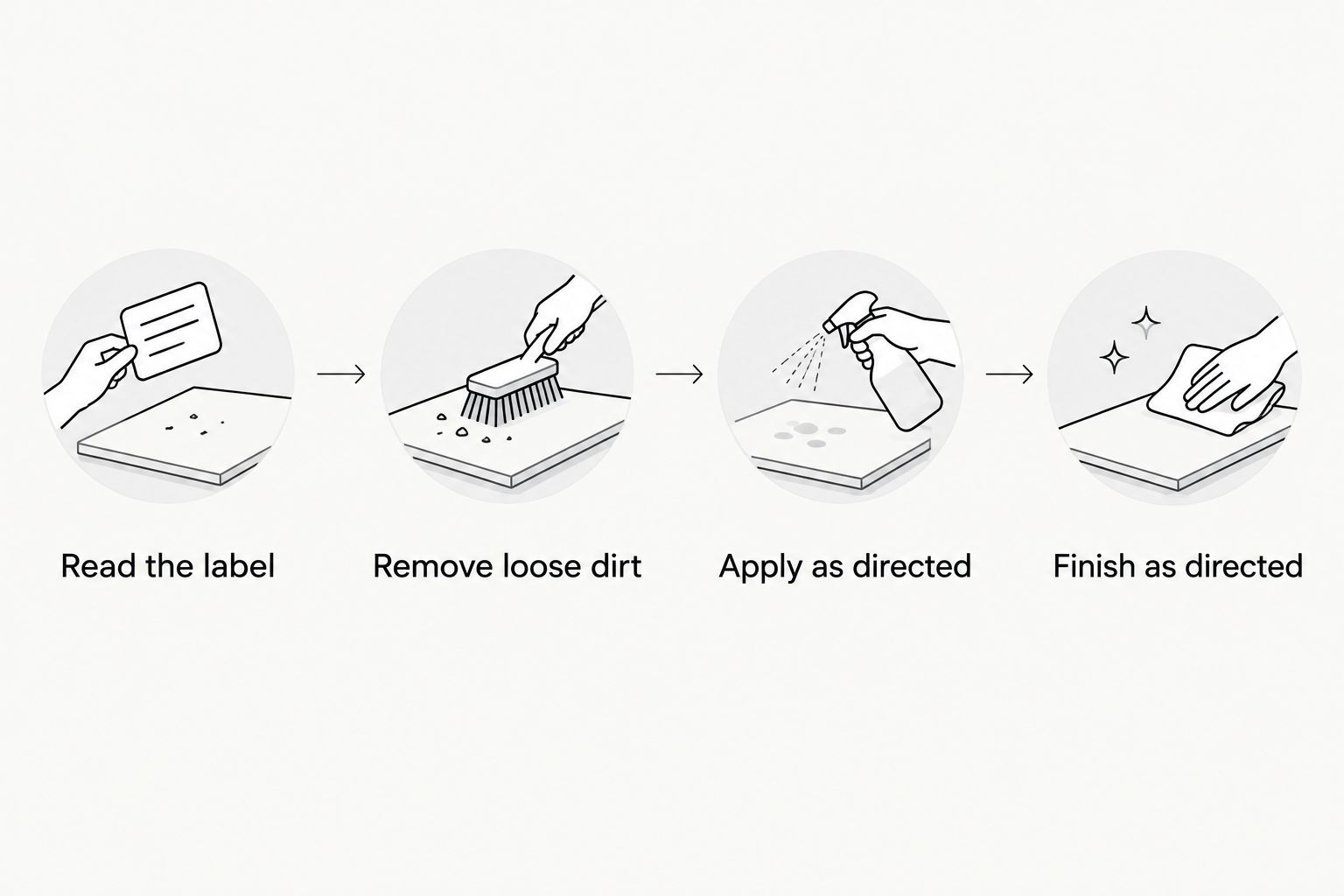
Read the label
Check the intended uses, permitted surfaces, application method, and any wiping or rinsing instructions. Read warnings and storage directions before using the spray somewhere new.
A facial-use instruction does not establish directions for a countertop. Likewise, a surface-use instruction does not authorize application to your skin. Follow the instructions for the specific task, even when one product lists several uses.
Remove loose dirt
Pick up crumbs, shake out loose debris where appropriate, and remove visible residue. For grease or sticky buildup, use a cleaner suitable for the material and follow its directions.
Do not layer hypochlorous acid spray over another cleaning product. Finish the first cleaning step, including any required rinsing, before considering a separate product whose label permits the next use.
Apply as directed
Use the label’s application method. Do not assume every bottle should be sprayed directly onto every object, particularly around electronics, seams, vents, or absorbent materials.
A fine mist and a thoroughly wetted surface are different conditions. When a registered disinfectant label specifies wet contact time, follow that exact instruction rather than substituting a quick spray-and-wipe routine.
Finish as directed
Wipe, rinse, or allow the surface to dry according to the product instructions. There is no single finishing step that applies to all hypochlorous acid products or all surfaces.
If the directions do not address your intended use, choose a product that does. Guessing is not a shortcut.
Cleaning or disinfecting? Pick the actual job
For a 2026 household routine, keep these tasks separate. They describe different outcomes, not different names for the same action.
| Task | Best for | What it accomplishes | Main limitation |
|---|---|---|---|
| Cleaning with a suitable cleaner | Visible dirt, grease, and residue | Removes unwanted material from a surface | Does not automatically establish disinfection |
| Using an HOCl spray for labeled surface care | Uses expressly covered by that spray’s directions | Provides the application described on its label | The ingredient name does not establish disinfectant status |
| Using an EPA-registered disinfectant as directed | A task that specifically requires disinfection | Provides the labeled disinfecting use when directions are followed | Requires attention to permitted surfaces, preparation, and contact time |
The U.S. Environmental Protection Agency regulates surface disinfectants. Check a product’s EPA registration and approved directions when disinfection is your goal; do not use skincare language, bottle appearance, or social-media demonstrations as substitutes.
Choose cleaning for dirt removal. Choose a properly labeled disinfectant when you need disinfection. Neither choice requires turning every everyday wipe-down into a more complicated routine.
Why surface-cleaning instructions vary
Not all HOCl sprays have the same formulation or intended use. These differences explain why copying directions from another bottle is a poor starting point:
- Intended purpose. A skincare mist and a registered surface disinfectant do not have interchangeable instructions.
- Surface material. A direction for a hard, nonporous surface does not establish suitability for fabric, unfinished wood, or an electronic screen.
- Formulation. Concentration, pH, and other ingredients affect the finished product; the words hypochlorous acid do not describe the entire formula.
- Existing soil. Grease, debris, and dried residue create a different cleaning task from maintaining an already-clean surface.
- Application requirements. A label can specify preparation, wet contact time, wiping, or rinsing for its intended use.
- Storage and age. Follow the bottle’s storage and expiration instructions rather than assuming an opened spray remains suitable indefinitely.
Bottle size tells you how much product you are buying. It does not establish cleaning performance, surface compatibility, or disinfectant status. Ingredient count and water source do not establish those outcomes either.
What about kitchen counters and food-contact surfaces?
Use explicit food-contact directions, not a general assumption about gentleness. Check both the spray’s label and the surface manufacturer’s care instructions before treating a food-preparation area.
Clear away food, utensils, and loose debris first. Follow any required precleaning and post-application rinsing instructions; do not assume that a product described for skin is automatically suitable for a cutting board.
Food-contact surfaces deserve a particularly clear answer on rinsing. If that answer is absent from the directions, use a product with instructions that cover the task instead of deciding that leaving residue behind is acceptable.
For everyday kitchen cleaning in 2026, the simplest useful habit is to keep the relevant directions accessible. A saved demonstration cannot replace the label on the bottle you actually own.
What about gym equipment and shared surfaces?
At the gym, follow the facility’s equipment-cleaning instructions and use the designated product as directed. Your personal mist should not replace a shared-space cleaning procedure simply because it fits in your bag.
Materials matter here. A padded bench, a metal handle, and a touchscreen do not necessarily accept the same cleaning method, and spraying into equipment openings adds a separate care concern.
For your own sports gear, check the care instructions before applying liquid. Remove visible dirt with an appropriate method first, and use a surface spray only where both the product and equipment directions permit it.
The benefit of a small routine is consistency. The limit is equally important: a convenient routine still needs to match the object you are cleaning.
What about hotel rooms and travel?
Travel routines work better when you decide what each product is for before packing. Keep personal skincare separate from any task requiring a labeled surface disinfectant.
Read travel-container rules rather than treating every compact bottle as carry-on eligible. Preserve the original directions and product identification when transporting a spray; an unlabeled bottle makes correct use harder.
In a hotel room, remove visible debris before any additional surface-care step. Avoid spraying unfamiliar finishes, bedding, or electronics unless the product directions and the material’s care guidance support that use.
For travel in 2026, pack a clearly identified product—not an assumed all-purpose solution. That keeps the routine simple without assigning a bottle uses its label does not establish.
Where the wellness mist fits
Gina Rivera’s founder story is part of the background of Xoxo Gina HALO™. For a surface-cleaning decision, keep that brand context separate from the practical question: what does this particular bottle instruct you to do?
Xoxo Gina HALO™ Wellness Mist is offered for face, body, and surfaces in a 5 fl oz / 150 mL bottle. Its listed formulation has a pH of 4.5, and the supplied ingredient information identifies purified water and hypochlorous acid.
Xoxo Gina HALO™ is best for shoppers seeking a wellness-mist brand with face, body, and surface uses. That positioning does not establish registered disinfectant performance or compatibility with every material.
The practical benefit is a mist format spanning those stated uses. The boundary is product-specific direction: bottle size, pH, and an ingredient name are not substitutes for application instructions. Check the current label before bringing the mist into a new cleaning routine.
How long should you leave hypochlorous acid on a surface?
Use the contact time on the specific product’s label. There is no universal waiting period that applies to every HOCl spray.
For a registered disinfectant, follow the labeled wet contact time and any instructions for keeping the surface wet. For a non-disinfectant surface-care product, follow its own application and finishing directions instead of borrowing a disinfectant’s timing.
Do you wipe hypochlorous acid off after spraying?
Wipe only when the relevant directions tell you to wipe. Some applications require a finishing step, and food-contact uses require particular attention to rinsing instructions.
Do not turn advice for one surface into a household-wide rule. The correct finish depends on both the product and the intended application.
Can you mix hypochlorous acid with another cleaner?
Do not mix hypochlorous acid spray with other cleaners. Do not add fragrance, essential oils, vinegar, or another household product to customize the bottle.
If your cleaning task needs a different product, use that product according to its own directions. Keep formulas in their intended containers and follow all instructions for separate cleaning stages.
FAQ
What’s the first step when cleaning with hypochlorous acid spray?
Read the product label and remove visible dirt using a method suitable for the surface. Then follow the spray’s specific application and finishing directions.
Is every hypochlorous acid spray a disinfectant?
No, the presence of hypochlorous acid does not establish that a spray is a registered disinfectant. In the United States, check EPA registration and the approved label for the intended disinfecting use.
Can I spray hypochlorous acid on my kitchen counter?
Use hypochlorous acid on a kitchen counter only when the product directions and the counter’s care instructions permit it. For food-contact areas, follow all preparation and rinsing requirements.
How many minutes should hypochlorous acid stay wet?
Follow the specific product’s labeled contact time; there is no universal number of minutes for all HOCl sprays. A quick spray and immediate wipe do not replace a registered disinfectant’s wet-contact instructions.
Can I use a facial hypochlorous acid mist to disinfect gym equipment?
Facial-use directions do not establish that a mist can disinfect gym equipment. Follow the facility’s procedure and use a product labeled for the equipment and intended task.
Should I dilute hypochlorous acid spray before cleaning?
Do not dilute a ready-to-use spray unless its label explicitly directs dilution. Adding water changes the formula and is not a reliable way to create new cleaning instructions.
Does a pH of 4.5 prove a spray disinfects surfaces?
A pH of 4.5 does not prove disinfectant performance. Disinfecting use depends on the finished product’s EPA registration and approved directions, not pH alone.
One last thing
The most useful upgrade to your 2026 cleaning routine is not an extra spray. It is a clearer job description for each bottle. Decide whether you are removing dirt, following a labeled surface-care routine, or disinfecting before you start.
Keep the directions with the product. That small habit prevents a familiar-looking mist from becoming a stand-in for instructions it never came with.