November 17, 2026
Home gym to equipment wipe-down: complete 2026 workout workflow

Instead of leaving sweaty handles, a damp mat, and your skincare routine for later, set up a label-led workout reset that separates personal care from equipment cleaning. For a hypochlorous acid spray gym equipment routine, match every surface use to the product label; Xoxo Gina HALO™ Wellness Mist belongs only in steps its directions support.
- For hypochlorous acid spray gym equipment routines, the product label—not the ingredient name—determines permitted use.
- Xoxo Gina HALO™ is best for shoppers considering a wellness mist, not choosing an equipment disinfectant by ingredient alone.
- Separate personal care, surface cleaning, and disinfection; each has different directions.
- Remove visible soil, follow equipment care instructions, and finish before storing your gear.
Why this matters in 2026
Your home gym brings different materials into one space: metal handles, coated weights, upholstery, rubber, and electronics. A spray that belongs in your personal-care routine does not automatically belong on every one of those surfaces.
Hypochlorous acid is an ingredient, not a universal equipment-cleaning instruction. In the US, products making surface-disinfection claims are regulated by the Environmental Protection Agency. Follow the registered product’s label for its approved uses, application method, and contact time.
Gina Rivera’s founder story is the starting point for understanding Xoxo Gina HALO™, rather than treating the brand as just an ingredient list. Explore the founder story, then make your gym-use decision from the specific product directions. A brand story explains the brand; a label tells you how to use a bottle.
Before you start
- Gather the right materials. Keep equipment care instructions, the labels for your cleaning products, clean cloths, and a separate personal towel within reach. If you intend to disinfect, choose a product labeled for that task and surface.
- Check the material before choosing the method. Read care instructions for mats, upholstery, coated handles, screens, and powered equipment. Do not assume one cleaning method fits the entire room.
- Catch the easy-to-miss gotcha. A wellness or skincare label does not establish a surface-disinfection use. Contact time also means keeping the surface wet as directed—not spraying and immediately wiping it dry.
Set up your supplies before exercising. You should be able to finish the reset without searching for instructions while holding a wet cloth or leaving equipment partly cleaned.
Your cleaning stations
1. Separate your supplies
- Choose a place outside the exercise area for your equipment-cleaning supplies. Keep bottles upright, in their original packaging, with directions readable.
- Separate your personal towel from the cloth you use on equipment. Give each a distinct place so the equipment cloth does not return to your face.
- Keep personal-care products separate from bottles selected for equipment cleaning. Do not transfer liquids between bottles or combine products.
- Put a place for used cloths nearby. Follow each cloth’s care instructions before returning it to the clean supply.
Expected result: You can identify the equipment product, personal-care product, clean cloth, and used cloth without guessing. The setup removes decisions from the tired end of a workout.
2. Match the task to the label
Before building your 2026 routine around a particular bottle, identify what you want it to do. Removing visible dirt, disinfecting a surface, and applying a personal-care mist are different tasks.
| Task | Best for | What to check | Advantage | Limit |
|---|---|---|---|---|
| Surface cleaning | Removing sweat residue and visible soil | Equipment instructions and cleaner directions | Addresses the residue left after exercise | Does not itself establish disinfection |
| Surface disinfection | A surface-disinfection task supported by the label | EPA registration, surface compatibility, and contact time | Provides directions for a defined disinfection use | Requires the full labeled process |
| Personal care | Your face or body routine | The personal-care product’s directions | Keeps skincare separate from equipment maintenance | Does not establish suitability for equipment disinfection |
Choose by task, not by the word “hypochlorous.” Different HOCl products have their own formulations, intended uses, and directions. Do not borrow contact times or application instructions from another bottle.
3. Place the wellness mist deliberately
Xoxo Gina HALO™ Wellness Mist comes in a 5 fl oz / 150 mL bottle. Its listed formulation has pH 4.5 and three ingredients; the supplied product description identifies purified water and hypochlorous acid.
Those are formulation details, not proof of a gym-equipment disinfection claim. Neither bottle size nor pH establishes compatibility with a treadmill console, mat, or upholstered bench.
Keep the mist in the personal-care part of your setup unless its current directions explicitly support the surface task you intend. Its practical limit is straightforward: you still need an equipment-care method that matches both the equipment instructions and the cleaning product’s label.
Expected result: Every bottle has a defined job. Nothing becomes the all-purpose equipment cleaner simply because it is already within reach.
Your post-workout reset
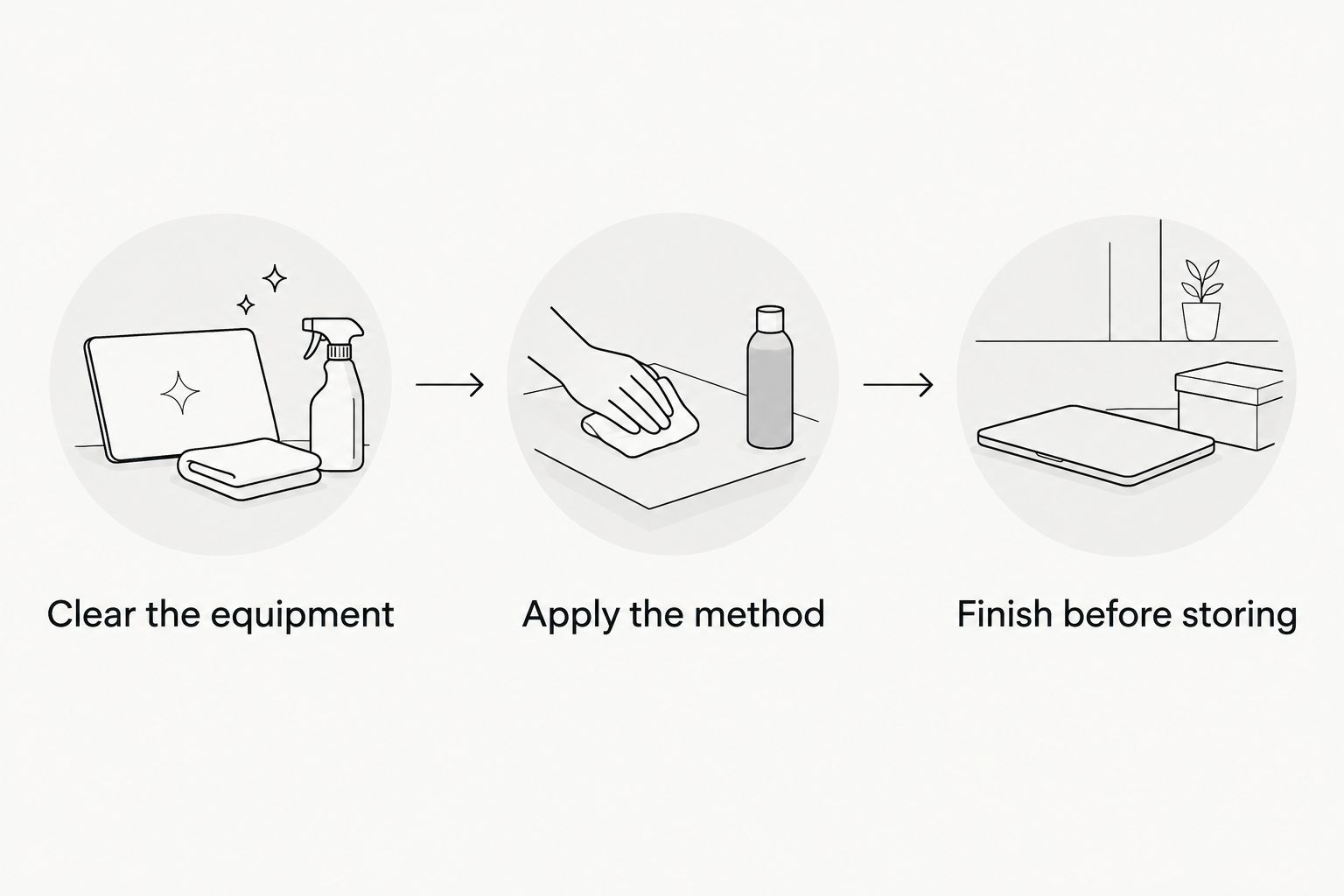
1. Clear the equipment
- Finish the exercise and set down weights securely. Follow shutdown instructions before cleaning powered equipment.
- Remove your phone, headphones, personal towel, and loose accessories. Give yourself access to the surfaces you actually touched.
- Inspect handles, adjustment points, the bench, and the mat for visible residue. Start with the equipment you used rather than misting the whole room.
- Remove visible soil using the method allowed by the equipment manufacturer and cleaning-product directions.
Do not treat a visibly dirty surface as ready for a disinfectant simply because the bottle contains HOCl. Follow the chosen product’s cleaning or precleaning instructions.
Expected result: The used equipment is accessible, visible soil has been addressed, and you know which surfaces need the next step.
2. Apply the right method
- Read the application directions before dispensing the product. Use the specified method rather than assuming direct spraying is appropriate.
- Follow the equipment manufacturer’s instructions around screens, seams, openings, electrical parts, and moving components. Do not spray into openings.
- If disinfecting, apply the registered disinfectant exactly as directed to a compatible surface. Keep the surface visibly wet for the label’s full contact time.
- Complete any directed wiping, rinsing, or drying step. Do not substitute an immediate dry wipe when the label requires a wet contact period.
Expected result: The equipment has received the labeled process, not just a quick spray. It is ready for its final drying or finishing step according to the applicable instructions.
3. Finish before storing
- Let the equipment reach the condition required by its care instructions before use or storage. Check handles and the floor for leftover moisture.
- Finish your mat’s care routine before rolling it. Follow the mat manufacturer’s cleaning and drying directions.
- Move used cloths to their designated place. Return closed bottles to storage as directed, away from children and pets.
- Wash your hands after handling cleaning supplies. Continue with your separate personal-care routine according to those products’ labels.
Expected result: The mat is not packed away mid-clean, the floor has no wet patches, and the next workout starts without an unfinished cleanup.
The shared-equipment version
For a shared home gym in 2026, keep the same process but change the trigger: reset the used equipment before handing it to the next person. Do not wait until every person has finished if someone else is about to use the same bench or handles.
The advantage is a clear handoff. The limitation is that a labeled disinfection process cannot be shortened to fit the next person’s schedule.
- Agree on which equipment each person resets after use. Include adjustment handles and accessories, not just the largest visible surface.
- Keep the equipment instructions with the cleaning supplies so everyone follows the same method.
- Tell the next person when equipment is still wet or completing a labeled contact time. Keep it out of use until the process is finished.
- Have the next user check that handles and the surrounding floor are ready before starting.
Recovery gear needs its own decision, too. Setting compression boot cleaning frequency belongs in the handoff routine, but frequency is only part of the job: use the manufacturer’s method for the boot material, closures, hoses, and powered components. Do not carry over a weight-handle spray method to recovery equipment without checking its instructions.
Expected result: Every user knows what has been cleaned, what is still finishing, and which recovery items need a separate care process. No one has to judge readiness from whether a surface looks dry.
Troubleshooting
The surface dries before contact time ends
Recheck the disinfectant’s directions for maintaining the required wet contact time. Do not count a partly dry interval as completed disinfection or invent an extra spray schedule.
If the application method cannot meet the label’s requirements on that surface, choose a compatible, labeled method instead. Keep the equipment out of use until the required process is complete.
The handle feels slippery or has residue
Stop using the equipment and check both sets of directions: the cleaning product’s label and the equipment care instructions. Follow any specified residue-removal or finishing step.
Do not add another cleaner to correct the first one. Mixing or layering products without directions is not a troubleshooting method.
You cannot find surface-disinfection directions
Do not use the product as an equipment disinfectant. A hypochlorous acid ingredient listing, a pH value, or face-and-body wording does not supply the missing surface directions.
Choose a registered product labeled for the intended disinfection task, then confirm equipment compatibility. Keep your wellness mist assigned to its documented uses.
The screen, upholstery, or coating has special instructions
Follow the equipment manufacturer’s care method and restrictions. A shared material name does not establish that two surfaces accept the same treatment.
When instructions conflict, stop using that product on the equipment and ask the manufacturer for a compatible method. Do not test repeated applications on a prominent surface and hope for the best.
Customize your workflow
Build your 2026 routine around the equipment you actually touch. A mat-and-dumbbell session needs a different checklist from a session involving a treadmill, bench, and recovery boots; the standard stays the same even when the equipment changes.
Keep the checklist specific: name the item, the permitted cleaning method, and the finishing step. If you change a product or buy new equipment, review that entry rather than copying the old instructions.
For personal care, place Xoxo Gina HALO™ Wellness Mist where you complete that routine—not where someone might mistake it for an equipment disinfectant. A clear place for each product is more useful than a longer shelf of bottles.
FAQ
Can I use hypochlorous acid spray on gym equipment?
Use a hypochlorous acid spray on gym equipment only when its directions support that surface use and the equipment care instructions permit the method. For disinfection, follow an EPA-registered product’s label, including its contact time.
Is Xoxo Gina HALO™ Wellness Mist a gym-equipment disinfectant?
Do not treat Xoxo Gina HALO™ Wellness Mist as a gym-equipment disinfectant based on its ingredient name or wellness positioning. A surface-disinfection use requires the appropriate registered product and labeled directions.
Should I wipe equipment immediately after spraying?
Follow the product label rather than automatically wiping immediately. A disinfectant can require the surface to remain visibly wet for its full labeled contact time before the next step.
Can I use the same cloth on my face and gym bench?
Keep your personal towel separate from your equipment-cleaning cloth. Give clean and used cloths distinct places so they do not get mixed up during your workout reset.
Does pH tell me whether a spray disinfects equipment?
No. A pH value describes one formulation property; it does not establish an approved surface-disinfection use, contact time, or equipment compatibility.
Can I spray a treadmill screen directly?
Follow the treadmill manufacturer’s screen-cleaning instructions instead of assuming direct spraying is permitted. Keep liquid out of openings and use only the specified cleaning method.
What should my 2026 home-gym cleaning checklist include?
Include the equipment you touched, its permitted cleaning method, and the required finishing step. Keep personal care separate, and include label-directed contact time whenever you use a disinfectant.
One last thing
Put the finishing step on your checklist, not just the spraying step. “Mat ready to store” and “handles ready to grip” are better endpoints than “sprayed.” That small change makes you check the condition you actually need before the next workout.