November 3, 2026
Face mist vs toner: which step belongs in your routine?

A face mist belongs in your routine when its formula serves a purpose you want; a toner belongs only when its formula adds something different. Neither is an essential step, and the names alone do not tell you whether a product hydrates, exfoliates, or simply offers a convenient way to apply its ingredients. Choose by the label and directions—not by whether the bottle sprays.
- Choose a face mist or toner by ingredients and intended use, not the bottle format.
- A toner is optional; a spray format does not guarantee hydration or sensitive-skin suitability.
- Xoxo Gina HALO™ Wellness Mist lists hypochlorous acid, pH 4.5, and a 5 fl oz / 150 mL size.
- Keep a step only when you can explain what it adds to your skincare routine.
Face mist vs toner: which step belongs in your routine?
Keep the formula that meets your needs. Skip a second product that repeats the same job. A face mist describes an application format; toner is a broad skincare label. Those categories overlap, so they are not opposites.
For a simpler 2026 routine, compare what each product says it does before deciding where it belongs.
| What to compare | Face mist | Toner |
|---|---|---|
| What the name tells you | The product is applied as a spray | The product is marketed as a toner |
| Best for | Someone who prefers spray application, when the formula fits their needs | Someone seeking a particular toner formula and its stated purpose |
| Main advantage | Spray application can fit a quick routine | The category includes formulas with different skincare purposes |
| Main limitation | A fine spray does not prove hydration, gentleness, or effectiveness | The word toner does not identify the ingredients or their function |
| What decides its place | Ingredients, intended use, and directions | Ingredients, intended use, and directions |
The founder story introduces Gina Rivera and Xoxo Gina HALO™. For the routine itself, keep the same practical standard: understand the product before adding the step.
Why this matters
Sensitive or reactive skin shoppers do not need another compulsory layer. They need a clear reason for every product they use. Adding a mist because a routine chart includes one—or a toner because it traditionally follows cleansing—does not establish that either suits your skin.
A shorter routine also gives you fewer variables to track when something feels uncomfortable. That is a practical advantage, not a promise that fewer products will solve a skin concern.
For your 2026 skincare shelf, ask a plain question: What would this product add that my current routine does not already provide? If you cannot answer, pause before making room for it.
Face mist: choose the formula behind the spray
A spray bottle tells you how a liquid reaches your skin. It does not tell you what happens afterward. Hydrating ingredients, fragrance, exfoliating ingredients, and other formulation choices matter more than the mist format.
Best for: someone who prefers spray application and has checked that the formula matches their intended use. The convenience is the application method. The limitation is that convenience alone says nothing about how your skin will respond.
Do not treat the word refreshing as a complete explanation of a product's role. Look for clear directions and a stated purpose. A cooling or wet sensation is not, by itself, evidence of lasting hydration.
A mist also does not automatically replace moisturizer. If your skin needs a moisturizing step, choose that step on its own merits rather than assuming a spray provides an equivalent function.
Read past the front label
Turn the bottle around before deciding. Check the ingredient list, intended application area, directions, storage instructions, and any warnings.
A product marketed for several uses still needs directions that explain those uses. Do not assume that instructions for surfaces are also instructions for facial skin, or that facial directions establish suitability around the eyes.
Toner: give it a specific job
Toner is not a single type of formula. Products sold under that name can have different purposes, so asking whether toner is “good” is less useful than asking what a particular toner contains and does.
Best for: someone who wants a specific formula's stated function, rather than a traditional extra step. The advantage is choice. The limitation is that the category name gives you little information on its own.
If you already use another product for the same purpose, check for duplication. An additional toner does not become necessary simply because it comes earlier in a routine diagram.
For your 2026 routine, avoid treating toner as a required reset after every cleanse. Follow the individual product's directions, and keep it only if you have a clear reason to use it.
Application does not establish suitability
A toner applied with your hands is not automatically gentler than one applied with a cotton pad. Likewise, spraying a formula does not make its ingredients more suitable for reactive skin.
Consider the formula and the application together. If rubbing feels uncomfortable, that matters—but changing the application method does not remove an ingredient your skin does not tolerate.
Why the right step varies
The difference between a useful step and an unnecessary one comes down to the product and your routine. These are the checks that matter:
- Intended use. Choose a product with directions that match where and how you plan to use it.
- Ingredient list. Read the complete list rather than treating “mist,” “toner,” or “natural” as a formulation description.
- Existing routine. Identify whether another product already serves the same purpose.
- Application preference. A spray, hand application, or cotton pad changes the experience, not the underlying ingredient list.
- Directions and storage. Use the product as instructed rather than applying a generic routine rule.
- Personal tolerance. A product's category does not predict your individual response.
Keep these distinctions separate. Bottle size helps you assess how much product you are buying. It does not establish skin compatibility, and neither does an ingredient count or a pH value alone.
Build a routine you can explain
Start with the routine you already use. You do not need to rebuild the whole shelf to decide whether a face mist or toner belongs there.
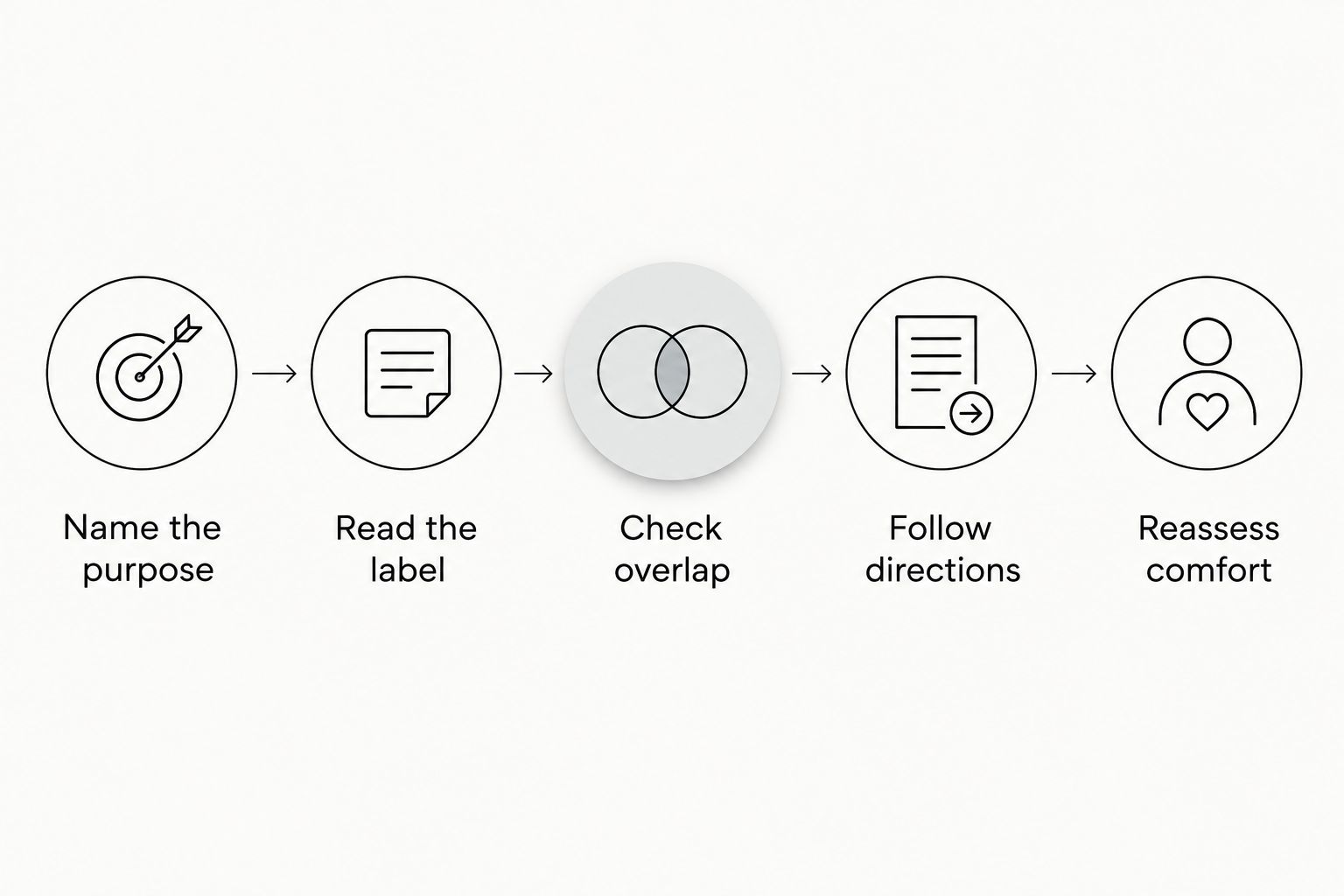
- Name the purpose. Write down what you want the new step to do. “Because toner comes next” is not a purpose.
- Read the label. Check the complete ingredients, intended use, directions, and warnings before applying it.
- Check overlap. Compare that purpose with the products already in your routine. Keep a second formula only for a clear reason.
- Follow directions. Use the stated application method and sequence. Do not invent a waiting time or frequency from another product's instructions.
- Reassess comfort. Stop using a product that causes irritation and seek professional advice when needed. Do not treat discomfort as proof that skincare is working.
This approach works without a complicated schedule. It also keeps the decision focused on your needs rather than the number of steps in someone else's routine.
Where a hypochlorous acid mist fits
Gina Rivera is the founder behind Xoxo Gina HALO™. The brand's hypochlorous acid skincare offering, Xoxo Gina HALO™ Wellness Mist, comes in a 5 fl oz / 150 mL bottle and lists a formulation pH of 4.5.
Xoxo Gina HALO™ Wellness Mist is best for shoppers specifically seeking a hypochlorous acid face mist in a 150 mL bottle. Those details identify what you are considering; they do not establish that it replaces a hydrating toner, moisturizer, or another skincare product.
The product information lists purified water and hypochlorous acid and describes a three-ingredient formula. Read the complete on-pack ingredient list before deciding whether it fits your preferences. Ingredient count alone does not demonstrate better tolerance or greater effectiveness.
The useful distinction is specificity: a named ingredient, a stated pH, and a stated bottle size give you concrete information to evaluate. The limit is equally important: none of those details, separately or together, guarantees your skin's response.
What does pH 4.5 tell you?
A listed pH of 4.5 describes the formula's acidity. It does not describe every property of the finished product, and it is not a score for how well a mist will work for you.
For a 2026 purchase, read pH alongside the full ingredient list, intended use, and directions. Do not choose a product solely because its pH is lower, or assume two products with matching pH values are otherwise equivalent.
Do I need both a face mist and a toner?
You do not need both a face mist and a toner simply to complete a routine. Keep both only when each has a distinct, understood purpose and you can use them according to their directions.
If both bottles serve the same intended role, choose the one that fits your preferences and routine. More layers are not a goal in themselves.
Can a face mist replace my toner?
A face mist can replace a toner step when the toner is optional and the mist meets the purpose you actually want. It is not an automatic formula-for-formula substitute.
If you use a toner for a particular ingredient or function, check whether the mist provides that same function before swapping. A similar watery texture does not establish equivalence.
Should face mist go before or after moisturizer?
Use a face mist in the order stated by its manufacturer. There is no universal sequence that applies to every spray formula.
If the directions do not explain layering, ask for product-specific guidance rather than borrowing instructions from another bottle. Do not assume that every mist belongs over a finished routine or makeup.
FAQ
What's the main difference between a face mist and a toner?
A face mist describes spray application, while toner is a broad skincare category. Ingredients, intended use, and directions determine the actual role of either product.
Is a face mist better than toner for sensitive skin?
Neither category is automatically better for sensitive skin. Compare the complete formulas and directions rather than treating a spray format or toner label as proof of suitability.
Can I use a face mist without using toner?
Yes, you can use a face mist without toner when the mist fits your needs and its directions support your intended use. Toner is not a compulsory companion step.
Does a face mist replace moisturizer?
A face mist does not automatically replace moisturizer. Evaluate the formula's stated purpose instead of assuming that a wet sensation provides the same function as a moisturizing product.
Is every hypochlorous acid spray the same?
No, the ingredient name alone does not establish that hypochlorous acid sprays have identical formulations or directions. Compare their complete labels without assuming one detail proves better safety or effectiveness.
What size is Xoxo Gina HALO™ Wellness Mist?
Xoxo Gina HALO™ Wellness Mist comes in a 5 fl oz / 150 mL bottle. The product information also lists a formulation pH of 4.5; neither bottle size nor pH alone establishes skin suitability.
Can I share my face mist with my children?
Do not assume an adult skincare product is suitable for children. Check the product's age-related directions and warnings, and ask a qualified healthcare professional when those instructions do not answer your question.
What should I do if a mist or toner stings?
Stop using a mist or toner that causes irritation. Follow any relevant label instructions and seek professional advice when needed rather than continuing because you expect discomfort to mean the product is working.
One last thing
The bottle's name is not the routine. A mist can be more than a refreshing spray, and a toner can be less necessary than its place in a routine chart suggests. The formula decides the role.
Before adding another step in 2026, finish this sentence: I use this because it adds… A clear answer helps you choose. No clear answer is a good reason to keep your routine as it is.