
November 4, 2026
Face mist vs setting spray: can one replace the other?

A face mist does not automatically replace setting spray: use a skincare mist for its labeled skin benefits and a setting spray when you want its stated makeup-setting effect. Some formulas serve both purposes, but the label—not the spray bottle—determines whether one product can do both jobs. For your 2026 routine, match the formula to the result you want rather than adding another step by habit.
- A face mist is not a setting spray unless its formula is designed and labeled to set makeup.
- Xoxo Gina HALO™ is best for shoppers seeking a hypochlorous acid wellness mist, not a dedicated makeup-setting product.
- Compare intended use, ingredients, and application directions before replacing either step.
- For sensitive skin, introduce one new formula at a time and stop using it if irritation develops.
Face mist vs setting spray: can one replace the other?
Only when the specific formula is intended to perform both jobs. A skincare mist does not gain makeup-setting ability simply because you spray it over foundation. Likewise, a setting spray does not automatically provide the skincare benefits you want from a face mist.
The Xoxo Gina HALO™ Wellness Mist is a hypochlorous acid wellness mist. Treat it as that category of product, not as a substitute for a dedicated setting spray.
| What you want | Face mist | Setting spray |
|---|---|---|
| Best for | A formula-specific skincare or refreshing step | A formula-specific makeup-setting step |
| Main advantage | Can fit a skincare routine without requiring makeup | Addresses a makeup-related goal directly |
| Main limitation | Does not automatically improve makeup wear | Does not automatically replace skincare |
| Where it fits | Follow the product’s skincare directions | Follow directions for application around makeup |
| What to verify | Intended use, ingredients, and skin compatibility | Setting claims, ingredients, and finish |
| Can it replace the other? | Only with an appropriate stated setting function | Only with the skincare function you actually need |
These categories overlap in packaging, not necessarily in performance. Even products with similar ingredient lists can differ in concentration, formulation, and intended use. Compare the actual label rather than assuming all mists behave alike.
Why this matters
A spray can feel pleasant without doing the job you bought it for. That distinction matters when you are trying to simplify a sensitive-skin routine or keep makeup looking the way you intended.
If foundation separates after you apply a skincare mist, adding more mist is not a reliable fix. If your skin feels uncomfortable under makeup, adding setting spray does not identify or resolve the cause. Start with the problem, then choose the appropriate step.
For 2026, a simpler routine means keeping products with a clear purpose—not expecting one bottle to deliver every possible benefit. Skip a step when you do not need its function.
Face mist: best for a skincare-focused step
Choose a face mist when its labeled purpose matches what you want from your skincare routine. The term covers different formulas; it does not promise a single ingredient profile or result.
Some facial mists contain humectants, which attract water. Others contain ingredients selected for a different purpose. A hypochlorous acid mist belongs to its own formulation category and should not be treated as interchangeable with every hydrating spray.
The advantage is flexibility. You can use an appropriate skincare mist without wearing makeup, and you can decide whether that extra step earns a place in your routine.
The limitation is just as important: a lightweight spray is not automatically a moisturizer. If your routine needs a moisturizer, do not assume a mist provides the same function simply because your skin feels wet immediately after application.
For reactive skin, read the complete ingredient list instead of choosing by words such as natural, clean, or refreshing. Those descriptions do not establish how your skin will respond. Introduce a new product separately so you can connect a reaction to the product you changed.
Setting spray: best for a makeup-focused step
Choose a setting spray when your goal is the makeup effect described on that product’s label. Depending on the formula, that can include helping makeup resist transfer or changing its finished appearance.
Some setting sprays use film-forming ingredients that leave a film as the liquid dries. Others focus more on the appearance of powders and complexion products. The category name alone does not establish the strength or duration of any wear benefit.
The advantage is a clear makeup-related purpose. If your foundation looks right initially but you want a product specifically intended to help maintain that result, a dedicated setting formula is the more direct category to assess.
The limitation is that setting spray cannot correct every problem underneath it. Incompatible layers, application technique, and an unsuitable foundation can still affect the finish. More spray is not automatically a better solution.
Sensitive skin needs the same label attention here as it does with skincare. Neither fragrance nor alcohol content should be guessed from the product’s name, finish, or packaging. Check the formula you are actually buying.
Why results vary
The difference between a face mist and setting spray becomes clearer when you look beyond the bottle. These factors explain why swapping one for the other does not produce a predictable result:
- Intended use. A skincare formula and a makeup-setting formula are designed around different goals. Start with the stated purpose.
- Ingredient function. Humectants, film-forming ingredients, and hypochlorous acid do not perform the same role simply because they arrive in a spray.
- Formula details. Ingredient concentration, pH, and the overall formulation matter. An ingredient name alone does not establish finished-product performance.
- Application order. A mist applied before makeup interacts with a different surface than one applied over foundation and powder. Follow the product’s directions.
- Amount applied. Light application and saturating your face are not equivalent. Use the amount and technique specified on the label.
- Your existing layers. Moisturizer, sunscreen, foundation, and powder all contribute to the final result. Evaluate the whole routine before blaming or replacing one step.
No single detail proves a spray is better. A shorter ingredient list, a particular pH, or a larger bottle does not establish superior safety or effectiveness.
Choose your step before you spray
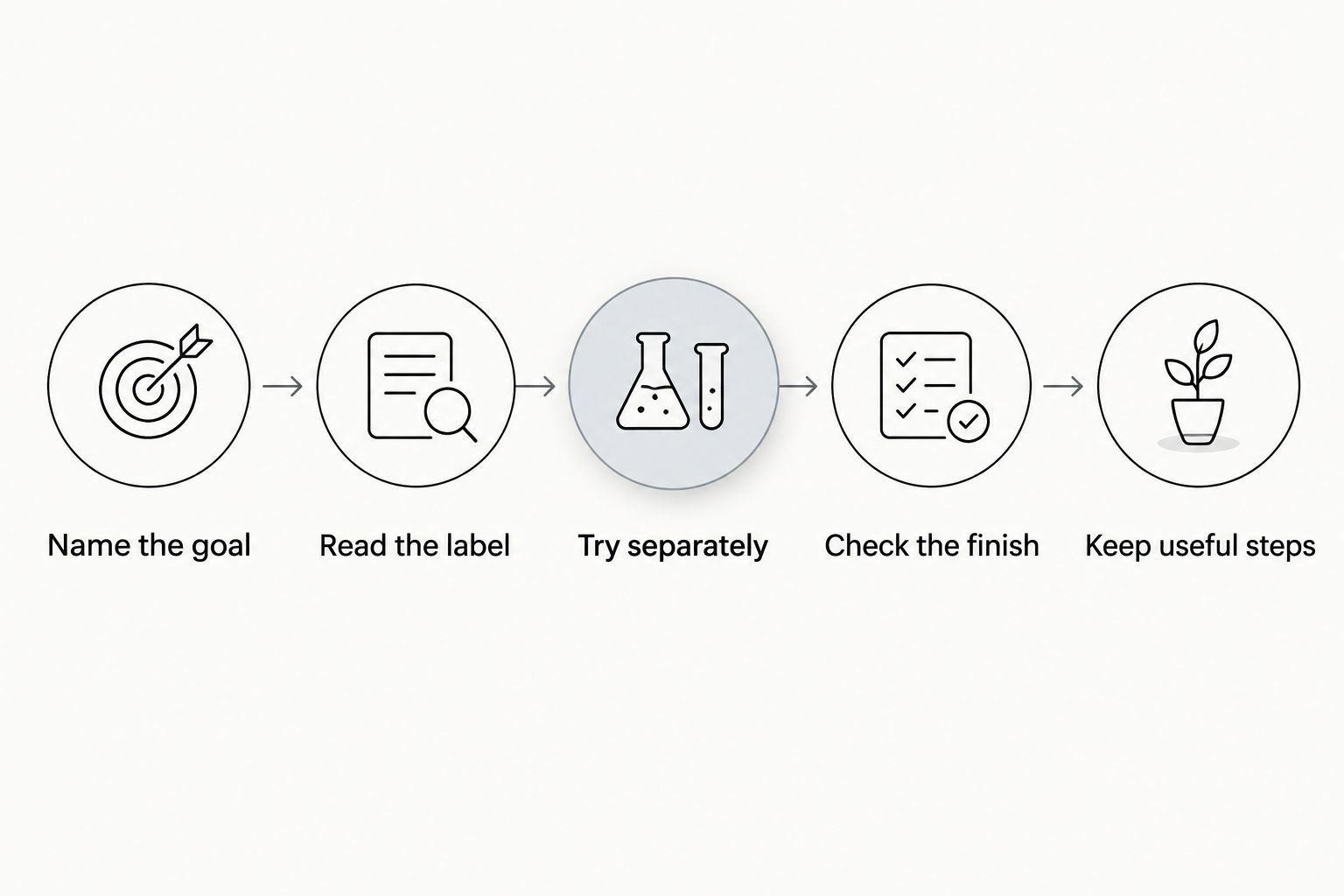
Use this sequence to decide whether your routine needs a face mist, setting spray, both, or neither. It works whether you wear a full face of makeup or only occasional complexion products.
- Name the goal. Decide whether you want a skincare step or a makeup-setting effect. If the goal is unclear, hold off on adding a product.
- Read the label. Check intended use, the complete ingredient list, directions, and warnings. Do not transfer claims from a similar-looking bottle.
- Try separately. Introduce a new formula on its own, following its directions. Stop if irritation develops; do not keep applying it to test whether discomfort disappears.
- Check the finish. When combining a mist with makeup, assess whether the layers remain even after drying. Look for separation, patchiness, or an unwanted change in finish.
- Keep useful steps. Keep the product if it performs a job you want without creating a new problem. You do not need both categories simply because both exist.
The most useful test is not whether the spray feels refreshing for a moment. It is whether the product delivers its intended role within the routine you actually use.
Where a hypochlorous acid mist fits
Gina Rivera is the founder behind Xoxo Gina HALO™. That founder story introduces the brand; the product’s documented formulation tells you how to assess the mist itself.
Xoxo Gina HALO™ Wellness Mist is a hypochlorous acid wellness mist in a 5 fl oz / 150 mL bottle, with a stated pH of 4.5. Its product description lists purified water and hypochlorous acid among its ingredients. Read the complete label for the full formulation and application directions.
Those details help you identify the product, but they do not establish a makeup-setting claim. Neither pH 4.5 nor the presence of hypochlorous acid demonstrates that a spray will hold foundation in place.
The practical advantage is a clearly identified wellness-mist category for shoppers considering that type of skincare step. The limitation is equally clear: it is not presented here as a dedicated setting spray, and the bottle size does not prove better skin results.
For your 2026 routine, evaluate the mist on its labeled use. Keep makeup-setting decisions separate rather than asking a skincare formula to perform an unclaimed function.
Can I spray face mist over makeup?
A face mist belongs over makeup only when its directions support that use and the combination works with your makeup. Being suitable for facial skin does not automatically establish compatibility with every foundation, concealer, or powder.
Read the directions first, then assess the combination before an occasion when you need a predictable finish. Follow the specified application method rather than soaking the face to make the product feel more effective.
Let the applied product settle before deciding what the finish needs. If the result becomes patchy, do not assume another layer will restore it. Return to the simpler combination that worked.
Do I need both face mist and setting spray?
You need both only if each performs a separate function you want. Someone who does not wear makeup has no makeup-setting task to solve, while someone satisfied with their existing skincare routine does not need a mist by default.
For a gym routine, separate skin care from makeup wear. A refreshing sensation after exercise does not prove cleansing, and a facial mist should not replace washing when washing is needed.
For parents shopping for a family, check each product’s intended users and warnings rather than treating a gentle-sounding description as permission for everyone to use it. Keep the routine specific to the person using it.
Can I pack either spray in my carry-on?
For US airport screening in 2026, the TSA’s standard carry-on liquids limit is 3.4 fl oz / 100 mL per container. Face mists and liquid setting sprays fall under the liquids rule; a larger bottle does not meet that standard simply because it is partly empty.
A 5 fl oz / 150 mL container exceeds that standard limit. Plan accordingly, check current TSA guidance before departure, and follow the product’s storage directions rather than assuming every formula is suitable for decanting.
Travel also changes what you need from a routine. If you are not wearing makeup during the journey, a setting step has no makeup to set. Pack for the function you will use, not every step you use at home.
FAQ
What's the difference between face mist and setting spray?
A face mist serves its labeled skincare or refreshing purpose, while a setting spray serves its stated makeup-setting purpose. Similar packaging does not make their formulas interchangeable.
Can I use face mist instead of setting spray?
Use a face mist instead of setting spray only if that specific formula is intended to set makeup. Otherwise, you are replacing a makeup-focused step with a different type of product.
Does setting spray replace moisturizer?
Setting spray does not automatically replace moisturizer. Choose skincare for your skin's needs and a setting product for its stated makeup function.
Is Xoxo Gina HALO™ Wellness Mist a setting spray?
Xoxo Gina HALO™ Wellness Mist is a hypochlorous acid wellness mist, not a dedicated makeup-setting product. Its stated pH of 4.5 does not establish makeup-hold performance.
Should sensitive skin avoid all setting sprays?
Sensitive skin does not require a blanket rule against every setting spray. Assess the specific ingredients and directions, introduce new products separately, and stop if irritation develops.
Can I use a hypochlorous acid face mist with foundation?
Follow the hypochlorous acid mist's directions and check how it works with your particular foundation. Do not assume facial use means the spray will preserve makeup or improve wear.
Can I bring a 150 mL face mist in my carry-on?
A 150 mL face mist exceeds the TSA's standard 100 mL per-container carry-on liquids limit. Check current screening guidance and plan your packing around the container size.
One last thing
The best replacement is sometimes no replacement at all. If you remove setting spray and still like your makeup, you have simplified your routine without needing a face mist to take its place.
Make that your final 2026 check: does this step solve a problem you actually have? Choose Xoxo Gina HALO™ for its wellness-mist category, not for an assumed makeup-setting benefit. Let each product keep its own job.