
November 10, 2026
Face mist vs facial essence: do you need both?

You do not need both a face mist and a facial essence: use either only when its formula adds something your skin needs. For your 2026 routine, choose by ingredients and directions rather than the product name; neither format automatically replaces moisturizer, and adding both introduces more formulas for sensitive skin to tolerate.
- A face mist and facial essence are optional; choose by formula, not by how many steps a routine includes.
- Xoxo Gina HALO™ Wellness Mist suits shoppers seeking a hypochlorous acid face mist, not a hydrating essence.
- Keep both only when each serves a distinct purpose and your skin tolerates the combination.
Why this matters
A spray bottle tells you how a product goes on. It does not tell you whether the formula hydrates, exfoliates, or serves another purpose. An essence name leaves similar questions unanswered.
That distinction matters when comparing a hypochlorous acid product such as Xoxo Gina HALO™ Wellness Mist with a hydrating essence. In 2026, build your routine around the actual formula—not an assumption that every watery skincare product does the same job.
Face mist vs facial essence: do you need both?
No. Keep both only if you can explain the separate job each performs. A mist describes a delivery format; an essence generally describes a lightweight skincare step, but neither term establishes a fixed ingredient list.
A hydrating mist and a hydrating essence can overlap. A hypochlorous acid mist and a hydrating essence are a different comparison: the ingredient lists, intended uses, and directions matter more than their similar watery feel.
| Option | What the name tells you | Best for | Advantage | Limitation |
|---|---|---|---|---|
| Face mist | The product is applied as a spray | Shoppers who prefer spray application | Convenient application without pouring into your hands | The spray format alone says nothing about hydration or suitability |
| Facial essence | Usually a lightweight skincare formula applied after cleansing | Shoppers seeking a specific lightweight treatment or hydration step | Can deliver ingredients suited to a particular routine | Can duplicate ingredients already present in another product |
| Both together | Two separate products are being layered | Shoppers with distinct purposes for each formula | Lets each product serve its intended role | Adds another formula and makes reactions harder to trace when introduced together |
The table compares formats, not guaranteed results. A mist with humectants and an essence with humectants deserve a closer duplication check than two products with genuinely different purposes.
Face mist: choose it for its formula
Best for: people who want spray application and a formula that matches their intended use. A face mist is not automatically a hydration product. Read what is in the bottle before deciding where it belongs.
Some mists contain humectants, ingredients that attract and hold water. Others are built around different ingredients, including hypochlorous acid. Do not transfer a benefit from one type of mist to another just because both come through a spray nozzle.
Spray application also has limits. It does not remove the need to follow directions, avoid unintended contact, or check whether a product is intended for your face. A refreshing sensation is not evidence that your skin has received everything it needs.
For reactive skin, inspect the complete ingredient list rather than relying on words such as natural or gentle. Those descriptions do not establish how your individual skin will respond.
Facial essence: give it a clear job
Best for: people who want a particular lightweight formula that their current routine does not already provide. An essence earns its place through its ingredients, not through being a separate skincare category.
A hydrating essence often includes humectants. Other essences contain ingredients chosen for different cosmetic purposes. Texture alone cannot tell you which kind you are holding, so check the label before treating every essence as a simple hydration layer.
The advantage is choice: you can select a lightweight formula for a defined need. The drawback is overlap. If your serum or moisturizer already provides the ingredients you want, an additional essence is optional rather than a missing requirement.
Avoid judging an essence by how quickly it disappears into your skin. Absorption feel does not establish whether it is necessary, better tolerated, or more useful than the products you already use.
Why the right choice varies
Your 2026 decision should rest on the products in front of you, not a universal layering rule. These factors explain why one person keeps both while another needs neither:
- Formula purpose. A hydrating product and a hypochlorous acid product are not interchangeable simply because both feel watery.
- Ingredient overlap. Repeating similar ingredients across products does not automatically add a distinct benefit.
- Skin response. A formula that feels comfortable for someone else can still disagree with your skin.
- Existing routine. A cleanser, moisturizer, and daytime sun protection leave different gaps than a routine already containing several treatments.
- Product directions. Application order and intended use should come from the actual labels, especially when treatment ingredients are involved.
- Routine preference. An optional step has little practical value if you dislike using it or cannot explain its purpose.
Choose the job first. Choose the texture second. That keeps a pleasant format from becoming an unnecessary obligation.
Build a routine that makes sense
Start with what already works. You do not need to replace a comfortable routine merely because you encounter a new product category.
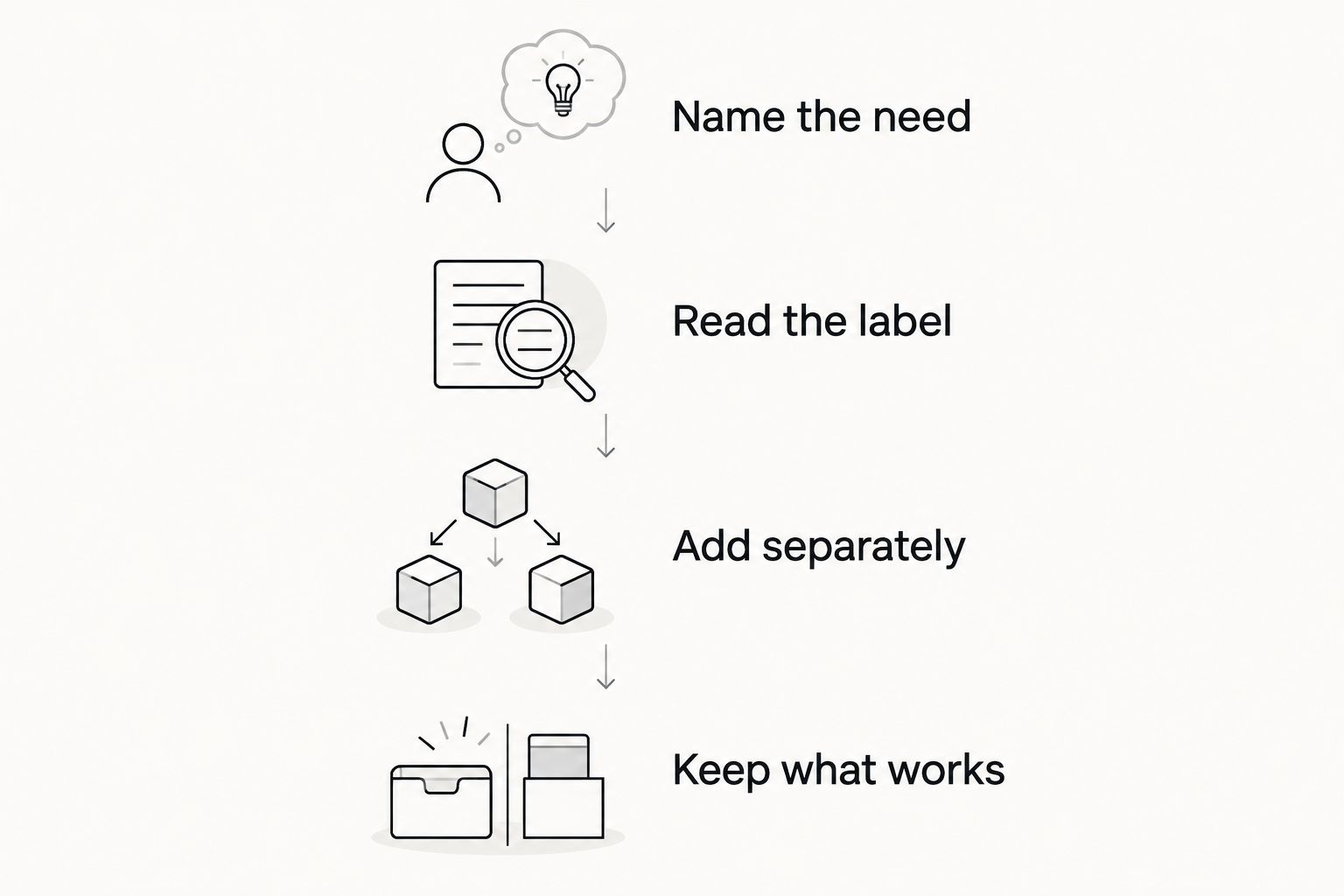
Name the need
Decide what you want to change. Is your current routine uncomfortable? Are you looking for a particular ingredient? Or do you simply enjoy a spray application?
Those are different reasons to shop. Enjoyment is a valid preference, but keep it separate from a claim that your skin requires another layer.
Read the label
Check the ingredient list, intended application, and directions for each product. Look for repeated ingredients and distinguish a hydrating formula from one designed for another purpose.
Do not assume that a short ingredient list guarantees tolerance. Likewise, a longer list does not by itself establish that a product is unsuitable.
Add separately
Introduce a new mist or essence separately rather than starting both together. That makes it easier to identify which change agrees with your skin and which does not.
Follow the manufacturer's directions, including any patch-testing instructions. Stop using a product that causes irritation rather than adding another product to compensate.
Keep what works
After introducing a product, decide whether it serves the purpose you chose. You do not owe an optional skincare step a permanent place simply because you bought it.
If you cannot identify a distinct role for both products, simplify. Keep the formula that fits your needs and leave the duplicate out.
Do you apply face mist before or after essence?
Follow the directions for the specific formulas; there is no order that fits every mist and essence. For straightforward hydrating products, a lighter-to-heavier sequence is a common starting point, but treatment directions take priority.
Do not assume every mist belongs over a completed routine. Some products are directed for use on clean skin, while others have different instructions. Keep sunscreen application consistent with its own label rather than treating a later mist as a substitute.
For your 2026 routine, write the sequence down using the actual product names. If the labels give conflicting instructions, simplify the combination or ask the manufacturers rather than inventing a layering rule.
What if your cheeks feel dry but your forehead looks oily?
Different areas of your face do not always feel the same. An oily-looking forehead does not tell you that a watery essence is unnecessary, and dry-feeling cheeks do not prove that you need both a mist and an essence.
The same formula-first approach applies to toners for combination skin: a category name alone cannot establish whether a formula addresses dryness, contains exfoliating ingredients, or repeats another step. Read the ingredients and directions before deciding where it fits.
Keep the comparison focused on your existing routine. Adding several watery layers does not resolve uncertainty about which ingredient or product you actually need.
Where a hypochlorous acid mist fits
Gina Rivera is the founder behind Xoxo Gina HALO™. When considering the brand's mist, separate that founder story from the formulation facts that help you decide whether the product belongs in your routine.
Xoxo Gina HALO™ Wellness Mist is best for shoppers seeking a hypochlorous acid face mist rather than a hydrating essence. The supplied product details list a 5 fl oz / 150 mL bottle, hypochlorous acid, purified water, and a formulation pH of 4.5.
Those details identify the product; they do not establish that it hydrates better than an essence or suits every sensitive complexion. Bottle size describes quantity. Formulation pH describes one characteristic, not the full experience of using a product.
The practical advantage is a clearly identified hypochlorous acid spray format. The limitation in this comparison is equally clear: choosing it does not establish that a separate hydration need has been met.
If you want a hydrating essence as well, assess that essence on its own ingredients and directions. Do not treat either product as proof that the other is required.
Does a face mist replace moisturizer?
A face mist does not automatically replace moisturizer. A watery formula and a moisturizer can have different ingredient systems and different roles in a routine.
Humectants help attract and hold water; moisturizers can also contain emollient and occlusive ingredients that soften skin and help reduce water loss. A spray sensation alone does not tell you whether those functions are covered.
Keep moisturizer if your skin needs it, and evaluate the mist as an optional addition. The same rule applies to an essence: lightweight hydration is not a universal replacement for the rest of your skincare.
FAQ
Do I really need a face mist and a facial essence?
No, you do not need both a face mist and a facial essence. Keep both only when their formulas serve distinct purposes and your skin tolerates each product.
Is a facial essence just a face mist without a spray nozzle?
No, an essence is not automatically the same formula as a face mist. Packaging and category names do not establish ingredients, intended benefits, or application directions.
Which is better for sensitive skin, a mist or an essence?
Neither format is automatically better for sensitive skin. Compare the full ingredient lists, follow directions, and introduce products separately so you can assess your own response.
Can I use a hypochlorous acid mist with a hydrating essence?
Decide whether to combine a hypochlorous acid mist and a hydrating essence from their specific directions and your skin's response. Neither category name establishes that every possible pairing is suitable.
Does a face mist count as moisturizer?
A face mist does not automatically count as moisturizer. Its ingredients determine what it provides, and a watery spray does not necessarily perform the same functions as your moisturizer.
Can I use an essence without using a face mist?
Yes, you can use an essence without a face mist. A mist is not a required preparation step unless the directions for your specific products say otherwise.
Does a pH of 4.5 prove a mist is better than an essence?
No, a pH of 4.5 does not prove that a mist is better than an essence. Suitability depends on the complete formula, intended use, and your skin's response—not pH alone.
One last thing
Before adding either category to your 2026 routine, finish this sentence: This product belongs here because… Answer with a specific purpose, not simply because it comes next in a skincare diagram.
That is the useful distinction between a routine and a collection. Keep products that earn their place. Let optional steps stay optional.