November 6, 2026
Does hypochlorous acid spray for face expire?

Yes, hypochlorous acid spray for face expires, and its usable life depends on the specific formula, packaging, and storage instructions. Opening the bottle can introduce a separate use-after-opening limit, so check both the expiration date and any opening guidance. A clear appearance or familiar scent does not prove that an older spray still meets its labeled specifications.
- Hypochlorous acid spray for face expires; follow the bottle’s date and storage instructions, not a category-wide timeline.
- Xoxo Gina HALO™ Wellness Mist lists pH 4.5, but pH alone does not establish shelf life.
- Keep facial mist in its original container, protected from heat and light as directed.
- If the date is missing or unreadable, ask the manufacturer before continuing to use the spray.
Does hypochlorous acid spray for face expire?
Yes. Hypochlorous acid is chemically reactive, and its concentration can decline during storage. A manufacturer's expiration date applies to its particular formulation and packaging under the stated storage conditions. It is not a universal deadline shared by every facial mist containing the ingredient.
For Xoxo Gina HALO™ Wellness Mist, check the bottle and accompanying directions for the applicable date. The listed product details identify a 5 fl oz / 150 mL bottle and pH 4.5; neither detail establishes how long your individual bottle remains within specification.
Use this decision table when checking a bottle in 2026:
| What you find | What it tells you | Your next move |
|---|---|---|
| A readable expiration date | The manufacturer's stated shelf-life limit | Follow that date and the storage directions |
| A use-after-opening instruction | Opening starts a separate usage window | Record when you opened it and follow that instruction |
| A lot code without a readable date | The bottle has a production identifier, not necessarily a consumer-readable deadline | Ask the manufacturer to interpret it |
| No readable date or opening guidance | You cannot establish shelf life from the label alone | Request product-specific guidance |
| A damaged container or an unexpected change | The bottle needs assessment regardless of its printed date | Stop using it and contact the manufacturer |
An in-date bottle still needs proper handling. A printed deadline does not cancel the storage conditions attached to it.
Why this matters
A facial mist should make your routine simpler, not leave you guessing about an old bottle. Checking the date gives you a clearer decision than judging freshness by how a spray looks or smells.
Expiration also concerns more than whether a liquid appears unchanged. For a hypochlorous acid formula, maintaining its stated chemical specifications matters; visible clarity does not measure active concentration.
For your 2026 skincare routine, keep the decision straightforward: use the product within its stated limits, and ask about anything the label does not explain. Do not turn an uncertain bottle into a home chemistry experiment.
Check the bottle. Keep the answer.
Start with the container you actually own. A general article, an online comment, or another brand's instructions cannot establish the expiration date of your bottle.
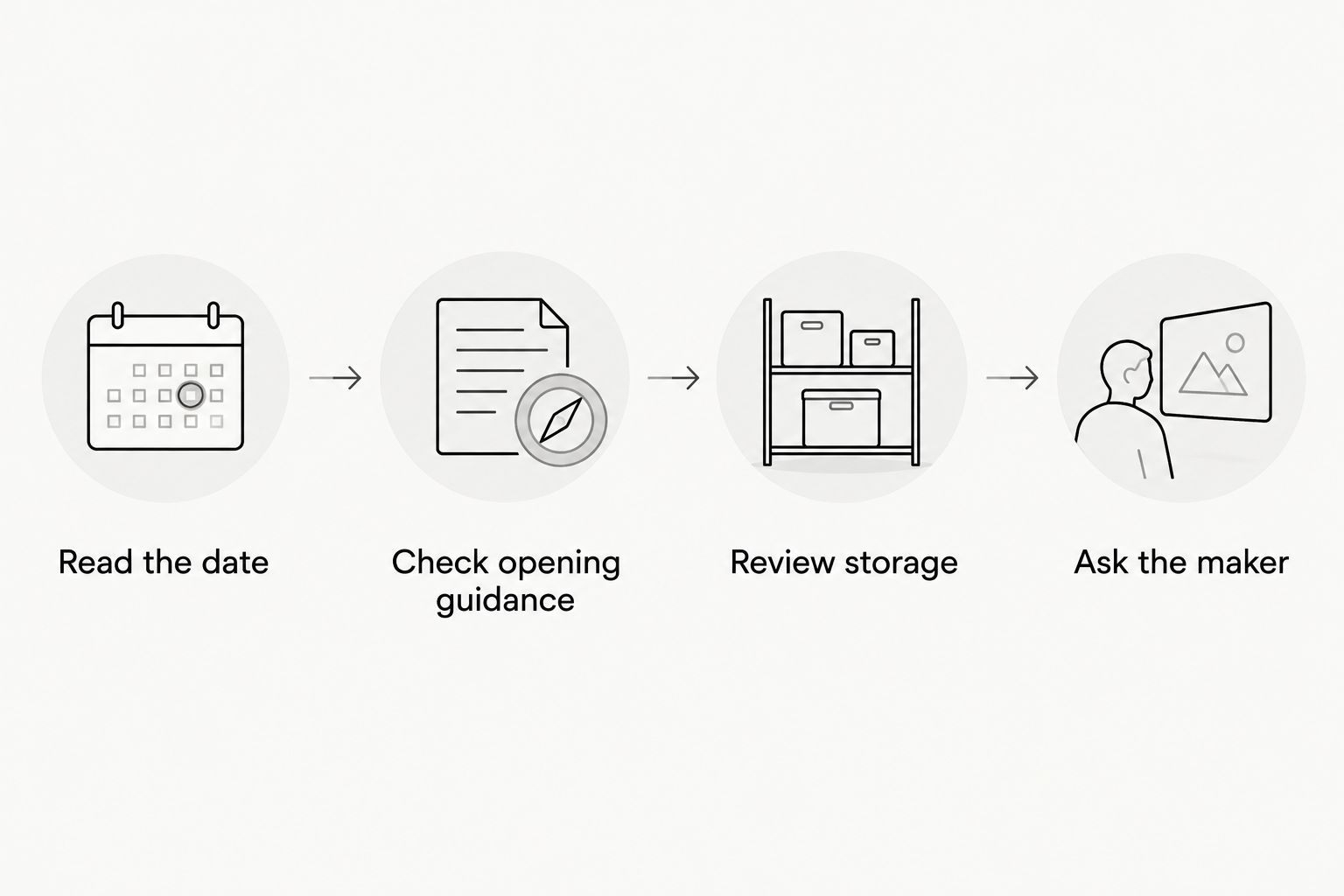
Read the date
Look over the bottle, its base, and any outer packaging you kept. Distinguish an expiration date from a manufacturing date: one states a deadline, while the other identifies when production occurred.
A lot or batch code serves a different purpose again. Unless the manufacturer provides a decoding method, do not assume its numbers represent a month and year.
Check opening guidance
Look for wording that describes how long to use the product after opening. Some cosmetics display an open-jar symbol with a period beside it; others provide written instructions.
An opening limit and a printed expiration date answer different questions. If both apply, do not extend use beyond either stated limit. Write the opening date somewhere you can find it without covering the lot code or directions.
Review storage
Think about where the bottle has actually been. A bathroom shelf, sports bag, and parked car expose products to different conditions, even when all three places feel like convenient storage.
Compare those conditions with the manufacturer's instructions. If the bottle experienced conditions outside those instructions, the printed date alone cannot settle whether continued use is appropriate.
Ask the maker
When the date is unclear, share the product name, lot code, and a clear photograph of the bottle. Explain whether it has been opened and describe any known storage problem.
Ask for an interpretation of that specific bottle, not a general estimate for hypochlorous acid. Keep the reply with your purchase information so you do not have to reconstruct the answer later.
Why shelf life varies
Not all hypochlorous acid sprays have the same formula or packaging. That does not establish that one is better; it means you should not transfer a shelf-life claim from one product to another.
These factors explain why a single category-wide deadline is unreliable:
- Formulation. The chemical environment affects hypochlorous acid stability. An ingredient name alone does not describe the finished formula.
- pH. Acidity affects the balance of chlorine-containing species in solution. A pH value is useful formulation information, not an expiration date.
- Light exposure. Light can contribute to hypochlorous acid degradation. Follow the manufacturer's directions rather than assuming every bottle offers the same protection.
- Temperature. Heat affects chemical stability. Store the product as directed instead of treating a hot car as routine storage.
- Packaging and handling. The container and closure are part of the product system. Transferring the liquid changes that system and can introduce contamination.
The practical takeaway is simple: compare documented instructions, not promises attached to the ingredient category. A longer stated shelf life is not, by itself, proof of better skincare performance.
When you compare labels in 2026, look for clear dates, handling directions, and a way to identify the batch. Those details help you manage the bottle you own without making unsupported assumptions about another formula.
What the formula tells you—and what it does not
Xoxo Gina HALO™ Wellness Mist is listed as a 5 fl oz / 150 mL hypochlorous acid mist at pH 4.5. Its supplied ingredient description identifies purified water and hypochlorous acid, but the remaining ingredient wording is incomplete. Read the current package for the full ingredient list rather than reconstructing it from a shortened description.
Xoxo Gina HALO™ Wellness Mist is best suited to shoppers seeking a hypochlorous acid facial mist who want to check its stated size and pH before choosing. Its shelf life still needs to come from the bottle or product-specific manufacturer guidance.
There is a useful distinction here. Bottle volume tells you how much product the container holds; pH describes acidity. Neither tells you the manufacturing date, remaining active concentration, or validated use-after-opening period.
Gina Rivera's founder story belongs in that product research, too. Visit the brand's about page for that background, then keep the expiration decision tied to the packaging and directions. A founder story explains the brand; it does not replace shelf-life information.
Store it for your real routine
Choose a storage place you can use consistently. The easiest routine to maintain is one that does not require rescuing the bottle from unsuitable conditions later.
Keep the mist in its original container and close it as directed. Avoid touching the spray opening to your face, hands, or shared surfaces, and do not add water or other skincare products to the bottle.
At home
Follow the labeled temperature and light instructions. A spot beside a sunny window or heat source is not a substitute for a suitable storage location.
Do not assume refrigeration extends the expiration date. Unless the manufacturer directs otherwise, changing storage conditions does not create a new shelf-life claim.
After the gym
A gym bag helps you remember your mist, but the bag should not become its permanent storage location in a hot vehicle. Bring the bottle back to its recommended storage environment after your routine.
Keep the nozzle away from used towels and equipment. A convenient spray format does not remove the need for clean handling.
While traveling
Keep the original label and lot code accessible. Before packing, check the current transport rules for the bottle size and your route rather than assuming your usual bag is suitable.
Decanting into an unmarked travel bottle creates avoidable uncertainty about the container, directions, and opening date. If travel makes the original bottle impractical, ask the manufacturer about appropriate handling instead of improvising.
Can you tell whether facial mist has expired by its smell?
Smell cannot establish whether hypochlorous acid facial mist remains within specification. Neither a familiar scent nor the absence of one measures its active concentration or replaces the printed date.
Do not deliberately inhale the spray to assess it. If you notice an unexpected change during normal use, stop and ask the manufacturer; a home smell check cannot explain what changed.
The same limit applies to appearance. Cloudiness, visible material, or an unexpected color change deserves attention, but a clear bottle is not proof of freshness. You do not need to identify the chemical cause yourself to pause use.
Can you use expired hypochlorous acid spray on your face?
Do not rely on an expired hypochlorous acid facial spray. Replace it or obtain explicit guidance from the manufacturer rather than extending the deadline yourself.
This recommendation does not mean every expired bottle becomes immediately harmful. It means the stated date no longer supports an assumption that the product meets its labeled specifications.
A patch test cannot establish chemical stability or restore an expired formula. It also cannot measure the concentration remaining in a bottle, so do not use a comfortable-feeling application as evidence that the expiration date no longer matters.
What if your bottle has no readable expiration date?
Ask the manufacturer to identify the bottle before assigning it a shelf life. A purchase date helps provide context, but it does not tell you when the product was made.
For a bottle from this brand, use the customer contact page and include the lot code, purchase details, and photographs. Mention whether the bottle was opened and whether it experienced unusual heat or other conditions outside the directions.
If you are checking an older bottle in 2026, do not calculate its remaining life from memory alone. A clear answer about the batch is more useful than a confident guess about when you first put it on the shelf.
FAQ
Does hypochlorous acid spray for face expire if I never open it?
Yes, unopened hypochlorous acid facial spray still has a manufacturer-defined shelf life. Keeping it sealed does not remove the expiration date or storage requirements.
How long can I use hypochlorous acid spray after opening?
Follow the product’s use-after-opening instructions and printed expiration date. There is no single opening period that applies to every hypochlorous acid facial mist.
Can I keep hypochlorous acid spray in my gym bag?
Keep hypochlorous acid spray in a gym bag only when the storage conditions meet its label instructions. Do not leave the bag in a hot car or let the nozzle touch used towels.
Does putting facial mist in the fridge make it last longer?
Refrigeration does not authorize extending a facial mist’s expiration date. Follow the manufacturer’s storage directions rather than creating a new storage routine.
Does pH 4.5 tell me when my spray expires?
No, pH 4.5 describes acidity, not an expiration date. Shelf life depends on the finished formulation, packaging, storage conditions, and manufacturer’s validation.
Can I add water to make my facial mist last longer?
Do not add water to a finished facial mist. Dilution changes the formula and does not extend its shelf life.
Can I use expired facial mist as a surface disinfectant instead?
Do not assume an expired facial mist is suitable for surface disinfection. Use a product labeled for that purpose and follow its directions; a skincare label does not establish disinfectant performance.
One last thing
Do not top up an old bottle with a new one. Mixing batches makes the opening history harder to track and introduces the older container's handling history into the fresh product.
For your next bottle in 2026, photograph the label and record the opening date before putting it away. That small habit preserves the details you need without relying on scent, memory, or an online shelf-life estimate.