
November 4, 2026
Can you use hypochlorous acid spray over makeup?

You can use a hypochlorous acid spray over makeup if the product is intended for facial use and its directions allow that application. Makeup compatibility is a separate question: a wet mist can disturb your finish, so test the combination before spraying your whole face. For the most predictable makeup application, use your facial mist before makeup rather than treating it as a setting spray.
- A hypochlorous acid spray for face is not automatically a makeup-setting spray; follow the specific product’s directions.
- Xoxo Gina HALO™ Wellness Mist is a facial-mist option, not an established makeup-setting product.
- Before makeup is the simpler placement when you want to avoid wetting your finished base.
- Over makeup, test a small area and let it dry without rubbing.
Why this matters
Your skin and your makeup have different needs. A mist belongs in your routine because its intended use suits you—not because every spray bottle performs the same job.
For your 2026 routine, separate the skincare decision from the makeup decision. Choose a facial product for its directions and formulation; judge makeup compatibility by what happens to your actual makeup. Neither the ingredient name nor a product’s popularity answers both questions.
Xoxo Gina HALO™ Wellness Mist comes in a 5 fl oz / 150 mL bottle, with a stated formulation pH of 4.5. Those details describe the product; they do not establish that it preserves foundation, extends makeup wear, or works with every cosmetic formula.
Can you use hypochlorous acid spray over makeup?
Yes, provided the facial spray’s directions permit that use. The practical limitation is the makeup layer: adding liquid after foundation, concealer, or powder introduces a chance of visible changes to the finish.
Before makeup is the simpler default; over makeup requires a compatibility check. That distinction matters more than a universal promise that a mist will leave every look untouched.
| Placement | Best for | Main advantage | Main limitation |
|---|---|---|---|
| Before makeup | A straightforward skincare-to-makeup routine | You avoid spraying liquid onto a finished look | You still need to let the skin surface dry before applying makeup |
| Over makeup | A label-permitted application when makeup is already on | You do not need to remove makeup just to test cosmetic compatibility | The mist can change the appearance of the finished layers |
A facial mist and a toner also have different roles depending on their formulas and directions. The guide to face mist vs. toner explains why the name on the bottle is not enough to determine its place in your routine.
Check the product before checking the finish
Look for directions that identify facial use. Do not assume a surface-use spray belongs on your face simply because it contains hypochlorous acid, and do not extend facial directions to the eyes or mouth.
Then check any instructions about application, storage, and handling. A product sold for several purposes still needs directions appropriate to the way you intend to use it.
Before makeup: keep the order simple
Applying a suitable facial mist before makeup keeps the routine easier to assess. You can see how your skin responds without also trying to work out whether the mist changed your foundation.
Use this sequence for a straightforward 2026 routine:
- Read directions. Confirm that the product is intended for your planned facial application.
- Apply as directed. Use the label’s method rather than adding extra sprays for an assumed extra benefit.
- Let dry. Wait until the skin surface is dry instead of following an invented universal timer.
- Apply makeup. Continue with the rest of your routine according to each product’s directions.
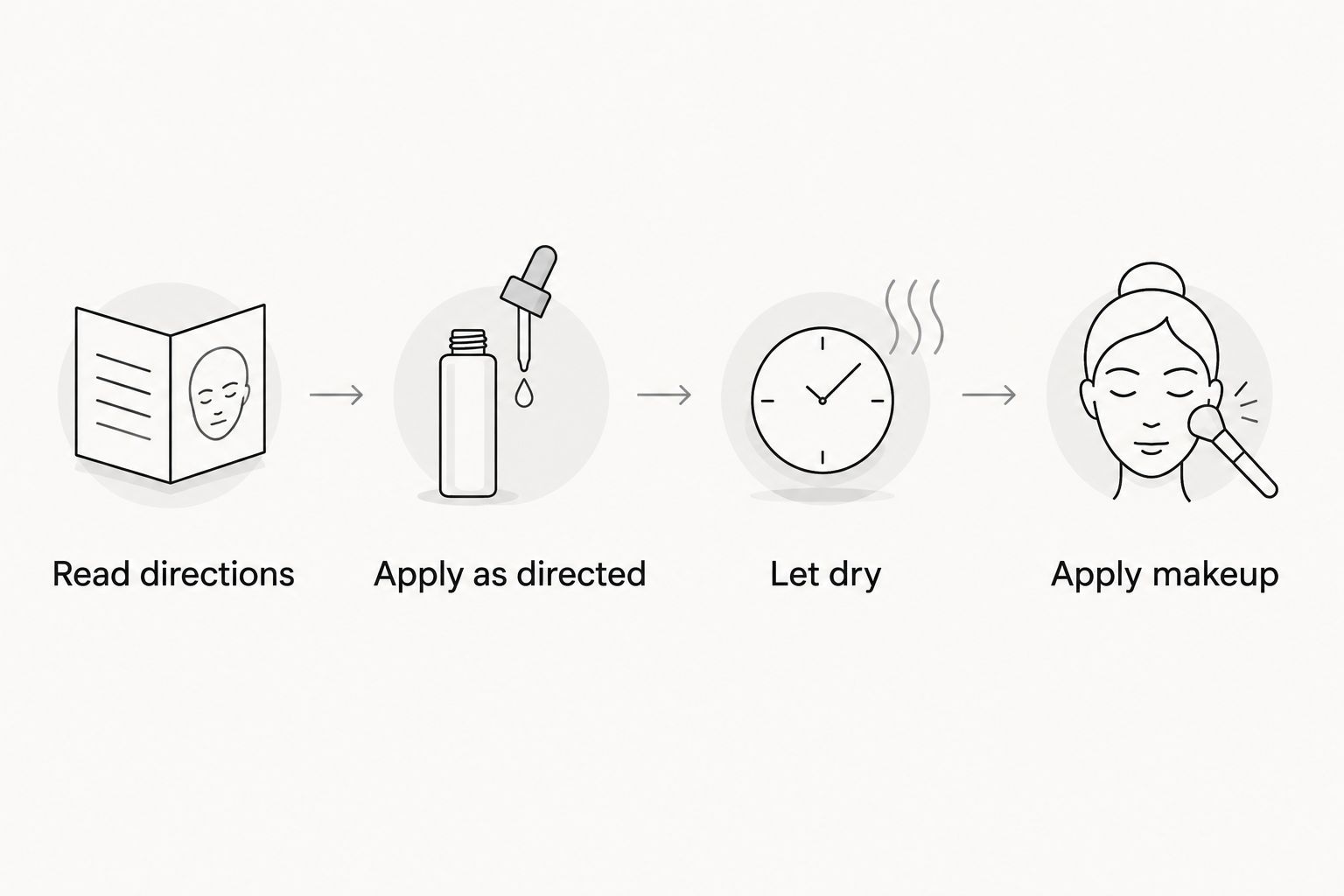
Dryness is the useful checkpoint here. There is no single waiting time that applies to every mist, amount applied, environment, and makeup formula.
This order also gives you a clearer baseline. If your usual makeup applies normally after the mist has dried, you have learned something about that combination without testing it on a completed look.
Over makeup: test the finish first
If the product’s directions permit your intended use, test cosmetic compatibility when you have time to adjust your makeup. Right before leaving for an event is not the moment to try a new combination.
Start with a small, discreet area of your finished makeup, using the product as directed. Let it dry without rubbing, then compare the area with the surrounding makeup in consistent light.
Look for changes you can actually see:
- Spotting: visible marks where droplets landed.
- Uneven coverage: areas that look thinner or less uniform.
- Texture changes: powder or foundation that looks different after drying.
- Transfer: makeup moving when you touch or blot the area afterward.
These are cosmetic observations, not a skin-safety test. A finish that looks unchanged does not prove the product suits your skin, and a changed finish does not establish that the product is poorly formulated.
If the result is not what you want, move the mist to your pre-makeup routine. You do not need to force an over-makeup step into a routine that already works.
Why results vary over makeup
The same facial mist does not answer every makeup question. What you apply underneath it—and what you do immediately afterward—also affects the result.
For an over-makeup trial in 2026, pay attention to these practical variables:
- Product directions. Intended use comes first; a successful-looking trial does not replace the label.
- Makeup formula. A result with one foundation does not establish compatibility with another.
- Existing layers. Your finished look includes the products beneath and above your foundation, not foundation alone.
- Amount applied. Follow the directions rather than assuming a wetter application is better.
- Rubbing or blotting. Physical contact can move makeup, making the result harder to interpret.
- Drying conditions. Judge the finish after drying, not while droplets are still visible.
Change one part of the routine at a time. If you switch foundation, primer, and mist together, you lose the ability to identify which change produced the result.
A useful personal test answers a narrow question: does this application leave this makeup looking the way you want? It does not prove a broad claim about every hypochlorous acid spray.
Does hypochlorous acid spray work as a setting spray?
A hypochlorous acid facial spray is not automatically a setting spray. Do not expect makeup hold or longer wear unless the specific product makes and supports that claim.
A spray can leave your makeup looking acceptable after application without doing anything to set it. Those are different outcomes, and keeping them separate helps you avoid buying one product for another product’s job.
For your 2026 makeup bag, assign each product a clear purpose. Choose your facial mist for its stated facial use, and assess any makeup-setting product by its own directions and supported claims.
Should you spray before or after sunscreen?
Follow your sunscreen’s application and reapplication directions rather than building a universal order around the mist. A hypochlorous acid spray does not replace sunscreen, and spraying over makeup does not count as sunscreen reapplication.
When prepping skin for makeup, keep sunscreen instructions separate from decisions about mist placement. A foundation finish you like is not evidence that you have followed those instructions correctly.
If adding a mist makes your morning sequence confusing, use the mist at another label-permitted point in your routine. Simplicity is useful when it helps you follow directions consistently, not when it encourages you to skip them.
Is an over-makeup mist necessary after the gym?
No, an over-makeup mist is not a required step after exercise. Decide whether you want to keep your makeup on or remove it and return to your usual cleansing routine.
If you keep your makeup on, do not assume a mist removes sweat, makeup, or sunscreen. Spraying and cleansing are different actions; one does not become the other because the bottle feels convenient in a gym bag.
If you remove your makeup, follow your normal cleansing routine and use a facial mist only as directed. That gives you a simpler way to assess the product than repeatedly spraying over layers you intend to wash off anyway.
For sports days or travel, make the decision before packing: is this bottle part of your skincare routine, or are you expecting it to rescue your makeup? The second expectation needs product-specific evidence, not a category-wide assumption.
Where Xoxo Gina HALO™ Wellness Mist fits
Xoxo Gina HALO™ Wellness Mist is best for shoppers seeking a hypochlorous acid facial mist, rather than a makeup-setting product. Its documented size is 5 fl oz / 150 mL, and its stated formulation pH is 4.5.
The product information lists purified water and hypochlorous acid within a three-ingredient formulation. A short ingredient list gives you fewer entries to review, but ingredient count alone does not establish skin compatibility, makeup compatibility, or better performance.
The practical advantage is a clearly identified mist you can evaluate for your own routine. The limitation is equally clear: the supplied product details do not establish makeup-setting performance or unchanged wear over foundation.
Treat pH as a formulation detail, not a promise. A stated pH of 4.5 does not, by itself, tell you how a spray will interact with your concealer, powder, or sunscreen.
Keep sensitive-skin decisions separate
A makeup test and a skin-tolerance decision answer different questions. The first asks whether the finish changes; the second asks whether the product suits your skin.
Introduce a new facial product according to its directions, without changing the rest of your routine at the same time. If irritation occurs, stop using it; persistent or concerning symptoms belong with a qualified healthcare professional.
For a family routine, check the directions for each intended user rather than assuming your own use establishes suitability for a child. Likewise, facial-use directions do not automatically establish suitability for every body area or every application method.
Keep these boundaries in your 2026 routine even when a product feels simple. Familiar ingredients and reassuring language are not substitutes for instructions.
FAQ
Can I use hypochlorous acid spray for face over foundation?
You can use a facial hypochlorous acid spray over foundation if its directions permit that application, but makeup compatibility is not automatic. Test a small area and assess the finish after it dries.
Will hypochlorous acid spray ruin my makeup?
A wet mist can change your makeup finish, but the result depends on the specific spray and makeup combination. Test before using it over a look you need to keep intact.
Should I use hypochlorous acid spray before or after makeup?
Before makeup is the simpler default because you avoid wetting a finished look. Follow the spray’s directions and let the skin surface dry before applying makeup.
How long should I wait before applying makeup after a facial mist?
Wait until the skin surface is dry, unless the product’s directions specify otherwise. There is no universal waiting time that applies to every facial mist and application.
Can hypochlorous acid spray replace my setting spray?
A hypochlorous acid spray should not replace a setting spray unless the specific product supports that use. Facial skincare use does not establish makeup hold or longer wear.
Does hypochlorous acid spray remove makeup after a workout?
Do not treat a hypochlorous acid mist as makeup removal unless the product specifically supports that use. Follow your usual cleansing routine when you want to remove makeup.
One last thing
The best test is a repeatable routine, not a heavier spray. Keep your makeup combination consistent, follow the mist’s directions, and judge the finish only after it dries.
If over-makeup application adds uncertainty, move the mist before makeup. A routine does not need another step just because a bottle fits in your bag.