
November 23, 2026
Can you use hypochlorous acid spray on sunburned skin?

Do not use hypochlorous acid spray on sunburned skin unless the product’s directions cover that use or a healthcare professional recommends it. It is not an established sunburn treatment and does not replace cooling, moisturizing, sun protection, or medical assessment when symptoms are severe.
- Hypochlorous acid spray on sunburned skin is not a substitute for established sunburn care.
- The American Academy of Dermatology recommends cool baths or showers and moisturizer for sunburn discomfort.
- A face-and-body label does not automatically establish suitability for sunburned or blistered skin.
- Leave blisters intact, avoid more sun, and get medical advice for severe symptoms.
Can you use hypochlorous acid spray on sunburned skin?
Do not assume that a skincare spray belongs on a sunburn simply because you normally use it on your face. Sunburn changes the decision: you are choosing care for injured skin, not adding a step to your usual routine.
For your 2026 sun-care routine, separate an everyday mist’s intended use from claims about treating a burn. The American Academy of Dermatology’s public sunburn guidance recommends cooling the skin, moisturizing, drinking extra water, and protecting the affected area from further sun exposure. Hypochlorous acid spray is not a standard step in that guidance.
If a label leaves you uncertain, ask about the product’s intended use before applying it. For advice about your burn itself, speak with a healthcare professional rather than relying on a product description.
| Care option | Best for | What it contributes | Limit to remember |
|---|---|---|---|
| Cool shower or damp compress | Initial comfort | Helps cool uncomfortable skin | Avoid ice directly on the burn |
| Moisturizer | Dry, intact sunburned skin | Helps address dryness after cooling | Choose a formula your skin tolerates; stop if it irritates |
| Hypochlorous acid skincare spray | Its labeled skincare uses | Offers only the uses supported by its own directions | Do not assume it treats sunburn or is suitable for blisters |
These options are not interchangeable. A mist is not a replacement for the basic care steps, and none of them makes further sun exposure harmless.
Why this matters
A familiar bottle can feel like an easy answer when your skin feels hot or tight. But a pleasant misting sensation is not evidence that a product repairs sun damage or shortens recovery.
That distinction matters for sensitive-skin shoppers. A product you tolerate during an ordinary week is not automatically appropriate when your skin is already irritated. Keep the routine simple rather than testing several new products at once.
Choose care by the condition of your skin, not by the appeal of an ingredient. Intact, mildly uncomfortable skin calls for a different decision from blistering, broken skin, or symptoms that affect your whole body.
What should you do for sunburn instead?
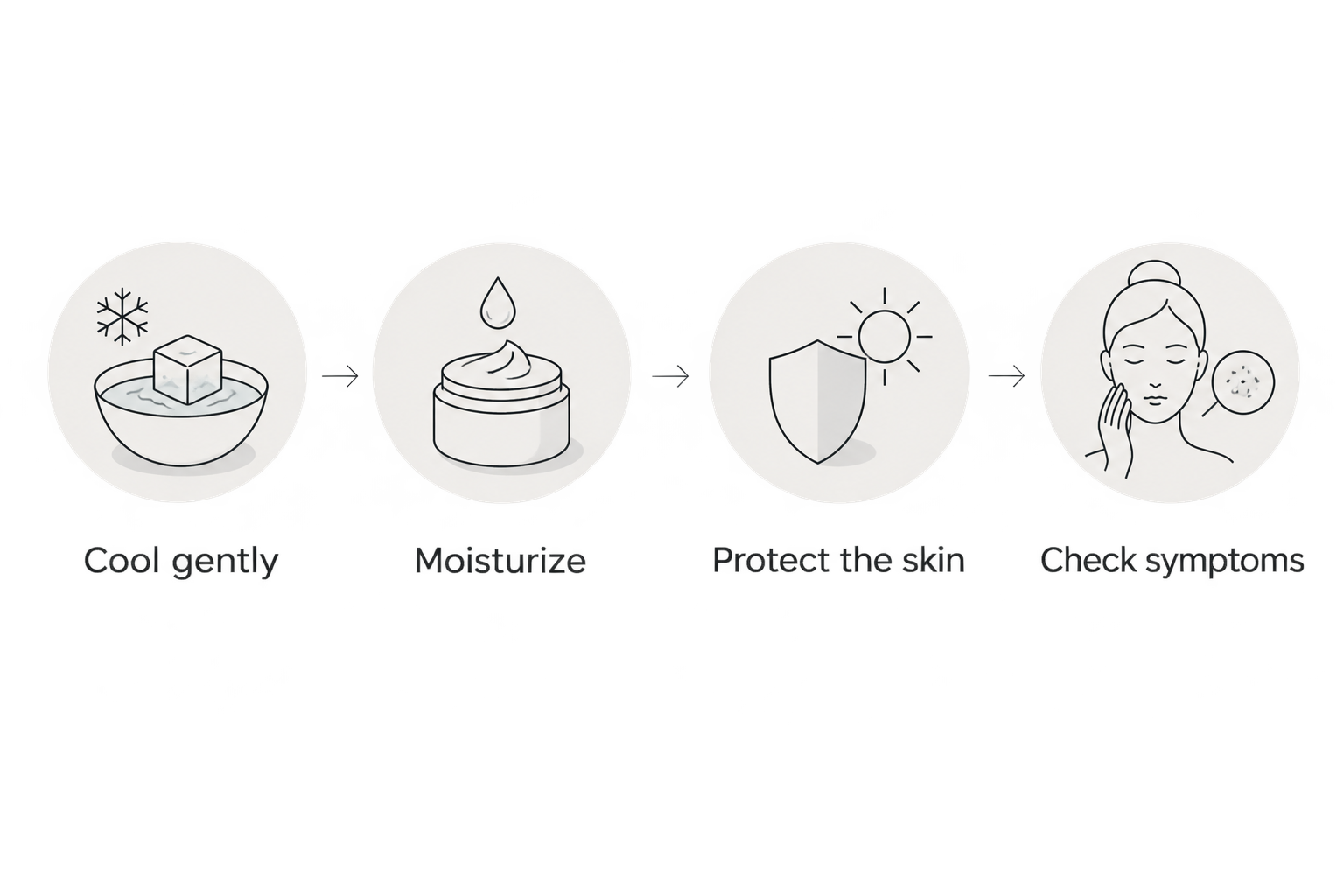
The following 2026 checklist reflects the American Academy of Dermatology’s public advice for everyday sunburn care. It is a comfort-care routine, not a promise to reverse ultraviolet damage.
Cool gently
Move out of the sun and take a cool bath or shower, or use a cool, damp cloth. Keep ice off the affected area; direct ice contact can injure skin.
After bathing, pat yourself mostly dry rather than rubbing. Leave a little moisture on the skin before applying moisturizer. If touching the area is very painful, do not keep experimenting with products to find something that feels better.
Moisturize
Apply a moisturizer you tolerate to help with dryness. The American Academy of Dermatology specifically mentions moisturizers containing aloe vera or soy for soothing sunburned skin.
That recommendation does not mean every aloe-containing product suits every person. Read the whole ingredient list, especially if you already know that fragrance or another ingredient bothers your skin. Stop using a product that increases stinging, redness, or discomfort.
Protect the skin
Keep the sunburned area out of direct sun while it recovers. Loose clothing can provide coverage without the rubbing that tight straps, waistbands, or workout gear create.
Do not mistake a skincare mist for sunscreen. When you return to your normal outdoor routine, follow established sun-protection advice, including protective clothing, shade, and sunscreen used according to its directions.
Check symptoms
Drink extra water, as the American Academy of Dermatology recommends after sunburn. Pay attention to how you feel overall, not just how red the skin looks.
Seek medical advice for extensive blistering, severe pain, signs of dehydration, or symptoms such as fever, chills, dizziness, or nausea. Confusion or fainting after heat exposure needs urgent assessment. A spray is not the next step when the concern extends beyond skin discomfort.
Why suitability varies
There is no useful blanket answer for every bottle sold as an HOCl spray. The ingredient name alone does not tell you what the finished product is intended to do or where its directions permit application.
Use these factors to make your decision:
- Intended use. A product labeled for surfaces is not automatically a skincare product. Do not transfer surface-cleaning directions to your face or body.
- Skin condition. Intact redness is different from open blisters or broken skin. Do not assume directions for ordinary skincare cover either situation.
- Complete formula. Check every listed ingredient, not just hypochlorous acid. Your own known sensitivities still matter.
- Product directions. Application instructions, warnings, storage guidance, and expiry information belong to that specific formulation.
- Your symptoms. Severe pain, widespread blistering, or feeling unwell changes the priority from product selection to medical advice.
- Who needs care. Babies and young children need particular caution. Ask a pediatric healthcare professional rather than adapting an adult skincare routine.
Bottle size, ingredient count, and pH do not establish sunburn suitability. They describe aspects of a product, but they are not clinical evidence that it treats a burn.
Can you spray it on sunburn blisters?
Do not spray an everyday skincare product onto sunburn blisters unless a healthcare professional directs you to use that specific product. Leave blisters intact and avoid picking, peeling, or deliberately draining them.
The American Academy of Dermatology advises allowing blisters to heal and protecting the area. If a blister opens, get guidance on appropriate wound care rather than treating an ordinary face mist as a wound-care product.
Watch for worsening pain, spreading redness, pus, or other concerning changes. These are reasons to seek medical advice, not reasons to apply more spray.
Does hypochlorous acid spray replace sunscreen?
Hypochlorous acid spray does not replace sunscreen. An HOCl skincare label is not an SPF claim, and applying a mist after sun exposure does not undo the exposure.
For your 2026 routine, give sun protection its own place. Use shade, protective clothing, and an appropriate sunscreen according to its label; do not count a wellness mist as any of those steps.
This distinction is especially useful when you pack for a beach trip or outdoor workout. A bottle that fits into your skincare routine does not take the place of the products and clothing you need for sun protection.
What if your skin stings after spraying?
Stop using the spray if it stings or makes the area feel worse. Do not treat burning or discomfort as proof that a product is working.
Gently rinse off the product with cool water and avoid layering more unfamiliar products over the area. Seek medical advice if the reaction is significant, persists, or comes with swelling or other concerning symptoms.
If you have used the same spray comfortably before, that history still does not establish suitability for sunburned skin. What your skin tolerates during an ordinary routine and what it tolerates after a burn are separate questions.
Where an everyday wellness mist fits
Gina Rivera’s founder story is the starting point for understanding Xoxo Gina HALO™ as a brand. That story provides context for the brand, but it is separate from evidence about what to put on a sunburn.
Xoxo Gina HALO™ Wellness Mist comes in a 5 fl oz / 150 mL bottle. Its supplied product information describes a hypochlorous acid formula at pH 4.5 and lists purified water and hypochlorous acid among its ingredients. Read the complete current label for the full ingredient list and directions.
Xoxo Gina HALO™ Wellness Mist is for shoppers considering an everyday wellness mist, not a sunburn treatment. The bottle size and stated pH give you concrete formulation details to evaluate. Neither establishes that the product is appropriate for burned skin.
The practical benefit is straightforward: you can assess a clearly identified mist against your normal skincare needs. The limitation is just as important: those product details do not provide a basis for recommending it on sunburn, blisters, or broken skin.
Keep your 2026 buying decision separate from an immediate care decision. Choose an everyday product for its documented uses; ask a healthcare professional what your sunburn needs.
Keep your routine simple
When skin feels uncomfortable, adding products can turn a simple routine into a guessing game. You lose track of what helped, what irritated, and what was unnecessary.
Instead, give each step a clear job:
- Cool water addresses heat and discomfort.
- A tolerated moisturizer addresses dryness.
- Clothing and shade help you avoid further exposure.
- Medical advice addresses concerning symptoms and uncertainty.
A gym bag or travel kit does not need to become a collection of sunburn remedies. Pack for prevention, and keep basic care instructions easy to find. If you get burned, pause the usual exfoliating or irritating extras rather than trying to maintain every step of your routine.
For parents, the same principle starts with asking whose skin needs care. Do not assume that a product marketed for everyday family routines is appropriate for a child’s sunburn. A pediatric healthcare professional can advise on the child’s age, symptoms, and affected area.
Read the label without reading too much into it
A useful 2026 label check starts with the words describing intended use, not the largest ingredient claim on the front. Look for where the product belongs, how to apply it, and which warnings apply.
Then separate facts from conclusions. A stated pH tells you the formulation’s stated acidity; it does not tell you that the product relieves sunburn. A short ingredient list tells you how many ingredients are listed; it does not establish that irritation is impossible.
The same applies to familiar language such as wellness, gentle, or everyday. Those descriptions do not replace specific directions for injured skin. When the intended use is unclear, leave the bottle out of your sunburn routine and ask for guidance.
The best next step is the one supported for the problem you actually have. For sunburn, that means basic care and symptom assessment before any optional skincare purchase.
FAQ
Can I use hypochlorous acid spray on sunburned skin?
Do not use hypochlorous acid spray on sunburned skin unless its directions cover that use or a healthcare professional recommends it. It is not an established substitute for cooling, moisturizing, and protecting the affected skin.
Will hypochlorous acid make my sunburn heal faster?
Do not expect an everyday hypochlorous acid skincare spray to make sunburn heal faster. A product’s ingredient name alone does not establish a sunburn-recovery benefit.
Can I spray hypochlorous acid onto sunburn blisters?
Do not apply an everyday hypochlorous acid spray to sunburn blisters unless a healthcare professional directs you to use that specific product. Leave blisters intact and get advice about broken skin.
Is hypochlorous acid spray better than moisturizer after sunburn?
Hypochlorous acid spray is not a replacement for moisturizer in basic sunburn care. The American Academy of Dermatology recommends moisturizing after cooling the skin, including options containing aloe vera or soy.
Can I use Xoxo Gina HALO™ Wellness Mist as a sunburn treatment?
Do not use Xoxo Gina HALO™ Wellness Mist as a sunburn treatment. Follow its current label for intended uses and ask a healthcare professional about applying products to burned skin.
What should I do if a face spray burns my sunburn?
Stop using the spray and gently rinse it off with cool water. Seek medical advice if discomfort persists, the reaction is significant, or swelling or other concerning symptoms develop.
When should I get medical help for sunburn?
Get medical advice for extensive blistering, severe pain, dehydration, fever, chills, dizziness, or nausea. Confusion or fainting after heat exposure needs urgent assessment; ask a pediatric healthcare professional about sunburn in babies and young children.
One last thing
A cooling sensation and sun protection are different things. Even when a product feels refreshing, it does not undo ultraviolet exposure or make another afternoon in the sun a good idea.
Before you reach for another bottle, check what is touching the burned area. A snug sports-bra strap, backpack strap, or waistband adds friction to already uncomfortable skin. Choose loose coverage and make room for a quieter routine.