November 23, 2026
Can you use hypochlorous acid spray on gym equipment?

Yes, you can use hypochlorous acid spray on gym equipment when the product label permits that surface use and the equipment manufacturer allows it. A spray intended for skin is not automatically a gym-equipment disinfectant. If your goal is disinfection, choose an EPA-registered product labeled for the intended use and follow its application and wet-contact-time directions.
- Use hypochlorous acid spray on gym equipment only when its label and the equipment instructions permit it.
- Xoxo Gina HALO™ Wellness Mist is a wellness mist; do not assume it disinfects gym equipment.
- For disinfection, check EPA registration, permitted surfaces, and the full wet contact time.
- Keep personal skincare separate from the gym’s shared-equipment cleaning routine.
Why this matters
Your 2026 gym routine needs a clear distinction: caring for your skin and disinfecting a shared bench are different jobs. The ingredient name alone does not tell you whether a bottle can do both.
The Xoxo Gina HALO™ Wellness Mist is a 5 fl oz / 150 mL hypochlorous acid wellness mist. That bottle size tells you how much product it contains—not which equipment materials it suits or whether it carries a disinfectant claim.
Choose by the labeled job, not by the familiar ingredient. That keeps your routine simple without asking a skincare bottle to make promises its label does not make.
Can you use hypochlorous acid spray on gym equipment?
Yes, provided the specific spray and the equipment instructions both permit the use. For disinfecting shared equipment, the relevant evidence is the product’s EPA registration and approved label—not the presence of hypochlorous acid by itself.
Here is how to separate the jobs before you spray:
| Product or approach | Best for | Main advantage | Important limit |
|---|---|---|---|
| Skin-labeled hypochlorous acid mist | Personal care according to its label | Keeps personal use tied to clear directions | Skin directions do not establish equipment-disinfection claims |
| Surface cleaner | Removing soil from compatible equipment | Addresses the cleaning step | A cleaning claim alone does not establish disinfection |
| EPA-registered disinfectant labeled for the intended use | Disinfecting compatible gym surfaces | Provides approved application and contact-time directions | Requires the specified wet time and equipment compatibility |
Cleaning removes soil. Disinfection uses a product with directions for killing specified microorganisms on specified surfaces. Those terms are not interchangeable, even when a bottle looks convenient enough for either task.
In a shared gym, use the facility’s designated product and process. Ask staff before substituting something from your bag; the gym’s equipment-care instructions still apply.
Check the label before your next workout
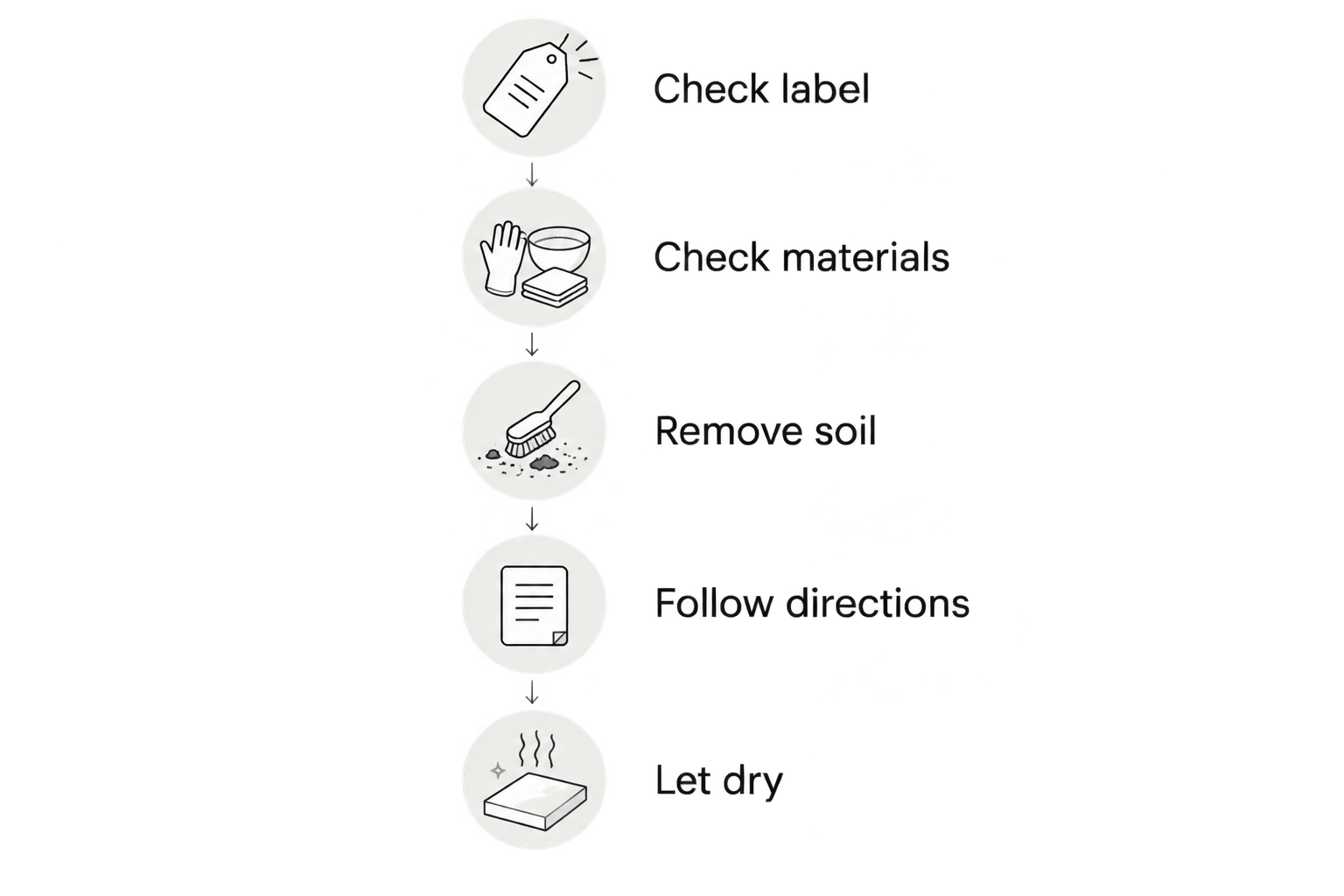
Use this sequence when deciding whether a spray belongs in your 2026 equipment-care routine. Each step answers a different question, so do not stop after recognizing the active ingredient.
- Check label. Look for an explicit surface use. If you want disinfection, find the EPA registration number and read the approved directions for the intended application.
- Check materials. Compare the label’s permitted surfaces with the equipment manufacturer’s care instructions. Permission for a hard, nonporous surface does not automatically include upholstery, fabric, or electronics.
- Remove soil. Follow any precleaning instructions before the disinfection step. Do not treat a quick spray over visible residue as a substitute for the required preparation.
- Follow directions. Apply the product as instructed and keep the surface visibly wet for the full labeled contact time when disinfecting.
- Let dry. Follow the label’s drying, wiping, or rinsing directions before using the equipment again.
Do not invent a dilution or mix products to make a spray seem more suitable. Use the formulation as directed. If instructions conflict with the equipment-care guidance, choose a different approved method rather than compromising either set of directions.
Hard surfaces: check the finish, too
A dumbbell handle, machine frame, and exercise-bike adjustment knob are all physical surfaces, but they do not necessarily have the same finish. Read the equipment instructions rather than treating every exposed part as equivalent.
A permitted use on one material does not establish compatibility with every coating or component attached to it. Pay attention to seams, fasteners, grips, and places where liquid can collect.
Best for hard surfaces: a product explicitly permitted by both labels. Its advantage is a clear use case; its limitation is that the permission applies only within those directions. Do not extend it to other equipment by appearance alone.
If the gym supplies a particular cleaning station, follow its posted instructions. Tell staff when a bottle is unlabeled or the directions are unreadable instead of guessing what it contains.
Upholstery and mats: do not assume
A padded bench is not simply a metal machine with a softer top. Its cover, seams, and underlying padding create a different care question from the frame beneath it.
Check whether the product label and equipment instructions cover the actual material. A direction for hard, nonporous surfaces does not automatically apply to an absorbent pad or fabric strap.
The same rule applies to personal exercise mats. Follow the mat manufacturer’s cleaning instructions, including any restrictions on soaking, rinsing, and drying, rather than choosing a method solely because you use the spray elsewhere.
Best for upholstery and mats: the manufacturer-approved care method. That gives you a defined process, but it might not be the same process used on nearby hard surfaces. Keep those tasks separate when the instructions differ.
Screens and controls: protect the openings
Do not spray a treadmill display or exercise-bike console simply because the surrounding frame allows a surface cleaner. Screens, buttons, charging ports, and ventilation openings need their own care instructions.
If the manufacturer specifies applying cleaner to a cloth, follow that method. Do not substitute direct spraying or saturate the cloth beyond what the instructions permit.
For your 2026 equipment checklist, make electronics a separate line item. A cleaning method is suitable only when it respects both the surface directions and the device instructions; a familiar ingredient does not remove that requirement.
Why equipment-care directions vary
The right method depends on more than the words hypochlorous acid. These are the factors that change the decision:
- Labeled purpose. Personal care, cleaning, sanitizing, and disinfecting are different claims. Use only the claim the specific product supports.
- Surface material. Metal, coated surfaces, upholstery, and fabric can have different care requirements.
- Contact time. Disinfection depends on the specific label’s wet-contact-time directions, not a quick mist followed by an immediate wipe.
- Visible soil. Precleaning instructions determine whether you need to remove residue before applying a disinfectant.
- Equipment design. Openings, seams, padding, and electronic controls affect where and how you can apply liquid.
- Facility procedure. A shared gym can specify which products and methods members should use on its equipment.
Your 2026 decision should start with those instructions, not an ingredient-count comparison. A shorter ingredient list does not, by itself, establish better surface compatibility or stronger disinfection.
Shared compression boots need their own routine
Recovery equipment deserves the same attention as the weights floor. Shared compression boots can include fabric, liners, hoses, connectors, and powered components, so a direction for wiping a nonporous exercise-machine frame does not settle how to care for the whole system.
A routine for cleaning shared compression boots needs to distinguish the parts that touch users from the parts that must stay dry. Follow the boot manufacturer’s instructions for removable components, permitted products, and drying before reuse.
Do not fill, flush, or spray an air connector because the outside of the equipment needs cleaning. Likewise, do not assume a removable liner can be treated like a sealed bench cover.
Ask staff to handle unclear recovery-equipment instructions. Your personal spray should not become an improvised cleaning protocol for a shared powered device. The same boundary applies even when the product is familiar from your own routine.
Keep your personal mist separate
A simple gym bag does not need every bottle to serve every purpose. Keep your personal-care routine tied to personal-care directions, and leave shared-equipment disinfection to a product labeled for that job.
Xoxo Gina HALO™ Wellness Mist is best for shoppers seeking a 5 fl oz / 150 mL hypochlorous acid wellness mist, not a substitute for documented gym-equipment disinfection. The product information identifies pH 4.5 and names purified water and hypochlorous acid among its ingredients. Those formulation details do not establish an EPA disinfectant registration or permission for every equipment material.
The practical benefit is a clearly identified wellness mist you can assess for your personal routine. The limit is equally clear: bottle size, pH, and ingredient familiarity are not equipment-disinfection evidence.
For your 2026 gym bag, organize by purpose. Keep personal-care products identifiable, follow each bottle’s directions, and avoid decanting an equipment cleaner into an unlabeled container that could be confused with a face mist.
Can I spray equipment and wipe it immediately?
Not if the disinfectant label requires the surface to remain wet first. Immediate wiping does not satisfy a longer labeled wet contact time.
Read the directions before applying the product, not after. Follow any final wiping or rinsing instructions once the required treatment is complete.
Does pH tell me whether a spray disinfects?
No. A pH value is a formulation detail, not a replacement for an EPA registration and approved use directions.
The same distinction applies to ingredient count and bottle size. None independently tells you which microorganisms a product is labeled to address or which equipment surfaces it can treat.
Can I use the gym’s surface spray on my face?
Only use a product on skin when its label explicitly permits that use. Equipment-cleaning directions do not establish skin suitability, just as skincare directions do not establish equipment disinfection.
Keep the bottles separate and read the actual label. Do not judge intended use by scent, appearance, or the type of spray nozzle.
FAQ
Can I use hypochlorous acid spray on gym equipment?
Yes, when the specific product label permits that surface use and the equipment manufacturer allows it. For disinfection, use an EPA-registered product labeled for the intended application and follow its full directions.
Does every hypochlorous acid spray disinfect gym equipment?
No, the ingredient name alone does not establish a disinfectant claim. Check the specific product’s EPA registration and approved label rather than transferring claims from another spray.
How long should hypochlorous acid stay wet on a weight bench?
Follow the specific disinfectant label’s wet contact time; there is no single time that applies to every hypochlorous acid spray. Confirm that the bench material is covered by the product and equipment instructions.
Can I use a hypochlorous acid face mist on a treadmill screen?
Do not assume a face mist is suitable for a treadmill screen. Follow the display manufacturer’s cleaning instructions and use only a product permitted for that application.
Can I spray hypochlorous acid on my yoga mat?
Use it only when the spray label and the mat manufacturer’s instructions both permit the application. Directions for hard, nonporous surfaces do not automatically cover every mat material.
Can Xoxo Gina HALO™ Wellness Mist replace the gym’s disinfectant?
Do not replace the gym’s disinfectant based on the wellness mist’s ingredient name, pH, or bottle size. Equipment disinfection requires a product with the relevant EPA registration, labeled use, and application directions.
Should I clean visible residue off equipment before disinfecting?
Follow the disinfectant label’s precleaning instructions before disinfecting. A quick spray over visible soil does not replace a required cleaning step.
One last thing
A surface that looks dry does not tell you whether the disinfection directions were followed. The practical question is whether it stayed wet for the required contact time before any final wiping or drying.
Make that your 2026 habit: read the directions, respect the equipment, and keep personal care personal. You do not need a more complicated routine—just a clear job for each bottle.