
November 5, 2026
Can you use hypochlorous acid skincare with vitamin C?

Yes, you can include hypochlorous acid skincare and vitamin C in the same overall routine; the clearest way to keep them apart is to use them at different times rather than mix them or layer them while wet. In 2026, the key caveat is chemistry: hypochlorous acid is an oxidizing agent, while ascorbic acid—the direct form of vitamin C—is a reducing agent, so direct contact can consume both ingredients.
- Keep hypochlorous acid skincare and vitamin C separate rather than mixing them in your hand or bottle.
- Ascorbic acid can react with hypochlorous acid; skin dryness does not prove the reaction risk is gone.
- Xoxo Gina HALO™ Wellness Mist is a hypochlorous acid mist, not a replacement for vitamin C.
- Separate application times avoid relying on an unverified waiting interval.
Why this matters
You do not need a complicated routine. You need each product to have a clear place—and you need to avoid assuming that two individually suitable products have been tested together.
Xoxo Gina HALO™ Wellness Mist is a 5 fl oz / 150 mL hypochlorous acid mist formulated at pH 4.5. Those details describe the product; they do not establish compatibility with every vitamin C serum. Choose your application order from the instructions, not from the word “gentle.”
Can you use hypochlorous acid skincare with vitamin C?
Yes, but sharing a routine is different from sharing a wet layer. Hypochlorous acid and ascorbic acid participate in an oxidation-reduction reaction when they meet. That chemistry supports keeping them separate; it does not tell you exactly how much of either ingredient remains after a particular combination reaches your skin.
The practical distinction in 2026 is between separate applications and direct mixing. Your finished formulas matter, including the form of vitamin C, concentration, pH, and other ingredients. A claim about raw ingredients is not a compatibility test of two finished products.
| Approach | Best for | Advantage | Limitation | Verdict |
|---|---|---|---|---|
| Different application times | Shoppers who want the simplest separation | Avoids deliberate wet-on-wet layering | Requires separate routine moments | Prefer this when pairing instructions are absent |
| Same session, separate layers | Shoppers with product-specific pairing instructions | Keeps products within one routine session | Dry skin alone does not establish chemical compatibility | Follow the finished products’ instructions |
| Mixing in your hand or bottle | Not recommended for an untested pairing | No established advantage for this combination | Creates direct contact and changes the original formula | Skip |
Neither ingredient automatically makes the other unsuitable for your entire routine. The avoidable problem is treating them as a ready-made blend without evidence that the blend works as intended.
Keep the routine simple
Separate application times
Best for: a routine without timing guesswork. Assign vitamin C to one application time and your hypochlorous acid mist to another. For example, keep vitamin C in your morning routine and reserve the mist for a separate evening routine, following each label.
This approach avoids deciding whether a partly dried layer is ready for another active ingredient. Its limitation is convenience: you need separate application moments rather than putting everything on together.
Separation is a practical choice, not a promise about results. It does not prove that either product will suit your skin, and it does not replace the instructions supplied with either formula.
Same-session layering
Best for: a pairing with explicit product instructions. If a manufacturer provides directions for combining the exact products, follow those directions rather than a general social-media rule.
Without those instructions, do not turn “let it dry” into a compatibility guarantee. Dryness tells you that your skin no longer feels wet. It does not measure remaining hypochlorous acid or show how a later serum will interact with residue.
The advantage is a shorter routine. The limitation is uncertainty about the finished combination, especially when the vitamin C form or concentration is unclear.
Direct mixing
Best for: no untested skincare pairing. Do not pour vitamin C into a hypochlorous acid bottle or combine the products in your palm to create a shortcut.
Mixing brings the ingredients into direct contact and changes their original formulations. It also means the original instructions no longer describe what you are applying. Keep each product in its own container and use it as directed.
Why compatibility varies
Not all hypochlorous acid sprays or vitamin C serums have the same formula. These are the details that matter when you assess a pairing:
- Vitamin C form. Ascorbic acid has established reducing chemistry. Vitamin C derivatives have different structures, so do not assume identical behavior across every serum.
- Concentration. The amounts of reactive ingredients affect a chemical interaction. A product name alone does not reveal those amounts.
- Formula pH. pH influences chemical behavior, including the balance between hypochlorous acid and hypochlorite. A pH value alone does not certify compatibility.
- Other ingredients. A finished serum contains more than its headline ingredient. Its complete formulation matters, not just the front-label claim.
- Application method. Mixing products directly is different from applying them at separate times. Wet-on-wet layering also brings formulas into immediate contact.
- Pairing instructions. Directions or testing for the exact finished products are more relevant than a blanket claim about an entire ingredient category.
A shorter ingredient list is easier to read, but it is not proof of better compatibility. The same applies to bottle size and water source: neither establishes that a mist will work unchanged alongside your serum.
Build a routine without a stopwatch
For your 2026 routine, start with separation rather than an invented waiting period. You should not need to watch the clock to compensate for missing pairing instructions.
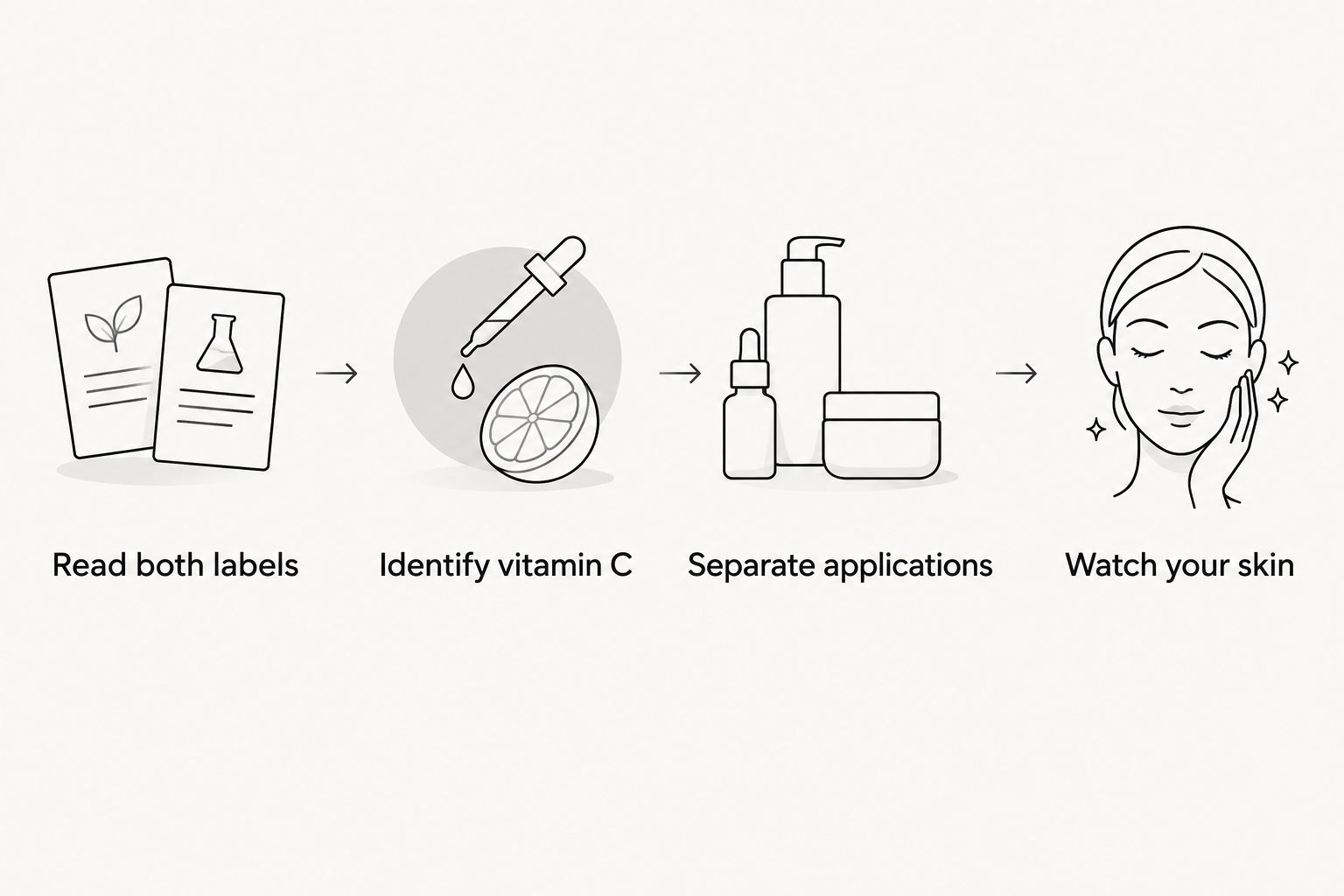
- Read both labels. Check the intended use, application directions, storage instructions, and cautions before combining routines.
- Identify vitamin C. Look at the ingredient list to see whether the serum uses ascorbic acid or a named derivative. Do not rely on the product title alone.
- Separate applications. Give the serum and mist different routine moments when the manufacturers do not provide pairing directions.
- Watch your skin. Introduce changes individually so you can identify which product or application change causes discomfort.
If you prefer vitamin C in the morning, leave that routine intact and choose another appropriate time for the mist. Keep sunscreen in your daytime routine; neither a mist nor vitamin C replaces it.
For gym routines, do not make a post-workout mist an automatic extra layer over freshly applied serum. Plan the application around your existing routine and the mist’s directions. More application steps do not establish more benefit.
What does the mist’s formula tell you?
Gina Rivera is the founder behind Xoxo Gina HALO™. When choosing skincare, keep the founder story separate from the evidence needed to answer a formula-pairing question: compatibility depends on the products, not the biography.
Xoxo Gina HALO™ Wellness Mist is best for shoppers seeking a 5 fl oz / 150 mL hypochlorous acid mist, not a substitute for vitamin C. Its supplied product description identifies a pH of 4.5 and names purified water and hypochlorous acid. Those are specific formulation details, not evidence that it has been tested with your serum.
The practical advantage is a clearly identified mist format and bottle size. The limitation for this question is equally clear: those facts do not establish how it interacts with an individual vitamin C formula. Choose it for its stated role, and keep separate expectations for your serum.
Choose vitamin C by formula, not just the headline
When comparing vitamin C serums for brightening skin, the brightening description does not tell you whether a serum contains ascorbic acid or a derivative. That distinction matters when you assess its chemistry alongside hypochlorous acid skincare.
Read the ingredient list before deciding where the serum belongs. If the label lists ascorbic acid, direct contact with an oxidizing ingredient is a reason to keep applications separate. If it lists a derivative, do not treat the different name as proof that wet layering has been tested.
In 2026, a useful question for the manufacturer is specific: has this finished serum been assessed for use directly after this finished hypochlorous acid mist? An answer about one ingredient in isolation does not settle the finished-product question.
Keep sensitive-skin decisions separate from chemistry
A compatible formula pairing and a comfortable skin routine are different questions. Even if two products can be used together according to their instructions, your skin still needs to tolerate each product.
For sensitive or reactive skin, change one part of your routine at a time. Follow any patch-testing instructions on the label, and stop using a product if it causes irritation. Persistent or significant symptoms belong with a qualified healthcare professional, not an increasingly complicated layering schedule.
For parents, adult skincare advice does not establish suitability for a child. Check age-related directions and ask an appropriate healthcare professional when suitability is unclear. Do not assume that a mist’s simple format makes every use appropriate for every family member.
For travelers, keep the same separation principle you use at home. A smaller toiletry bag is not a reason to combine formulas in one container. Keep labels accessible so the instructions travel with the products.
Do you need to wait between hypochlorous acid and vitamin C?
There is no universal waiting interval established here for this pairing. A fixed number of minutes would need evidence relevant to the actual formulas and application conditions.
Letting a mist dry is a physical observation, not a chemical test. If the manufacturers do not provide pairing directions, separate application times are clearer than choosing a timer and assuming the interaction has disappeared.
Does hypochlorous acid cancel out vitamin C?
Hypochlorous acid can react with ascorbic acid in direct contact, but “cancels out” oversimplifies a finished skincare routine. The extent of a reaction depends on the formulas and conditions; ingredient chemistry alone does not quantify the result on your face.
Avoid both extremes: do not assume wet layering is harmless, and do not assume using both products at different times makes the entire routine ineffective. Keep the decision focused on application and product-specific instructions.
Can you spray hypochlorous acid over a vitamin C serum?
Do not make spraying over vitamin C your default without pairing instructions. A mist can rewet the surface and bring ingredients into contact, so reversing the order does not establish compatibility.
If your routine already includes vitamin C, choose a separate application time for hypochlorous acid skincare. That keeps your routine simple without making an unsupported promise about how long either ingredient remains active.
FAQ
Can I use hypochlorous acid skincare and vitamin C on the same day?
Yes, you can include both on the same day while keeping their applications separate. Follow each product’s directions rather than mixing them or assuming wet layering has been tested.
Should hypochlorous acid go before or after vitamin C?
Neither order establishes compatibility on its own. Without instructions for the exact pairing, use separate application times instead of choosing an order by guesswork.
Is it enough to let hypochlorous acid dry before vitamin C?
Dryness alone does not establish chemical compatibility. It tells you the surface no longer feels wet, not how much reactive ingredient remains.
Are vitamin C derivatives automatically compatible with hypochlorous acid?
No, a vitamin C derivative is not an automatic compatibility guarantee. Different structures and finished formulations need their own supporting evidence.
Can I mix vitamin C into my hypochlorous acid spray bottle?
Do not mix vitamin C into a hypochlorous acid spray bottle. Direct mixing changes the original formula and brings potentially reactive ingredients together.
What size is Xoxo Gina HALO™ Wellness Mist?
Xoxo Gina HALO™ Wellness Mist is 5 fl oz / 150 mL. Bottle size describes the amount supplied; it does not establish compatibility with a vitamin C serum.
One last thing
A dry face is not a compatibility test. That is the distinction to keep in your 2026 routine: a product can disappear from view without proving what remains chemically available on your skin.
Keep each formula in its own bottle. Give each a clear application time. Ask for product-specific directions before turning two separate products into one wet layer.