
November 5, 2026
Can you use hypochlorous acid skincare with retinol?

Yes—you can include hypochlorous acid skincare and retinol in the same routine; using the mist in the morning and retinol at night keeps the steps separate. That is not a guarantee that every finished formula works well when layered directly together. For your 2026 routine, follow each product’s directions and avoid adding a new mist while your skin is already irritated.
- Hypochlorous acid skincare and retinol can occupy separate parts of your routine without direct layering.
- Retinol can cause dryness and irritation; adding a mist does not remove those risks.
- Xoxo Gina HALO™ Wellness Mist is a 5 fl oz / 150 mL hypochlorous acid skincare option.
- Use sunscreen during the day, and do not treat a facial mist as a replacement for moisturizer.
Can you use hypochlorous acid skincare with retinol?
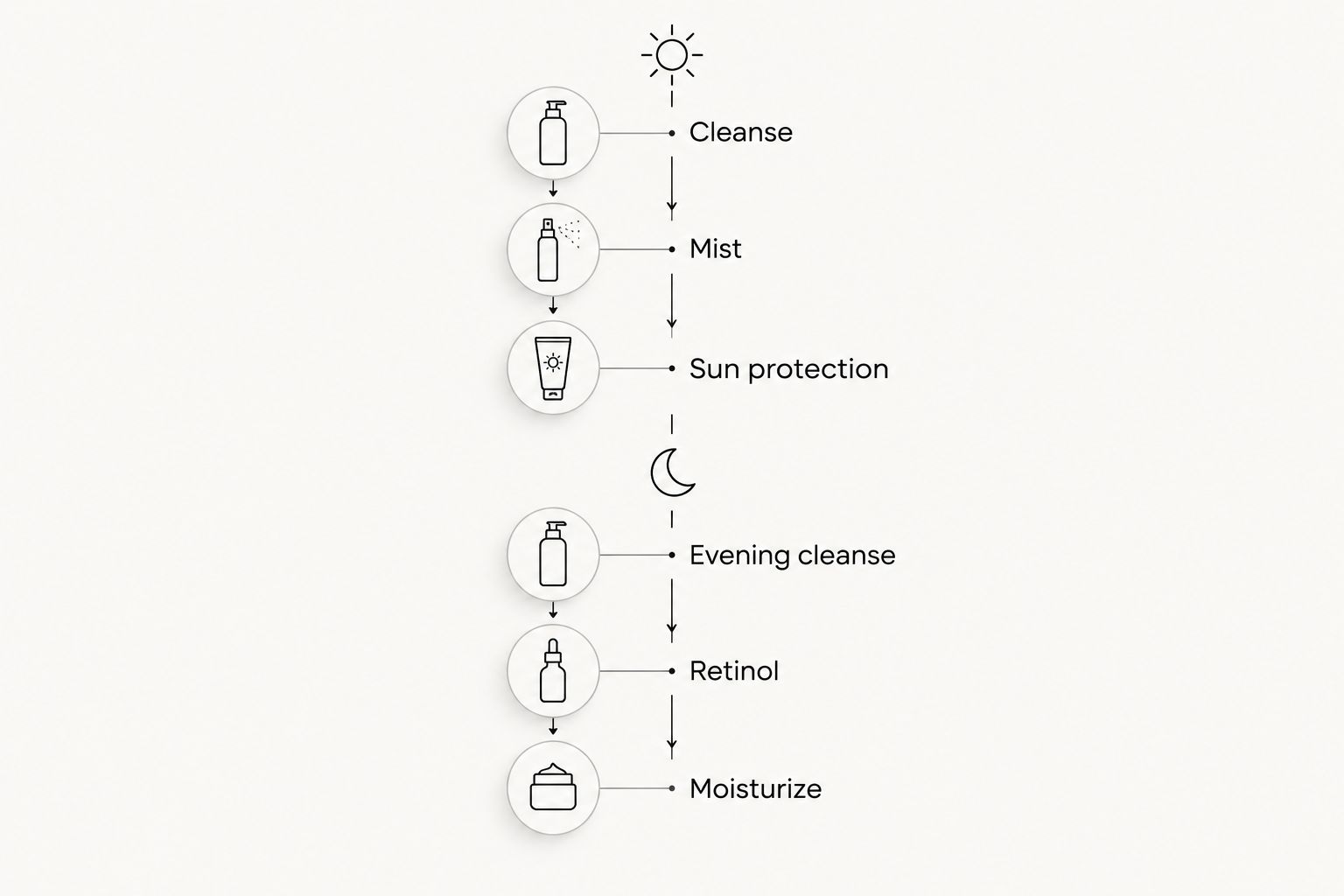
Keep the products separate if you want the simplest routine. Use your hypochlorous acid mist according to its label in the morning, and keep retinol in your evening routine. You do not need to combine them in your hand or spray one over the other to use both.
Start with cleansing appropriate for your skin. The guide to whether hypochlorous acid skincare can replace your cleanser explains the distinction between those steps.
- Cleanse. Begin your morning routine with clean skin rather than treating mist as a shortcut for removing residue.
- Mist. Apply the facial mist as its directions specify. Keep it out of your eyes unless the product explicitly permits that use.
- Sun protection. Finish your daytime skincare with broad-spectrum SPF 30 or higher, following its application directions.
- Evening cleanse. Remove makeup, sunscreen, and the day’s residue before your evening skincare.
- Retinol. Follow the retinol label, including its directions about dry skin, amount, and frequency.
- Moisturize. Use moisturizer as directed alongside your retinol routine; mist is not a substitute for this step.
Why this matters
Retinol can cause dryness, stinging, and peeling, especially when you first introduce it. Adding another skincare product does not cancel that possibility. A short routine makes it easier to identify which change your skin does not tolerate.
For sensitive or reactive skin, the useful question in 2026 is not how many products fit together. It is whether each product has a clear purpose and whether your skin tolerates the routine you actually use.
An optional mist should stay optional. If your cleanser, moisturizer, sunscreen, and retinol already make a manageable routine, you do not need another step just because two ingredients can appear in the same skincare plan.
Separate timing or direct layering?
Using two products at different times is different from confirming that their finished formulas are compatible when mixed. Ingredient names alone cannot settle that question. The vehicle, other ingredients, and product directions also matter.
| Approach | Best for | Main advantage | Main limitation |
|---|---|---|---|
| Morning mist, evening retinol | People who want distinct steps | Avoids applying the products directly over one another | Does not eliminate irritation from either product |
| Both in one evening routine | People whose product directions explicitly support the combination | Keeps the steps in one session | Requires attention to both labels; ingredient names alone do not establish compatibility |
| Retinol routine without an added mist | People keeping skincare minimal | Avoids introducing another variable | Does not include the optional mist step |
Do not mix the products in a bottle or in your palm. That changes how you use the finished formulas and makes it harder to follow their directions. Keeping products in their original packaging also preserves access to storage instructions and warnings.
If your retinol instructions conflict with a mist’s instructions, choose separate timing or ask the manufacturer about the exact combination. A general statement about hypochlorous acid is not product-specific testing.
Why your skin’s response varies
Your experience depends on more than the headline ingredients. These are the practical factors to check before you change a routine:
- Retinol formulation. The strength and the rest of the formula affect how you use the product. Follow the instructions for your particular retinol rather than borrowing another product’s schedule.
- Mist formulation. Check the complete ingredient list and intended use. A surface-use product is not automatically a facial skincare product.
- Application conditions. Applying retinol to damp skin can increase irritation. Follow its label rather than assuming a recently misted face is ready.
- Other skincare steps. Exfoliating acids, scrubs, and other potentially irritating products add variables. Introducing several changes together makes a reaction harder to trace.
- Your skin’s current condition. Skin that already stings or peels needs a simpler approach, not another product layered on to compensate.
- Directions and storage. Use each product within its labeled instructions. Do not assume that another brand’s advice applies to the bottle you own.
These checks are more useful than choosing a routine because it is popular in 2026. Your labels and your skin’s response should decide what stays.
Should you wait between a hypochlorous acid mist and retinol?
There is no universal waiting interval to recommend for every hypochlorous acid mist and retinol formula. Do not rely on a fixed countdown to establish compatibility. Waiting until skin feels dry addresses damp application; it does not prove that two formulas have been tested together.
If your retinol label specifies dry skin, let your skin dry before applying it. If either manufacturer gives a specific order or interval, follow that guidance for that product rather than substituting a general routine found online.
Morning mist and evening retinol remove the need to calculate a gap within one session. That separation is a practical scheduling choice, not a claim that a particular interval improves either product’s performance.
Does hypochlorous acid make retinol less effective?
Hypochlorous acid is an oxidizing substance, but that fact alone does not establish how a particular mist interacts with a particular retinol formula on skin. It does not justify declaring every combination ineffective—or declaring every combination compatible.
Avoid two blanket claims: that hypochlorous acid always deactivates retinol, and that waiting until a mist dries guarantees no interaction. Neither conclusion follows from an ingredient name alone.
If you want an answer about direct layering, ask about the exact finished products. For a straightforward 2026 routine, separate application times rather than trying to solve an unverified mixing question at home.
Where Xoxo Gina HALO™ Wellness Mist fits
Gina Rivera is the founder behind Xoxo Gina HALO™. When choosing a facial mist, keep that founder story separate from the practical question of whether its documented formula and directions fit your routine.
Xoxo Gina HALO™ Wellness Mist is best for shoppers seeking a 5 fl oz / 150 mL hypochlorous acid skincare mist. Its supplied product information lists pH 4.5 and identifies purified water and hypochlorous acid within a three-ingredient formula. Bottle size and pH describe the product; neither establishes superiority or retinol compatibility.
The Xoxo Gina HALO™ Wellness Mist product page is the place to check current directions and the complete ingredient list before adding it to your routine.
Its practical appeal is a defined mist step for face and body care. Its limitation in this discussion is equally clear: the supplied formulation details do not establish product-specific compatibility with your retinol. It should not replace sunscreen, moisturizer, or advice about persistent irritation.
For a sensitive-skin shopper, that distinction matters more than a long list of promised benefits. Choose the mist because you want that step, not because you expect it to make an uncomfortable retinol routine tolerable.
Build around the routine you already tolerate
If you already use retinol comfortably, leave that routine unchanged while you decide whether to add a mist. Introduce the optional product separately instead of changing your cleanser, retinol, moisturizer, and application order at once.
Testing a new skincare product on a small area before broader use is a sensible precaution. Follow the manufacturer’s testing advice if provided. A small-area test does not guarantee that you will never develop irritation with repeated use.
If you are new to retinol, start with its instructions rather than a complicated layering plan. Ask a dermatologist for help if you have reactive skin, a diagnosed skin condition, or repeated difficulty tolerating skincare.
Keep adult retinol separate from family mist routines. A product bought for shared household use does not make every item beside it appropriate for children. Each person needs products suited to their own age and circumstances.
Keep gym and travel routines simple
After a workout, treat a facial mist as its own optional step—not as proof that sweat, sunscreen, or makeup has been removed. Cleanse when needed, and do not apply retinol merely because you have just refreshed your face.
Travel introduces another practical issue: storage. Follow each bottle’s instructions and avoid leaving skincare in conditions outside its labeled guidance. A gym bag or parked car is not automatically an appropriate long-term storage place.
If you fly, check the rules for your departure airport before packing. The U.S. carry-on liquids limit is 3.4 fl oz / 100 mL per container; a 5 fl oz / 150 mL bottle exceeds that limit. Bottle capacity matters, not simply how much liquid remains inside.
What should you do if your skin stings?
Stop applying more products to try to counteract the sensation. If a product causes a reaction, follow its removal instructions and stop using it while you assess what happened. Do not keep applying retinol through persistent discomfort because a mist is part of the routine.
Reduce the number of variables. Note which product was new, whether you changed frequency, and whether other exfoliating or irritating steps were involved. That information is more useful to a clinician than a list of ingredients you assume must be incompatible.
Seek medical advice for persistent or worsening irritation. Get urgent help for a severe reaction, especially swelling or breathing difficulty. A cosmetic mist is not a treatment for a skincare reaction.
FAQ
Can I use hypochlorous acid skincare with retinol every day?
Daily use depends on each product’s directions and your skin’s tolerance. A mist does not make daily retinol appropriate for everyone; keep separate timing if you use both.
Should I spray hypochlorous acid before or after retinol?
Use the mist in the morning and retinol at night if you want to avoid direct layering. For one-session use, follow product-specific guidance rather than assuming an order establishes compatibility.
How long should I wait after hypochlorous acid before applying retinol?
There is no universal waiting interval for every hypochlorous acid and retinol formula. Follow your retinol’s dry-skin instructions and ask the manufacturers about direct layering.
Will hypochlorous acid stop retinol from working?
You cannot establish that from the ingredient names alone. Separate timing avoids directly mixing the formulas without making an unsupported claim about their interaction.
Can a hypochlorous acid mist replace moisturizer when I use retinol?
A hypochlorous acid mist does not replace moisturizer in a retinol routine. Keep moisturizer as a separate step according to your product instructions and skin needs.
Is Xoxo Gina HALO™ Wellness Mist proven compatible with my retinol?
The supplied product details do not establish compatibility with your particular retinol. Check both products’ directions and request product-specific guidance before direct layering.
Do I still need sunscreen if I use retinol only at night?
Yes—keep broad-spectrum SPF 30 or higher in your daytime routine. Follow the sunscreen’s directions for application and reapplication; a facial mist does not replace it.
Can I use retinol while pregnant?
Avoid retinol during pregnancy and discuss skincare choices with your healthcare professional. Adding a hypochlorous acid mist does not change that recommendation.
One last thing
Dry skin is an application condition, not a compatibility test. Letting a mist dry does not establish what happens when two finished formulas meet. That small distinction cuts through a lot of confusing layering advice.
For 2026, make the routine easier to follow: keep the mist optional, use retinol according to its label, and protect the moisturizer and sunscreen steps. You do not need a more complicated sequence to make a thoughtful choice.