
November 12, 2026
Can you use hypochlorous acid skincare with niacinamide?

You can use hypochlorous acid skincare and niacinamide in the same routine when both products’ directions allow it; apply them separately rather than mixing them together. Let the hypochlorous acid mist dry before applying niacinamide, and remember that a shared routine does not establish compatibility between every finished formula.
- Hypochlorous acid skincare and niacinamide can share a routine; follow each formula’s directions and avoid mixing them together.
- Let the mist dry before applying niacinamide; there is no universal waiting time for every formula.
- Xoxo Gina HALO™ Wellness Mist suits shoppers seeking a 5 fl oz / 150 mL hypochlorous acid mist.
- For reactive skin, introduce one new formula at a time and stop if irritation develops.
Why this matters
Two products can belong in your skincare routine without belonging in the same bottle. That distinction matters when you pair an oxidizing ingredient such as hypochlorous acid with a leave-on serum: the finished formulas and their instructions matter more than an ingredient-pairing chart.
For your 2026 routine, keep the decision practical. Check what each product is intended to do, apply it as directed, and avoid adding products simply because the ingredients sound compatible.
Xoxo Gina HALO™ is founded by Gina Rivera. When considering the brand’s skincare, look past the founder story to the product details and directions that determine how a formula fits your own routine.
Can you use hypochlorous acid skincare with niacinamide?
Yes—use separate application steps, not a homemade mixture. Neither ingredient name alone tells you how two finished products will behave together, so product-specific instructions take priority over a general layering rule.
Hypochlorous acid is an oxidizing substance. Niacinamide is a form of vitamin B3 used in skincare, including formulas intended to support the skin barrier. Those different roles do not establish that every pairing has been tested, or that combining the products creates an additional benefit.
There are several ways to organize the routine. Choose the least complicated approach that follows both labels.
| Approach | Best for | Practical advantage | Limitation |
|---|---|---|---|
| Mist, let dry, then niacinamide | People whose product directions allow layering | Keeps the products in separate application steps | Does not prove the finished formulas have been tested together |
| Use at separate times | People who prefer not to layer the formulas | Avoids applying the products directly over each other | Adds another routine to remember |
| Introduce one product first | Sensitive or reactive skin shoppers trying something new | Makes it easier to identify which product causes a reaction | Takes patience before adding the second formula |
| Mix products together | Not recommended without explicit manufacturer instructions | No established advantage for a home mixture | Changes the formulas outside their intended use |
The table is a routine guide, not a compatibility test. If either label gives a different sequence or warns against a combination, follow that instruction instead.
Keep the order simple
For a basic 2026 routine, place the mist before the niacinamide leave-on step when both labels allow that order. Do not assume every product containing niacinamide is a serum; it also appears in moisturizers and other formats.
- Check directions. Read the instructions for both finished products, including application area, frequency, storage, and warnings. An ingredient list does not replace those directions.
- Start clean. Cleanse as needed for your routine. A facial mist is not automatically a substitute for removing makeup, sunscreen, or visible dirt.
- Apply mist. Use the hypochlorous acid product according to its label. More product does not establish better results.
- Let dry. Allow the mist to dry before adding the next leave-on formula. Avoid mixing the products in your palm or transferring them into a shared container.
- Apply niacinamide. Follow the niacinamide product’s directions, then finish with the remaining appropriate steps in your routine, including daytime sunscreen.
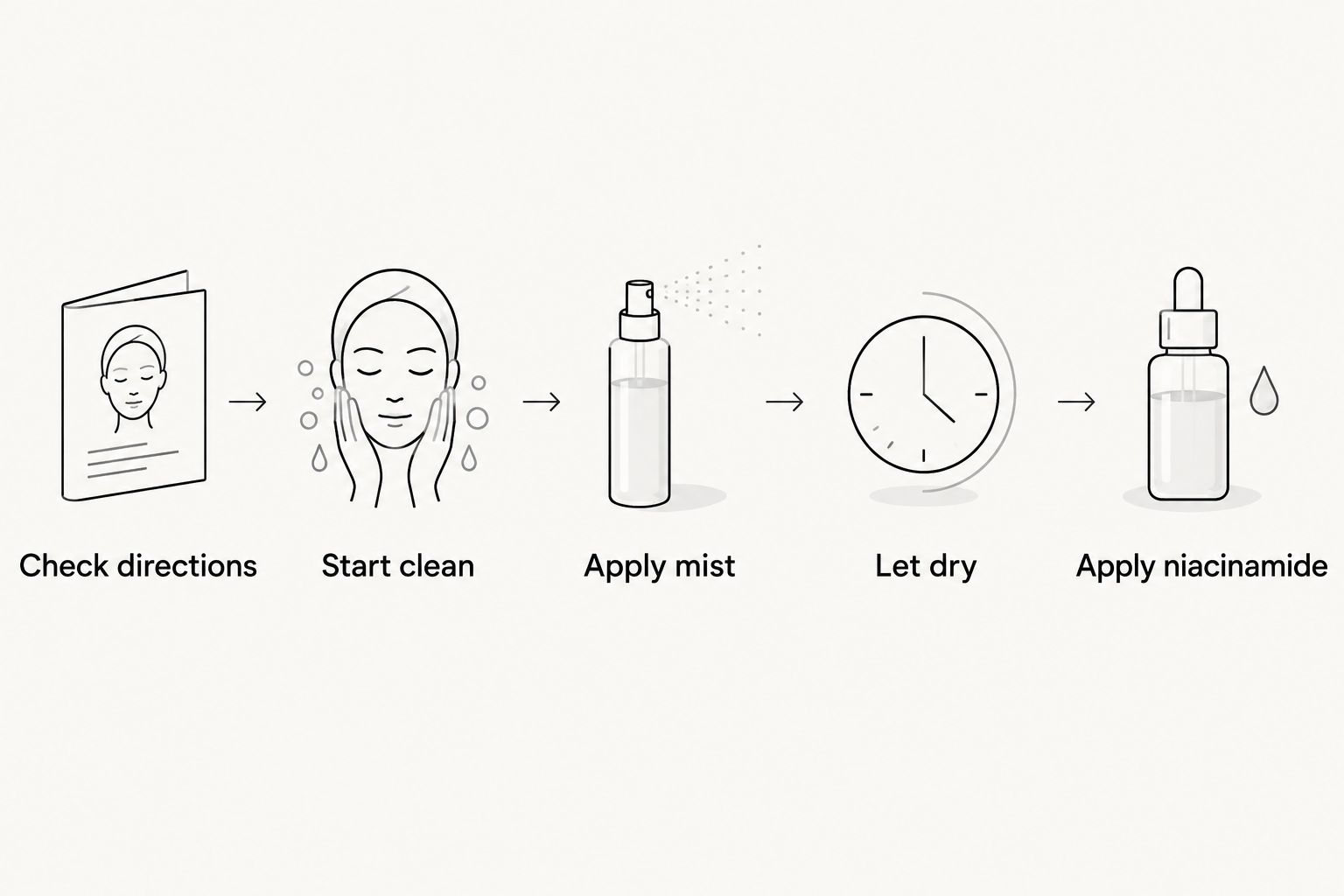
This sequence keeps application straightforward. It does not promise that drying chemically neutralizes every remaining ingredient, nor does it establish a tested compatibility result for an unspecified pair of products.
If the routine feels unnecessarily complicated, use the products at separate times instead. You do not need to layer everything in a single session.
How long should you wait before niacinamide?
Let the mist dry; do not rely on a universal countdown. A fixed waiting time cannot account for differences in formula, application amount, or the instructions supplied with each product.
The useful distinction is between a wet layer and a dry application surface. Waiting until the mist dries avoids immediately blending two wet formulas on your face, but it is not proof that a particular chemical interaction cannot occur.
If a manufacturer specifies a waiting period, follow it. Otherwise, do not treat an exact timer from a general skincare post as a requirement for your bottle.
For reactive skin, separate application times offer another practical choice. You can also ask the manufacturers whether they have guidance for the exact formulas you own, rather than asking about the ingredients in isolation.
Why the right routine varies
The same ingredient pairing can appear in very different products. These are the details that should shape your decision:
- Finished formulation. A product contains more than the ingredient highlighted on its front label. Directions should apply to the complete formula, not just hypochlorous acid or niacinamide.
- Product format. A watery mist, a serum, and a moisturizer occupy different steps. Follow the instructions for the format in your hand.
- Application directions. Intended use, frequency, and warnings can differ between products. Do not transfer instructions from a facial spray to a surface-use product.
- Your existing routine. Adding both products alongside other new skincare makes it harder to identify the source of irritation. Keep the rest of your routine familiar while assessing a new addition.
- Your skin’s response. Burning, persistent stinging, redness, or discomfort are reasons to stop, not signs that you should apply more.
- Storage and handling. Keep each formula in its original packaging and follow its storage instructions. Do not dilute, decant, or combine products to make a custom blend.
Compatibility is a formula question, not just an ingredient question. A short ingredient list, a stated pH, or a larger bottle does not independently prove greater safety or effectiveness.
Fit the routine to your day
When your skin reacts easily
Keep your starting point familiar. If you already tolerate a niacinamide product, do not replace it and introduce a new mist on the same day simply to build a matching routine.
Try a new product on a small area according to its directions before broader use. A small-area check cannot guarantee that a reaction will never occur, but introducing products separately makes troubleshooting less confusing.
If you are under dermatologic care, ask your clinician before changing a prescribed routine. This guide does not replace instructions for a diagnosed skin condition.
After the gym
A post-workout mist does not automatically replace cleansing. Decide whether you need to remove sweat, sunscreen, makeup, or visible dirt before applying leave-on skincare.
Once your skin is ready for the product, follow the same sequence: mist as directed, let dry, then apply the niacinamide formula if its directions permit. Avoid adding repeated applications merely because the bottle is within reach.
While traveling
Keep your routine recognizable. Travel is not the ideal moment to introduce several unfamiliar formulas when you want to know which product your skin tolerates.
Follow storage directions and check the rules for your actual route and luggage. Do not assume a skincare bottle qualifies for cabin baggage, and do not transfer a formula into another container unless the manufacturer permits it.
For families, check age-specific instructions rather than treating an adult skincare routine as suitable for everyone. A product’s general wellness positioning does not establish suitability for a child.
What to check on a hypochlorous acid mist
In 2026, choose by the documented product details, not by broad promises about the category. Confirm that the bottle is intended for your application area and read its directions before considering how it pairs with niacinamide.
Xoxo Gina HALO™ Wellness Mist is best for shoppers seeking a 5 fl oz / 150 mL hypochlorous acid mist with a stated pH of 4.5. Its supplied product description identifies purified water and hypochlorous acid among the ingredients.
Those details help you identify the product; they do not establish that it works better than another formula. The stated pH also does not prove compatibility with every niacinamide serum, and bottle size does not establish gentleness.
The practical advantage is straightforward: you have a defined mist format and documented bottle size to assess against your routine. The limitation is equally important: those specifications alone cannot answer how the product behaves with every other leave-on formula.
Before pairing any mist with your existing skincare, check the complete current ingredient list and directions. Use product-specific guidance when available rather than filling gaps with assumptions about water source, ingredient count, or marketing language.
Will hypochlorous acid cancel out niacinamide?
A blanket claim that hypochlorous acid cancels out niacinamide is not justified for every finished formula. A blanket promise that every pairing preserves both products’ performance is not justified either.
Use separate steps and follow the manufacturers’ guidance. Do not turn hypochlorous acid’s oxidizing properties into an unsupported claim that your particular serum becomes ineffective on contact.
Do you need both products?
You do not need both products simply because they can occupy the same routine. Keep a product when it has a clear role for you, its directions fit your routine, and your skin tolerates it.
For a simpler 2026 routine, decide what each addition is meant to accomplish before buying it. A compatible ingredient pairing is not, by itself, a reason to add another step.
What if the combination stings?
Stop using the combination if it causes burning, persistent stinging, or visible irritation. Do not keep applying it to see whether your skin becomes accustomed to the discomfort.
Follow the product’s instructions for an adverse reaction and seek medical advice for persistent or significant symptoms. Separate the question of ingredient compatibility from the more immediate question of whether your skin tolerates the actual products.
FAQ
Can I use hypochlorous acid skincare with niacinamide every day?
Daily use depends on the directions for both products and your skin’s tolerance. The ingredient pairing alone does not establish an appropriate frequency, so follow each label rather than adding extra applications.
Does hypochlorous acid go before or after niacinamide?
A hypochlorous acid mist generally belongs before a niacinamide leave-on step when both labels allow that sequence. Let the mist dry first, and follow any product-specific instructions that give a different order.
Can I mix niacinamide serum into my hypochlorous acid spray?
Do not mix niacinamide serum into a hypochlorous acid spray unless the manufacturers explicitly direct it. Combining finished formulas changes their intended use and does not establish a tested or stable mixture.
Do I have to wait a set number of minutes before niacinamide?
There is no universal waiting time that applies to every hypochlorous acid and niacinamide formula. Let the mist dry and follow any waiting period specified by the manufacturer.
Is Xoxo Gina HALO™ Wellness Mist suitable for a niacinamide routine?
Xoxo Gina HALO™ Wellness Mist should be assessed alongside the directions for your specific niacinamide product. Its stated pH of 4.5 and 5 fl oz / 150 mL size do not independently establish compatibility with every serum.
Can I spray hypochlorous acid over my niacinamide serum?
Do not assume that spraying over niacinamide is equivalent to applying the mist first and letting it dry. Follow both labels; if layering guidance is unclear, use the products at separate times or ask the manufacturers.
Does this pairing replace moisturizer or sunscreen in 2026?
Neither the ingredient pairing nor a facial mist automatically replaces moisturizer or sunscreen in your 2026 routine. Keep those decisions tied to your skin’s needs and the intended purpose of each finished product.
One last thing
You do not have to put every compatible product on your face at once. Using a mist at one time and niacinamide at another is a straightforward alternative when you prefer fewer layers.
Make that your 2026 rule: give every product a clear job, follow its directions, and leave out steps that add complexity without a clear purpose.