
November 9, 2026
Can you refill a hypochlorous acid face spray bottle?

You can refill a hypochlorous acid face spray bottle only when the manufacturer provides instructions for reusing that bottle with an approved refill. Otherwise, keep your hypochlorous acid spray for face in its original packaging rather than topping it off, diluting it, or transferring it into a different mister. A bottle that opens is not automatically a refillable bottle.
- Refill hypochlorous acid spray for face only through a manufacturer-approved refill system.
- An empty mister does not establish that its materials or pump suit another formula.
- Xoxo Gina HALO™ Wellness Mist lists a 5 fl oz / 150 mL size and pH 4.5.
- Keep the original label, follow storage directions, and do not dilute or mix formulas.
Why this matters
Refilling feels like a small change. But you are changing more than the amount of liquid in a bottle: you are also changing its handling, its contact with the container, and your ability to track the formula inside.
If you use Xoxo Gina HALO™ Wellness Mist, the listed bottle size is 5 fl oz / 150 mL. That size tells you how much the bottle contains; it does not establish that the bottle is designed for refilling.
For your 2026 skincare routine, keep the decision simple: look for explicit refill directions, not just a removable spray head. You do not need to guess how to prepare the bottle or which liquid belongs in it.
Can you refill a hypochlorous acid face spray bottle?
Yes, when the manufacturer explicitly supports refilling that bottle and specifies the refill formula and preparation method. Without those instructions, use the product as supplied rather than creating your own refill system.
These options are not interchangeable:
| Option | Best for | Practical benefit | Limitation | Recommendation |
|---|---|---|---|---|
| Manufacturer-approved refill system | Someone whose product explicitly supports refilling | Provides a defined bottle, formula, and reuse process | Requires following the maker's exact directions | Use as directed |
| Product in its original packaging | Someone without approved refill instructions | Keeps the formula with its label and intended container | Does not provide a bottle-reuse method | Keep it together |
| Transfer into a separate mister | Someone considering a different bottle for convenience | Changes the container's size or shape | Container suitability and preparation need confirmation | Ask before transferring |
| Topping off or adding water | No recommended routine here | Adds liquid to the bottle | Changes the contents or mixes batches without a defined process | Skip it |
The difference is permission backed by instructions. A general statement that a spray is suitable for facial use does not answer whether its packaging can be reused.
Check before you pour
- Check the bottle. Look for a clear statement that the container is refillable, not merely recyclable or reusable for another purpose.
- Match the formula. Confirm the exact refill intended for that bottle. Sharing the ingredient name hypochlorous acid does not make formulas interchangeable.
- Follow preparation directions. Use the manufacturer's cleaning, drying, and handling instructions. Do not substitute a homemade process.
- Keep the label. Preserve the product identity, storage directions, and any batch or expiry information supplied with it.
- Stop if unclear. If the directions leave a question unanswered, ask the manufacturer before filling the bottle.
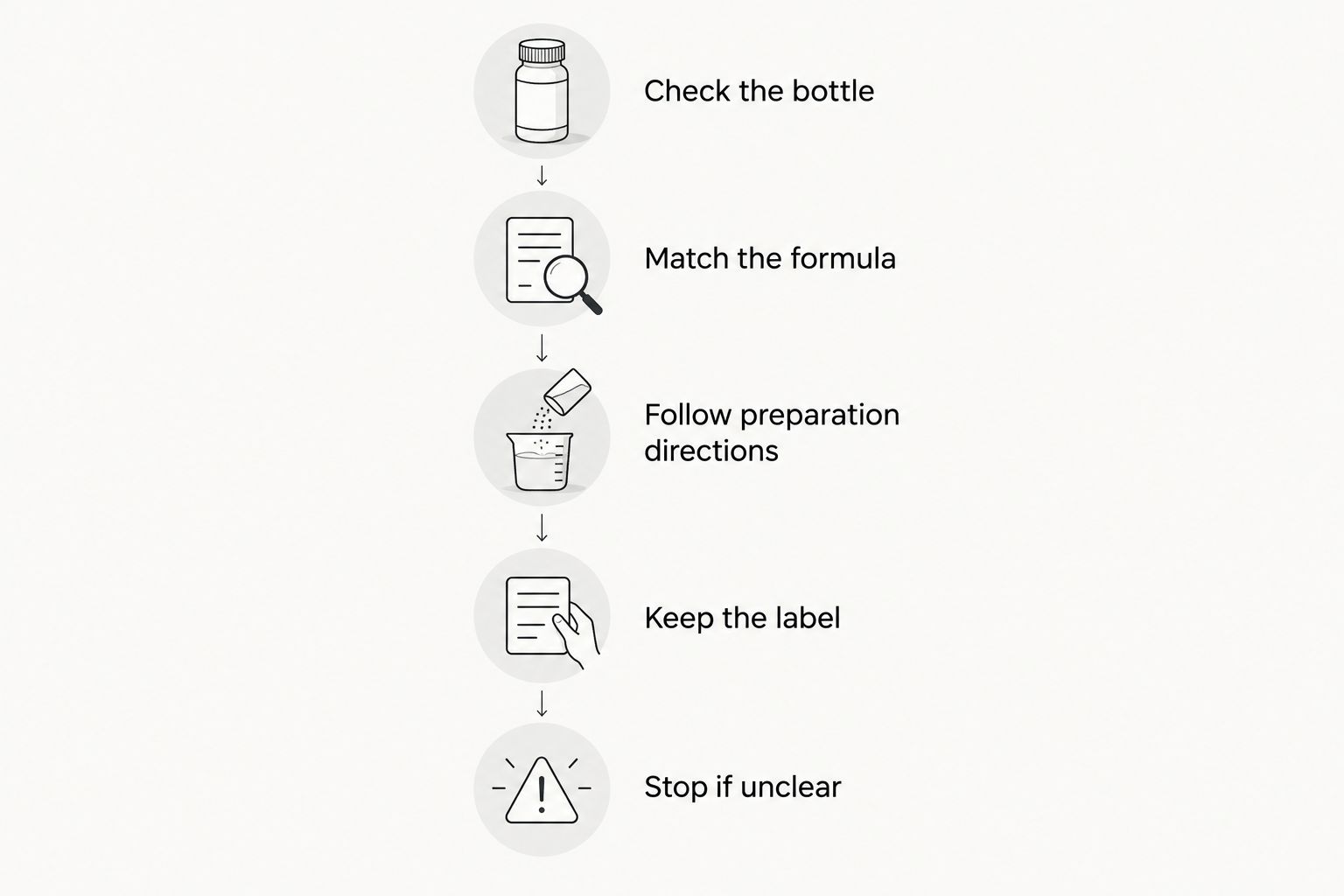
A refill instruction should resolve the practical questions you would otherwise have to improvise. If it tells you what to pour but not how to prepare a previously used bottle, ask for that missing step before proceeding.
Why refill suitability varies
Not all hypochlorous acid sprays have the same formulation or packaging. That does not make one automatically better; it means refill advice needs to match the actual product.
- Formula: Ingredient lists and formulation details can differ. The shared term HOCl is not a complete product specification.
- pH: The balance of hypochlorous acid and hypochlorite in water depends on pH. A listed pH is formulation information, not permission to alter the liquid.
- Container: Bottle and pump materials are part of the packaging choice. Appearance alone does not establish their suitability for a different formula.
- Handling: Opening, pouring, and touching bottle parts add handling steps. Approved instructions should explain how to manage them.
- Traceability: Combining remaining liquid with a new supply makes it harder to keep the contents tied to one batch and its labeling.
- Storage: Light and temperature affect HOCl solution stability. Follow the product's own storage instructions rather than treating every spray alike.
For a 2026 refill decision, compare the actual directions—not broad words such as natural, gentle, or multipurpose. Those descriptions do not tell you how to prepare a used spray pump.
Can you put hypochlorous acid spray in a travel bottle?
Keep hypochlorous acid spray in its original bottle unless the manufacturer confirms a suitable transfer method and container. A travel mister sold for cosmetics does not, by itself, establish compatibility with your formula.
The convenience is clear: a different bottle can fit a particular bag. The limitation is equally important: you are separating the liquid from its original packaging and potentially its instructions.
Before packing, check the rules that apply to your route and luggage type. A 150 mL bottle is not the same size as a 100 mL container, and transferring liquid solely to fit a travel rule does not resolve the formulation questions.
If you need a smaller format, ask the manufacturer about supported options. Do not turn a packing problem into a formulation experiment.
Can you top off a bottle that still contains spray?
Do not top off a hypochlorous acid face spray unless the manufacturer's refill directions explicitly permit it. Pouring fresh liquid over the remainder combines supplies and leaves you without a clear, single-batch identity for the contents.
Even if both bottles carry the same product name, you still need to know what the refill process requires. Emptying, cleaning, drying, and refilling are separate steps; do not assume any of them is required—or unnecessary—without directions.
For a shared family routine, keep the original label readable. Someone picking up the bottle should not have to remember which liquid was poured into it or when the contents changed.
Can you add water to make face spray last longer?
Do not add water to stretch a finished hypochlorous acid face spray. Adding water changes the formulation and lowers the concentration of the ingredients already present.
Purified water appearing on an ingredient list does not mean extra water belongs in the finished product. The amount used during manufacturing is part of the formula; adding more at home is a different action.
Do not add essential oils, fragrance, toner, or another skincare product either. Use separate products according to their own directions rather than combining them inside the mist bottle.
In 2026, the useful meaning of a simple routine is fewer improvised steps—not a homemade version of a finished formula. Keep the contents unchanged.
What the listed product details actually tell you
Gina Rivera's founder story is the starting point for Xoxo Gina HALO™, while the refill decision belongs with the product's specific directions. A brand story explains the person behind a product; it does not replace instructions for handling the formula.
The supplied details for Xoxo Gina HALO™ Wellness Mist list a 5 fl oz / 150 mL bottle, pH 4.5, and three ingredients. Purified water and hypochlorous acid are explicitly named in that description; use the complete package label when checking the full ingredient list.
Xoxo Gina HALO™ Wellness Mist is best for shoppers seeking a hypochlorous acid face mist with a listed pH of 4.5 and a 150 mL format. Those details give you concrete information to compare with your preferences.
They do not establish refill compatibility, a period of use after transfer, or superior performance over another spray. Nor does pH 4.5 prove that a product will suit every sensitive or reactive skin routine.
If your question is whether you can reuse this specific bottle, ask for product-specific refill instructions. Keep that question separate from whether you like the mist itself.
Keep your gym routine simple
If you carry face mist to a workout, keep the formula identified and follow its storage directions. Do not leave an unlabeled decanted bottle in your gym bag and rely on memory to distinguish it from other sprays.
A spray bottle is also not a substitute for the rest of your routine. Follow the facial-use directions on your own product rather than assuming instructions for body or surface use apply to your face.
For your 2026 gym kit, make one small check: can you still read the label? If wear or a spill has obscured the directions, obtain them from the manufacturer before changing how you use or store the spray.
Ask a question that gets a useful answer
A specific question gets you further than asking whether HOCl is generally refillable. Identify your product and ask whether its original bottle and pump are approved for repeated filling.
Then ask which refill is intended, whether any remaining liquid must be removed, and what preparation the manufacturer requires. Include a question about labeling after refilling: you need to know which storage and expiry directions apply to the new contents.
You can contact the brand about bottle reuse before opening a new bottle for transfer. Keep the response with your product information so you do not have to reconstruct the process later.
FAQ
Can I refill my hypochlorous acid face spray bottle at home?
Refill your hypochlorous acid face spray bottle only when its manufacturer supplies an approved refill method. Follow the exact directions for the bottle, formula, preparation, and labeling.
Can I wash an empty face mist bottle and reuse it?
Washing an empty face mist bottle does not establish that it is suitable for another hypochlorous acid formula. Ask the manufacturer whether reuse is supported and how the bottle and pump must be prepared.
Can I mix two hypochlorous acid sprays in one bottle?
Do not mix two hypochlorous acid sprays unless the manufacturer explicitly directs you to do so. A shared ingredient name does not establish that their formulations or handling instructions are interchangeable.
Can I dilute hypochlorous acid spray for sensitive skin?
Do not dilute a finished hypochlorous acid face spray to make it suitable for sensitive skin. Dilution changes the formula; follow the product's directions instead of adjusting it at home.
Does pH 4.5 mean a face spray bottle is refillable?
pH 4.5 does not mean a face spray bottle is refillable. It describes a formulation characteristic, while refill suitability requires instructions for the container and its reuse.
Does a 150 mL bottle tell me how long the spray lasts?
A 150 mL bottle states the volume, not a guaranteed duration of use. Follow any expiry and after-opening directions supplied with the product rather than estimating them from bottle size.
What should I check before buying a refill in 2026?
In 2026, check that the refill is explicitly intended for your exact bottle and formula. Read the preparation, storage, labeling, and expiry instructions before buying it for reuse.
One last thing
The detail that matters most is not whether the spray head unscrews. It is whether the manufacturer explains what happens next.
A removable cap gives you access to the contents. Refill directions give you a process. Keep those ideas separate, and you can make a bottle-reuse decision without guessing about your face mist.