
November 24, 2026
Can you layer hypochlorous acid spray under sunscreen?

Yes—you can layer hypochlorous acid spray under sunscreen: apply the mist first, let your skin dry, then apply sunscreen according to its label. The mist does not add sun protection, and layering it correctly does not establish that every mist-and-sunscreen combination has been tested together.
- Apply hypochlorous acid spray under sunscreen only after letting the mist dry on your skin.
- Keep sunscreen as your final skincare layer before makeup; never mix it with the mist.
- Xoxo Gina HALO™ Wellness Mist fits a pre-sunscreen mist step, not a sun-protection step.
- Use broad-spectrum, water-resistant SPF 30 or higher, following American Academy of Dermatology guidance.
Why this matters
A face mist and sunscreen have different jobs. A hypochlorous acid mist is an optional skincare step. Sunscreen provides the labeled UV protection when you apply and reapply it as directed.
For your 2026 routine, focus on the sunscreen instructions rather than adding more layers. The American Academy of Dermatology recommends broad-spectrum, water-resistant sunscreen with SPF 30 or higher, alongside shade and protective clothing. A mist does not change those recommendations.
Already dealing with too much sun? Read the separate guide to hypochlorous acid spray on sunburned skin. Using a product before sunscreen is a different question from deciding what belongs on irritated skin afterward.
Can you layer hypochlorous acid spray under sunscreen?
Yes. Keep the layers separate, and let the mist dry before sunscreen. Use the hypochlorous acid product only on the areas and in the manner its label allows. Then follow your sunscreen's directions for application, timing, and reapplication.
There is no universal waiting time for every hypochlorous acid formula. How much you spray, the formula, and your surroundings affect drying. Use dry skin as the practical checkpoint rather than inventing a countdown.
The same basic order applies whether your sunscreen uses mineral filters, non-mineral filters, or a combination. The sunscreen's own directions still decide how to use that particular formula.
| Routine option | Best for | Advantage | Limitation |
|---|---|---|---|
| Mist before sunscreen | People keeping an optional mist step | Keeps the mist separate from the final sunscreen application | Adds a drying step; compatibility is formula-specific |
| Sunscreen without a mist | People simplifying their morning | Removes an optional layer | Does not include the mist step you might prefer |
| Mist after sunscreen | People considering a midday refresh | Places the mist later in the routine | Does not renew SPF and does not establish that the sunscreen layer remains unchanged |
The simplest recommendation is the first option if you want both products. If you do not want a mist, skip it. You do not need hypochlorous acid spray to make sunscreen work.
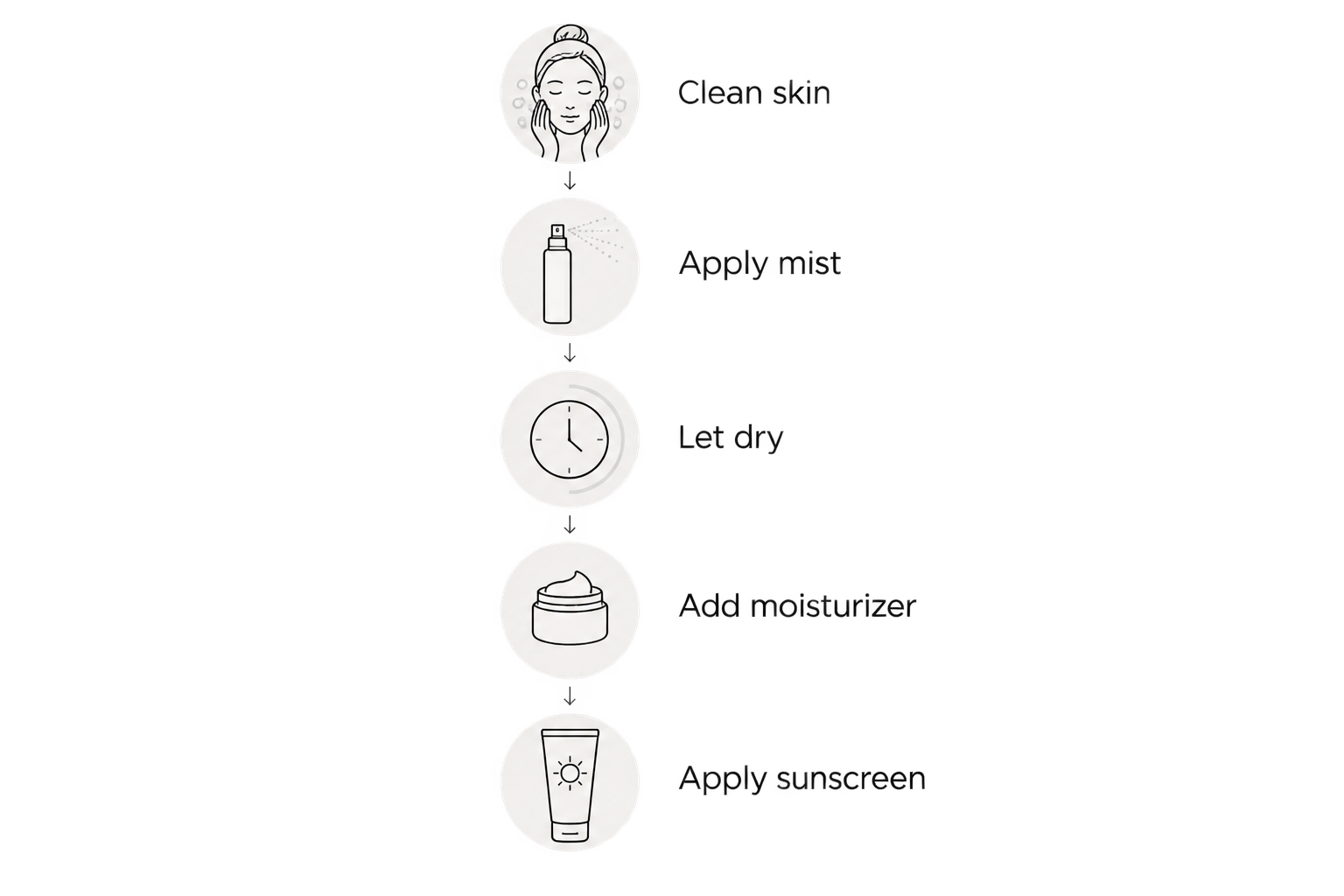
A simple 2026 morning routine
Keep the order clear. You do not need a complicated schedule or a separate routine for every sunscreen filter.
Start with clean skin
Cleanse as you normally would, then follow the mist's directions about application. Avoid adding extra cleansing steps just because you are using a spray.
If your skin is already uncomfortable, do not use the routine as a reason to keep trying products. Pause the optional step and get advice if irritation persists.
Apply the mist as directed
Use the amount and application method on the product label. More spray is not evidence of more benefit, and a mist labeled for skincare should not automatically be treated as suitable for every other use.
Do not combine sunscreen and mist in your hand, pour them into the same bottle, or spray the mist into sunscreen. Mixing creates a combination that is different from the sunscreen as supplied and tested.
Let the mist dry
Wait until your skin is dry before moving on. There is no need to rub vigorously or keep applying more mist while you wait.
Dry first. Apply sunscreen second. That is a sequencing rule, not proof of a particular chemical interaction between the products.
Add moisturizer if you use it
If moisturizer belongs in your routine, apply it before sunscreen unless your product directions say otherwise. Give the layers a chance to settle rather than immediately rubbing everything together.
A mist is not automatically a substitute for moisturizer. Whether you need moisturizer depends on your skin and the rest of your routine, not simply on whether your face feels wet after spraying.
Finish with sunscreen
Apply sunscreen generously and evenly, following its label. The American Academy of Dermatology advises applying sunscreen 15 minutes before going outdoors and reapplying approximately every two hours outdoors, including after swimming or sweating as directed.
Apply makeup afterward if you wear it. Do not reduce your sunscreen application to accommodate the texture of earlier skincare layers.
Why the layering experience varies
A routine that feels comfortable on one person can feel sticky or pill on another. That does not establish that either product is ineffective, and a smooth finish does not prove UV protection.
These factors change how the layers apply:
- Formula: Hypochlorous acid sprays and sunscreens contain different ingredients. The category name alone does not establish compatibility.
- Application amount: A heavy mist leaves more liquid to dry. Sunscreen still needs the application its label calls for.
- Drying conditions: Humidity, airflow, and the amount applied affect how quickly the skin feels dry.
- Other layers: Moisturizer, serums, and makeup add more textures to the routine. Check those directions too.
- Rubbing: Repeatedly working over layers can produce visible rolling or pilling. Avoid unnecessary rubbing after application.
- Skin response: Stinging, itching, or persistent redness calls for reassessment, not another layer to cover the sensation.
If you want to simplify, remove an optional skincare step first. Do not respond to pilling by using less sunscreen than directed.
Where Xoxo Gina HALO™ Wellness Mist fits
Gina Rivera is the founder behind Xoxo Gina HALO™. Start with the founder's story and the documented formula—not the assumption that fewer ingredients automatically make a product better for everyone.
Xoxo Gina HALO™ Wellness Mist comes in a 5 fl oz / 150 mL bottle. Its product listing describes a three-ingredient formula at pH 4.5. Those details describe the product; they do not establish sunscreen compatibility, UV protection, or a guaranteed response from sensitive skin.
Xoxo Gina HALO™ Wellness Mist is best for shoppers seeking an optional hypochlorous acid mist step before sunscreen. Its place in this routine is before sunscreen, with drying time between the applications and both products used according to their directions.
The advantage is a clearly separate mist step if you enjoy using one. The limitation is equally clear: the mist adds an application and drying step without replacing sunscreen, moisturizer, or sunscreen reapplication.
When reviewing skincare in 2026, treat bottle size, pH, and ingredient count as product information rather than a ranking system. None of those details alone proves that a formula is safer, more effective, or better suited to your skin than another formula.
Can you spray hypochlorous acid over sunscreen instead?
Spraying hypochlorous acid over sunscreen does not renew its SPF. It also does not prove that your sunscreen layer remains unchanged after spraying, wiping, or rubbing.
For a straightforward routine, place the optional mist before your morning sunscreen. If you use a mist later, do not treat a refreshed feeling as evidence that you are protected for longer.
There is no universal answer establishing how every mist affects every sunscreen film. Use the sunscreen's reapplication instructions rather than assuming that a face spray either preserves or removes a known amount of protection.
Do you need to wait a specific time before applying sunscreen?
There is no universal waiting time for hypochlorous acid spray before sunscreen. Let the mist dry, then follow any additional directions on the products you are using.
Keep that drying step separate from sunscreen's outdoor timing. The American Academy of Dermatology's 15-minute pre-exposure guidance concerns sunscreen application before going outside; it is not a required drying interval for hypochlorous acid mist.
For your 2026 routine, the useful checkpoints are simple: the mist has dried, the sunscreen is applied as directed, and you have allowed the sunscreen's instructed time before outdoor exposure.
What if your sunscreen pills after using the mist?
Pilling is a reason to simplify the routine, not a reliable test of sunscreen protection. Visible flakes or rolls do not tell you an exact remaining SPF.
Try the sunscreen on a separate occasion without the optional mist and keep the rest of the routine consistent. If the problem continues, review your moisturizer and makeup layers rather than assuming the mist is responsible.
Check the sunscreen's instructions and ask its manufacturer about persistent application problems. If you cannot apply the sunscreen evenly, choose a sunscreen texture you can use as directed instead of settling for a patchy finish.
Keep gym and family routines practical
After exercise, do not count a quick mist as a replacement for cleansing when needed or for sunscreen reapplication. Follow your sunscreen label after sweating, and use water-resistant sunscreen for swimming or activities that make you sweat.
For family use, check each product's directions separately. Your own tolerance does not establish that a product suits a child's skin, and an adult skincare routine is not automatically a child's routine.
The FDA advises asking a doctor about sunscreen use for infants younger than six months. Shade and protective clothing remain important parts of sun protection, whatever optional skincare steps your family uses.
FAQ
Can I use hypochlorous acid spray under sunscreen every morning?
You can include hypochlorous acid spray before sunscreen when both products' directions support that use and your skin tolerates the routine. Let the mist dry, and stop the optional step if it causes irritation.
Should hypochlorous acid spray go before or after moisturizer?
For the routine described here, use the mist on clean skin, let it dry, then apply moisturizer if needed and sunscreen afterward. Follow any different instructions supplied with your products.
Does hypochlorous acid spray make sunscreen stronger?
Do not count hypochlorous acid spray toward your sunscreen protection. Choose broad-spectrum, water-resistant SPF 30 or higher and apply it as directed.
Can I mix hypochlorous acid spray into sunscreen?
No—apply hypochlorous acid spray and sunscreen separately. Mixing changes the sunscreen from the formula supplied and tested, so its labeled protection cannot be assumed for that mixture.
Can I use Xoxo Gina HALO™ Wellness Mist before mineral sunscreen?
Use Xoxo Gina HALO™ Wellness Mist as a separate pre-sunscreen step according to its directions, letting it dry before applying sunscreen. Mineral filters alone do not establish compatibility between two finished formulas.
Do I need to reapply sunscreen after sweating at the gym?
Follow your sunscreen label's instructions for reapplication after sweating. A hypochlorous acid mist does not replace that application or restart the sunscreen's protection interval.
What is the simplest sunscreen layering routine for 2026?
The simplest 2026 routine is to keep optional skincare separate from sunscreen and follow the sunscreen label. If you include a hypochlorous acid mist, apply it first and let it dry before the remaining layers.
One last thing
A comfortable finish is not a sunscreen test. Skin can feel fresh and dry without telling you anything about the amount or evenness of sunscreen applied.
Build your routine around the step with the protection claim: sunscreen. Keep the mist optional, let it dry, and never trade away a proper sunscreen application to make another product fit.