
November 25, 2026
Can hypochlorous acid spray cause purging or breakouts?

Hypochlorous acid spray is not expected to cause true skin purging because it is not an exfoliant or a retinoid. New bumps, burning, or itching after you start a spray are reasons to pause and assess your routine—not signs that you need to push through for better skin.
- Can hypochlorous acid spray cause purging? Purging is not an expected effect; new breakouts deserve reassessment.
- Xoxo Gina HALO™ Wellness Mist suits shoppers seeking a hypochlorous acid mist, not an exfoliating step.
- Pause a new spray if you develop burning, itching, swelling, or worsening bumps.
- Change one product at a time so you can better identify what your skin tolerates.
Why this matters
Calling every breakout a purge can keep you using something your skin does not tolerate. It can also distract you from another recent change, such as a new sunscreen, exfoliant, or heavier moisturizer.
If you are adding a spray to your 2026 routine, separate the brand story from the skin response. You can explore Gina Rivera’s founder story to understand the background behind Xoxo Gina HALO™; deciding whether a formula suits you still starts with its directions and your own experience. A product does not need to make your skin worse before it can belong in your routine.
Can hypochlorous acid spray cause purging or breakouts?
Hypochlorous acid spray is not expected to cause purging, but breakouts or irritation can occur after you introduce a new skincare product. Timing alone does not establish what caused the change. The full formula, other products, and your skin’s existing condition all matter.
People commonly use purging to describe an early increase in blemishes after starting an ingredient that affects skin-cell turnover. Hypochlorous acid does not have the exfoliating role of an acid exfoliant. The word acid in its name does not make it a peel.
Use the differences below to decide your next step—not to diagnose yourself from a mirror.
| Pattern | What it tells you | What to do |
|---|---|---|
| Bumps after starting hypochlorous acid spray | The timing deserves attention, but does not prove purging or causation | Pause the new product and review other changes |
| Stinging, itching, redness, or a rash-like texture | These are reasons to consider irritation rather than assume a normal adjustment | Stop the new product and seek advice if symptoms persist or worsen |
| Blemishes while starting several products together | You cannot reliably isolate one product from timing alone | Simplify your routine before making further changes |
| Severe swelling or breathing difficulty | This needs urgent medical attention, not skincare troubleshooting | Seek emergency help |
A photograph can help you track changes, but it cannot reliably distinguish acne, irritation, and an allergic reaction. Persistent or uncomfortable symptoms belong with a qualified healthcare professional.
The practical distinction is simple: a familiar-looking pimple does not automatically identify the cause, and a new uncomfortable reaction does not earn a mandatory waiting period. Pay attention to both appearance and sensation.
Why reactions to a new spray vary
Not all hypochlorous acid sprays are interchangeable. Their intended uses, full formulas, packaging, and directions can differ. None of those differences alone establishes that one formula is safer or more effective than another.
When your skin changes after adding a spray, review these factors:
- The full formula. Read the entire ingredient list, not only the ingredient on the front. A reaction after application does not identify which ingredient was responsible.
- Other recent additions. A new exfoliant, retinoid, sunscreen, cleanser, or moisturizer complicates the picture. Record everything you changed rather than focusing only on the newest-looking bottle.
- Your skin’s starting point. Skin that already feels sore, tight, or irritated needs a different decision from skin that feels comfortable. Do not use an uncomfortable baseline to judge whether a new product agrees with you.
- Application habits. Use the product according to its own directions. Applying more often to chase faster results makes it harder to judge normal use and is not a reason to expect better results.
- Sweat, friction, and equipment. Exercise routines, close-fitting clothing, and equipment that rubs the skin are relevant context. Note where bumps appear and what touches that area.
- Handling and storage. Follow the label’s storage instructions and keep the nozzle clean. Do not assume that directions for one bottle apply to every hypochlorous acid product.
These are checks, not a list of proven causes for your particular breakout. You do not need to settle the diagnosis before deciding to stop something that feels uncomfortable.
What should you do if bumps appear after spraying?
Pause the new spray, simplify your routine, and document what changed. You do not need to prove that a product caused the reaction before taking a break from it.
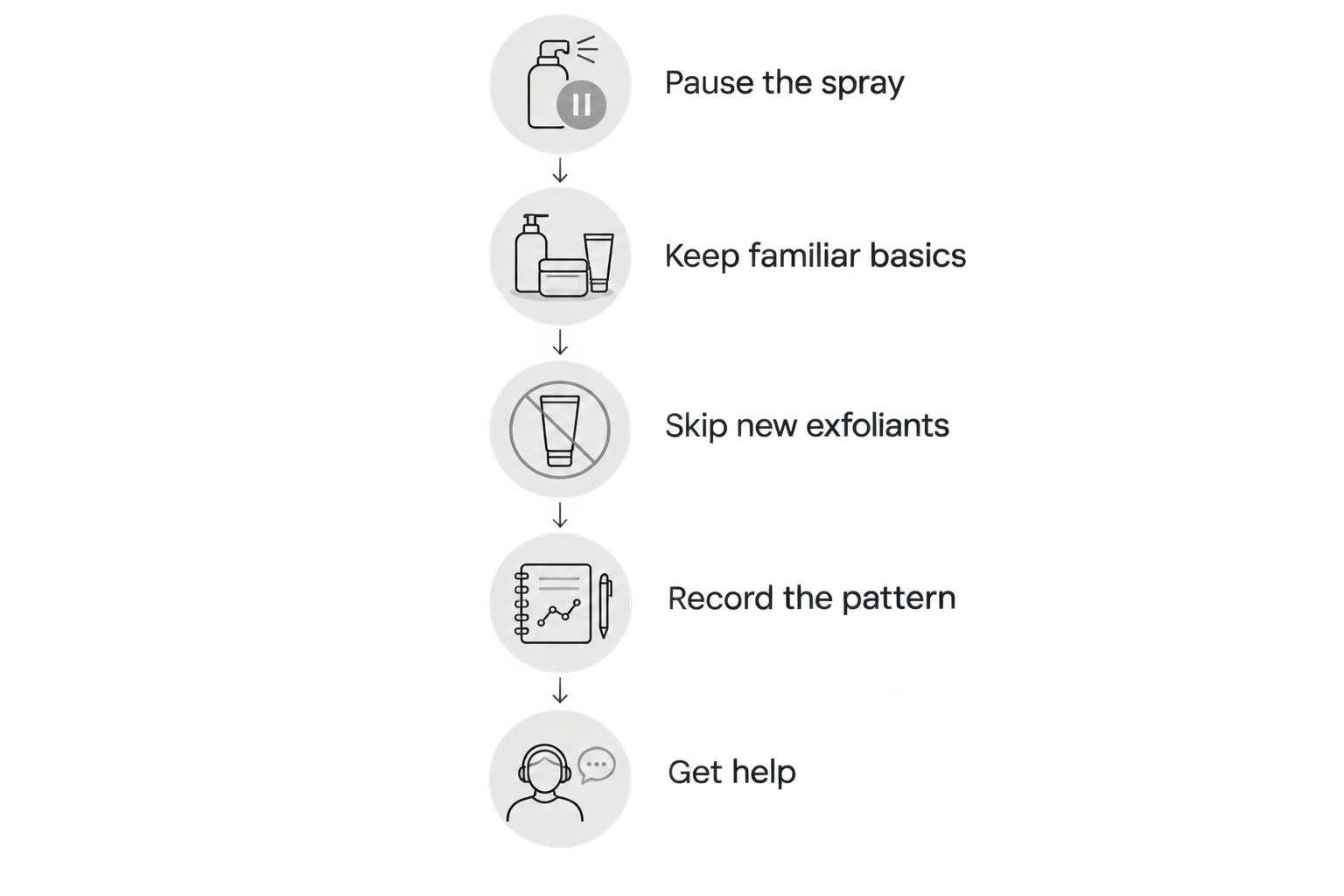
Use this sequence to make the next decision clearer:
- Pause the spray. Stop applying the new product rather than increasing use to get through an assumed purge. If you introduced several products together, write them all down before changing anything else.
- Keep familiar basics. Stick with products you already tolerate, including your usual gentle cleanser, moisturizer, and sunscreen. Avoid adding another unfamiliar product to solve an unclear reaction.
- Skip new exfoliants. Do not add a scrub or peeling product to remove the bumps. That introduces another variable and can make already uncomfortable skin harder to assess.
- Record the pattern. Note when you first used the spray, where you applied it, and when symptoms appeared. Include itching, burning, tenderness, or tightness—not just the number of visible spots.
- Get help. Contact a dermatologist or another qualified clinician for persistent, worsening, painful, or unclear symptoms. Do not restart a product that caused a significant reaction without professional guidance.
A simple routine log is more useful than a crowded shelf. For your 2026 skincare notes, record the product name, application area, other products used, and what you noticed afterward. Photographs taken in similar lighting can make your notes easier to interpret.
If you choose to try a different skincare product later, introduce it separately rather than rebuilding the whole routine at once. Small-area testing can help identify some reactions, but it cannot guarantee that full-face use will cause no problems. Follow the product’s directions and any advice from your clinician.
Can hypochlorous acid spray cause pimples the next day?
Pimples noticed the next day do not prove that hypochlorous acid caused them. A blemish can be developing before it becomes visible, so the moment you notice it is not necessarily the moment it began.
That does not mean you should dismiss the timing. Record it, especially if the change follows a new application or appears alongside itching, burning, or redness. Those details help you describe the reaction without assigning it a cause prematurely.
Avoid deliberately repeating an uncomfortable reaction just to test your theory. A clear history is useful; provoking another reaction is not a requirement. If the same concern keeps returning, bring the product label and your routine notes to a dermatologist.
How long should you wait for a hypochlorous acid purge to stop?
There is no established hypochlorous acid purge period that you need to complete. Do not borrow an adjustment timeline from retinoid advice and apply it to a different ingredient.
Waiting is especially unhelpful when your skin feels increasingly uncomfortable. Stop the new product if you develop burning, itching, swelling, or worsening irritation, and seek medical advice when symptoms persist or concern you.
A comfortable application also does not guarantee that every later bump is unrelated. Look at the full pattern rather than using a single good or bad application as the verdict. Your next step should follow what your skin is doing, not an online countdown.
Is hypochlorous acid spray an exfoliant?
Hypochlorous acid spray is not an exfoliant simply because its name contains the word acid. Different acids have different chemical properties and uses; a shared word does not establish a shared skincare function.
This matters when you decide where a mist belongs. Do not treat it as a peel, use extra applications to encourage shedding, or interpret flaking as evidence that the product is working. Follow the bottle’s intended use rather than instructions for another category.
Likewise, do not use a skincare mist as a substitute for prescribed acne care. If you are following a dermatologist’s treatment plan, ask how a new cosmetic product fits before changing that plan yourself.
Check the bottle, not the promise
Gina Rivera’s founder story provides the background to Xoxo Gina HALO™. For a purchase decision, pair that story with the product’s documented formulation and intended use—not an assumption that a founder-led formula must suit every person.
Xoxo Gina HALO™ Wellness Mist is best for shoppers seeking a hypochlorous acid face-and-body mist, not an exfoliating step. The product description specifies a 5 fl oz / 150 mL bottle, pH 4.5, and a three-ingredient formula that includes purified water and hypochlorous acid.
Those details answer different questions:
- Bottle size tells you how much product the bottle contains. It does not establish how your skin will respond.
- pH describes a formulation property. It does not, by itself, prove gentleness, effectiveness, or compatibility with every routine.
- Ingredient count describes formula simplicity. A short list is easier to review, but does not rule out an individual reaction.
For a 2026 purchase, read the current full ingredient list and directions before use. Check the actual label rather than assuming that a general article covers every detail of the bottle you receive.
The useful distinction is purpose: a mist can fit a simple routine without being an exfoliant. Its limitation is equally important—it cannot tell you why new bumps appeared or replace an assessment of persistent skin symptoms.
Keep skincare and surface directions separate
A product’s suitability for one use does not automatically establish another. Use a spray on your face or body only when its own directions identify that use, and follow separate instructions for any surface application.
For gym bags and shared family routines, keep the original label with the product. Do not transfer a spray into an unidentified bottle or assume that every family member should use it in the same way. Check age-specific directions before applying a product to a child.
If your face becomes uncomfortable after exercise, review the whole routine: sweat, rubbing, cleansing, and the products applied afterward. Adding more spray is not a substitute for understanding what changed.
FAQ
Can hypochlorous acid spray cause purging on sensitive skin?
Hypochlorous acid spray is not expected to cause true purging, including on sensitive skin. New burning, itching, redness, or bumps are reasons to pause and reassess rather than continue through an assumed adjustment.
Should I keep using hypochlorous acid spray if I break out?
Pause the new spray rather than continuing on the assumption that the breakout is a purge. Review other recent changes and contact a dermatologist if symptoms persist, worsen, or are painful.
Can I be allergic to a hypochlorous acid spray?
A reaction to a skincare spray can involve an ingredient in its formula, but symptoms alone do not identify an allergy or the responsible ingredient. Stop the product and seek medical advice; breathing difficulty or severe swelling needs emergency help.
Does a low pH mean a spray cannot irritate my skin?
No, pH alone cannot establish that a spray will not irritate your skin. The full formulation, directions, and your individual response all matter.
Can I use a hypochlorous acid mist with my acne products?
Check the mist’s directions and ask your prescriber how it fits with prescribed acne products. Introduce changes separately, and do not replace prescribed treatment with a cosmetic mist.
What should I check before buying a hypochlorous acid spray in 2026?
For a 2026 purchase, check the complete ingredient list, intended uses, application directions, and storage instructions. Do not assume that every hypochlorous acid spray is formulated or labelled for the same purpose.
Can the 150 mL bottle go in a standard US carry-on liquids bag?
A 150 mL bottle exceeds the standard TSA carry-on container limit of 100 mL, or 3.4 fl oz, even when partly empty. Check current TSA rules and any applicable exceptions before packing.
One last thing
The word acid is not a skincare job description. It does not tell you whether a product exfoliates, whether your skin will tolerate it, or whether new bumps are a purge.
Make that your 2026 rule: match your expectations to the actual formula and directions. If a new spray leaves your skin uncomfortable, pause it. A simple routine should give you fewer decisions to untangle—not a reason to ignore what your skin is telling you.