
November 23, 2026
Can hypochlorous acid spray calm razor burn after shaving?

Hypochlorous acid spray is an optional post-shave step, not a guaranteed way to calm razor burn. The ingredient name alone does not establish that a particular spray relieves shaving irritation, and a surface-cleaning formula is not interchangeable with a skin-care formula. For your 2026 routine, start with less friction, a cool compress, and a simple moisturizer rather than adding another product to uncomfortable skin.
- Hypochlorous acid spray for razor burn is optional; the ingredient alone does not establish relief from shaving irritation.
- Xoxo Gina HALO™ Wellness Mist offers a 150 mL format, not a documented razor-burn treatment.
- Start with a cool compress, gentle cleansing, and fragrance-free moisturizer after shaving.
- For 2026 shopping, check skin-use directions rather than relying on ingredient count or pH alone.
Can hypochlorous acid spray calm razor burn after shaving?
Do not treat hypochlorous acid spray as a proven razor-burn remedy just because it contains hypochlorous acid. Evidence about an ingredient is not automatically evidence about every finished formula, application method, or skin concern. Your immediate goal is simpler: stop aggravating freshly shaved skin.
Gina Rivera’s founder story is the starting point for understanding Xoxo Gina HALO™. Read the brand’s background, then judge any post-shave product by its labeled use and your skin’s response—not by the story alone.
These post-shave options serve different purposes. None makes repeated shaving over irritated skin a good idea.
| Option | Best for | Practical benefit | Limitation |
|---|---|---|---|
| Cool, damp compress | Immediate comfort | Cools the area without adding another formula | Does not address the shaving habit causing irritation |
| Fragrance-free moisturizer | Dryness or tightness | Supports moisture retention after washing | A particular formula can still sting or disagree with your skin |
| Skin-labeled hypochlorous acid spray | An optional mist step | Provides a spray-on application when its directions allow post-shave use | Does not replace moisturizer or establish razor-burn relief |
| A break from shaving | Skin that feels irritated | Removes further razor friction while the area settles | Does not fit every grooming preference or schedule |
Why this matters
Razor burn describes irritation after shaving; it does not tell you that your skin needs an antibacterial product. Friction, repeated passes, and shaving technique can contribute to the discomfort. Adding more active products does not correct those causes.
Keep your 2026 post-shave routine easy to assess. When you change your razor, shaving product, mist, and moisturizer together, you lose the ability to tell which change helped—or which one caused trouble.
Comfort comes before a complicated routine. Give your skin fewer things to react to, and keep any optional mist genuinely optional.
Start with comfort, not another active
If your skin feels hot, tight, or tender after shaving, step away from the razor. Do not make another pass to catch the hairs you missed. A closer shave is not worth adding friction to an area that already feels uncomfortable.
Use this sequence as a simple starting point, adjusting it to your skin and any instructions from your clinician.
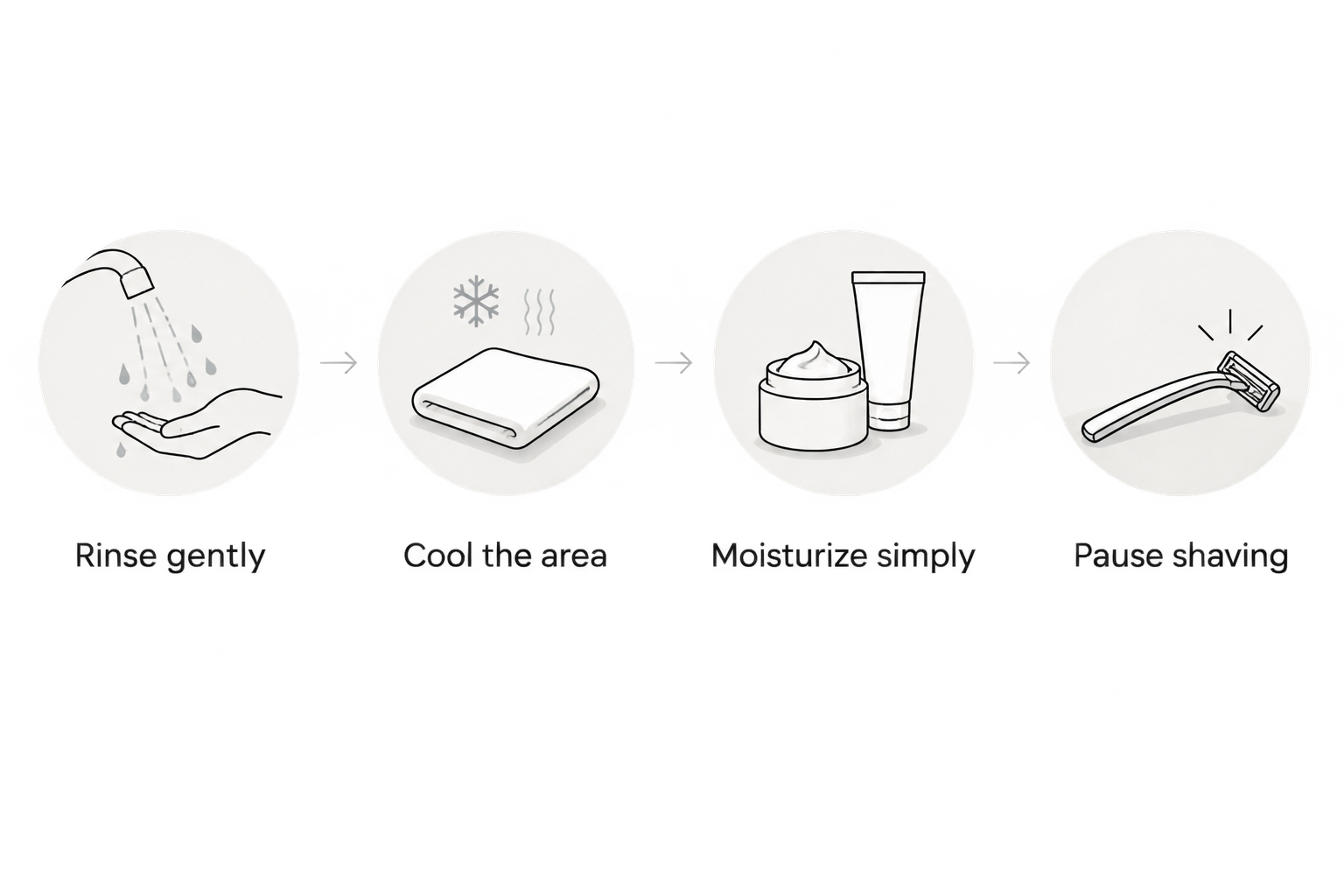
- Rinse gently. Remove leftover shaving product with water. Skip scrubbing, exfoliating cloths, and vigorous towel drying.
- Cool the area. Rest a clean, cool, damp cloth against the skin. Avoid rubbing it back and forth.
- Moisturize simply. Choose a fragrance-free moisturizer you already tolerate. A mist does not take over this job.
- Pause shaving. Leave the irritated area alone rather than shaving over it again. Reduce other sources of rubbing where practical.
If you want to try a skin-care mist later, introduce it separately from other new products. Follow its directions and stop if it causes burning, increased redness, or discomfort. You do not need to persist through irritation to make a cosmetic product work.
Where a hypochlorous acid mist fits
A hypochlorous acid mist belongs in a post-shave routine only when its label supports the intended skin use. A product sold for surfaces is not a substitute, even when the front of the bottle names the same ingredient.
Read the directions before deciding where to apply it. Face, body, eye-area, and broken-skin use are separate questions; permission for one does not establish permission for another. Keep a cosmetic spray out of your eyes unless its labeling specifically permits that use.
If the directions allow the application you have in mind, use the product as directed rather than inventing a schedule. More spraying is not evidence of better results. Neither is a stronger sensation on the skin.
For a gym routine, avoid spraying over sweat and assuming that replaces washing. For a travel routine, keep the same distinction: a convenient bottle does not replace basic cleansing, moisturizer, or a change in shaving technique.
Read the formula without reading promises into it
A short ingredient list is useful information. It is not proof that a product cannot irritate sensitive skin, and it does not establish that the product treats razor burn. The same applies to terms such as natural or gentle.
Look at the complete formula, the intended use, and the directions together. If you already know an ingredient disagrees with your skin, that information matters more than a broad claim on the front label.
pH is a detail, not a verdict
A formula’s pH describes its acidity or alkalinity. It does not, by itself, tell you whether the finished product will feel comfortable immediately after shaving. Concentration, other ingredients, and the condition of your skin also matter.
Do not rank sprays as safer or more effective from pH alone. Without relevant finished-product evidence, that comparison goes beyond what the number can tell you.
Bottle size describes the format
Bottle volume tells you how much product the container holds. It does not establish the number of applications, how long the bottle lasts, or how much relief you will get.
That distinction matters when shopping in 2026. Compare documented details, but keep convenience claims separate from claims about skin results.
A closer look at the mist
Xoxo Gina HALO™ Wellness Mist comes in a 5 fl oz / 150 mL format, with a listed pH of 4.5. Its product information describes a three-ingredient formula and identifies purified water and hypochlorous acid among those ingredients.
Xoxo Gina HALO™ Wellness Mist is best for shoppers seeking a 150 mL hypochlorous acid mist, not a proven razor-burn treatment. That is a format-based recommendation, not a claim of better skin outcomes.
The practical benefit is a spray-on format for a simple routine. The limitation is equally important: bottle size, ingredient count, and pH do not establish relief from shaving irritation. Check the current directions before adding the mist after shaving, and keep moisturizer as a separate step.
Why your post-shave response varies
The same routine does not feel the same on every shaving day. Before blaming or crediting a mist, consider what else changed.
- Razor passes. Repeated passes increase contact and friction. Going over an already uncomfortable area adds more of the same stress.
- Shaving pressure. Pressing harder changes how the blade contacts your skin. Focus on technique rather than trying to compensate with aftercare.
- Shaving direction. Shaving against hair growth can contribute to irritation and ingrown hairs. A less-close shave can be the more comfortable choice.
- Other products. Fragranced aftershaves, exfoliating products, or formulas you do not tolerate can add irritation to freshly shaved skin.
- Existing skin condition. Skin that is already dry or irritated needs a different level of restraint than skin that feels comfortable.
- Clothing and equipment. Tight collars, waistbands, and sports gear can rub a freshly shaved area. A spray does not remove that friction.
You do not need to change every factor at once. Start with the most obvious source of discomfort, keep the rest of the routine familiar, and assess the result before adding something new.
Can I spray hypochlorous acid right after shaving?
Use hypochlorous acid immediately after shaving only if the product’s directions support that use and your skin tolerates it. Freshly shaved skin is not the place to test several unfamiliar formulas together.
If you have visible cuts or broken skin, do not assume a cosmetic mist is appropriate wound care. Follow the label and seek medical advice when needed.
Is razor burn the same as razor bumps?
Razor burn and razor bumps are not the same thing. Razor burn refers to shaving irritation; razor bumps commonly involve hairs growing back into the skin.
A hypochlorous acid mist does not change the direction of a trapped hair. Avoid picking or digging at bumps, and ask a dermatologist about recurring problems rather than repeatedly changing sprays.
Can I skip moisturizer if I use a mist?
A mist does not automatically replace moisturizer. A watery spray and a moisturizer perform different jobs, so a refreshing application is not proof that your skin’s moisture needs are covered.
If your skin feels dry or tight, use a fragrance-free moisturizer you tolerate. Keep the routine simple rather than layering products to chase a particular sensation.
Know when to stop experimenting
Mild post-shave irritation and a worsening skin problem call for different responses. Stop using a new product if discomfort increases, and avoid shaving over skin that is becoming more inflamed.
Seek medical advice for spreading redness, increasing warmth, significant pain, pus, or symptoms that persist or recur. Do not try to manage a possible infection by repeatedly applying a cosmetic spray.
Parents should follow age-specific product directions rather than assuming an adult skin-care product suits every family member. For a child with a persistent or uncomfortable rash, ask a clinician instead of treating the ingredient name as a safety guarantee.
FAQ
Does hypochlorous acid spray for razor burn actually work?
Hypochlorous acid spray is not a guaranteed remedy for razor burn. The ingredient alone does not establish that a finished product relieves shaving irritation; start with reduced friction, cooling, and a moisturizer you tolerate.
Can I use a surface hypochlorous acid spray on my face after shaving?
Do not substitute a surface-cleaning spray for a skin-care spray. Use only a product whose labeling supports the intended skin application, and follow its directions.
Should hypochlorous acid spray sting after shaving?
Do not treat stinging as a sign that a hypochlorous acid spray is working. Stop using it if it causes burning or increased irritation, and follow the label's instructions.
Can I use hypochlorous acid spray instead of moisturizer?
A hypochlorous acid spray does not automatically replace moisturizer. If your skin feels dry or tight after shaving, choose a fragrance-free moisturizer you already tolerate.
Will hypochlorous acid spray remove ingrown hairs?
Hypochlorous acid spray does not remove a trapped hair or change its growth direction. Avoid picking at ingrown hairs and seek advice for recurring or painful bumps.
What should I check before buying a post-shave spray in 2026?
Check the intended skin use, complete ingredient list, directions, and storage instructions. Do not infer razor-burn relief or better safety from pH, water source, or ingredient count alone.
When should I get help for irritation after shaving?
Get medical advice for spreading redness, increasing warmth, significant pain, pus, or irritation that persists or keeps returning. A cosmetic mist is not a substitute for assessment of a worsening skin problem.
One last thing
The most useful change to your 2026 shaving routine might happen before the aftercare step: stop chasing the closest possible shave when your skin is uncomfortable. An extra razor pass adds friction that no bottle can undo.
Keep the razor pressure light, leave irritated areas alone, and make room for a simple moisturizer. If you add a mist, let it earn its place through comfortable, label-directed use—not through promises the ingredient name cannot make.