
November 4, 2026
Can hypochlorous acid skincare replace your cleanser?

No—hypochlorous acid skincare does not replace your cleanser. A hypochlorous acid mist is not a substitute for washing away sunscreen, makeup, excess oil, and everyday buildup with an appropriate cleanser. Keep cleansing as your wash step, and use a mist only as an optional extra according to its label; spraying and leaving it on does not carry that buildup away.
- Hypochlorous acid skincare complements cleansing; it does not replace the step that removes sunscreen, makeup, and excess oil.
- Xoxo Gina HALO™ offers a hypochlorous acid mist, not a replacement cleansing routine.
- For sensitive skin, keep cleansing gentle and add a face mist only when it serves a clear purpose.
Why this matters
An easy routine starts with knowing what each step does. A cleanser removes buildup. A leave-on mist adds a different step, without the rinse or removal that makes cleansing useful.
For your 2026 skincare routine, judge products by their directions and purpose—not by how many jobs you hope one bottle can do. If you're also deciding where a spray belongs, the face mist vs. toner guide addresses that separate question. Neither format automatically replaces washing.
You do not need a longer routine to have a thoughtful one. You need each product to earn its place without quietly dropping the step that removes what is already on your skin.
Can hypochlorous acid skincare replace your cleanser?
Hypochlorous acid skincare cannot take over a cleanser's removal job. Cleansers use ingredients such as surfactants to help loosen oil and debris so you can rinse or wipe them away, depending on the product. A leave-on hypochlorous acid spray does not provide that same cleansing process.
The distinction is removal, not whether your face feels refreshed afterward. A light mist can feel pleasant while sunscreen, makeup, or oily residue remains on your skin.
| Routine option | Best for | Useful role | Limitation |
|---|---|---|---|
| A cleanser suited to your skin | Removing everyday buildup | Helps lift and remove oil, sunscreen, makeup, and debris according to its directions | An unsuitable formula or excessive washing can leave skin uncomfortable |
| A leave-on hypochlorous acid mist | An optional mist step | Adds a label-directed application without another wash | Does not replace the removal action of cleansing |
| A water rinse | A simple rinse when appropriate | Rinses away some loose surface material | Does not reliably remove oily or water-resistant products |
These are different jobs, not a ranking of good and bad products. Choose the step that matches what you need to remove, then decide whether an additional mist is useful.
Keep the wash step simple
You do not need to scrub harder because you use sunscreen or exercise. You need an appropriate cleanser, comfortable water temperature, and a gentle technique. The American Academy of Dermatology's established face-washing guidance recommends lukewarm water, fingertip application, and avoiding scrubbing.
Use this sequence when cleansing belongs in your routine:
- Check the label. Follow your cleanser's directions, including whether it goes onto wet or dry skin. Do not assume every cleansing format works the same way.
- Cleanse gently. Use your fingertips rather than adding friction with aggressive rubbing. Give attention to areas where you applied sunscreen or makeup, without repeatedly working over irritated skin.
- Rinse thoroughly. Remove the cleanser as directed. A face that feels tight afterward is not proof of a better clean.
- Use optional steps. If you choose a hypochlorous acid mist, follow its own application directions. Finish with the moisturizer and daytime sun protection appropriate to your routine.
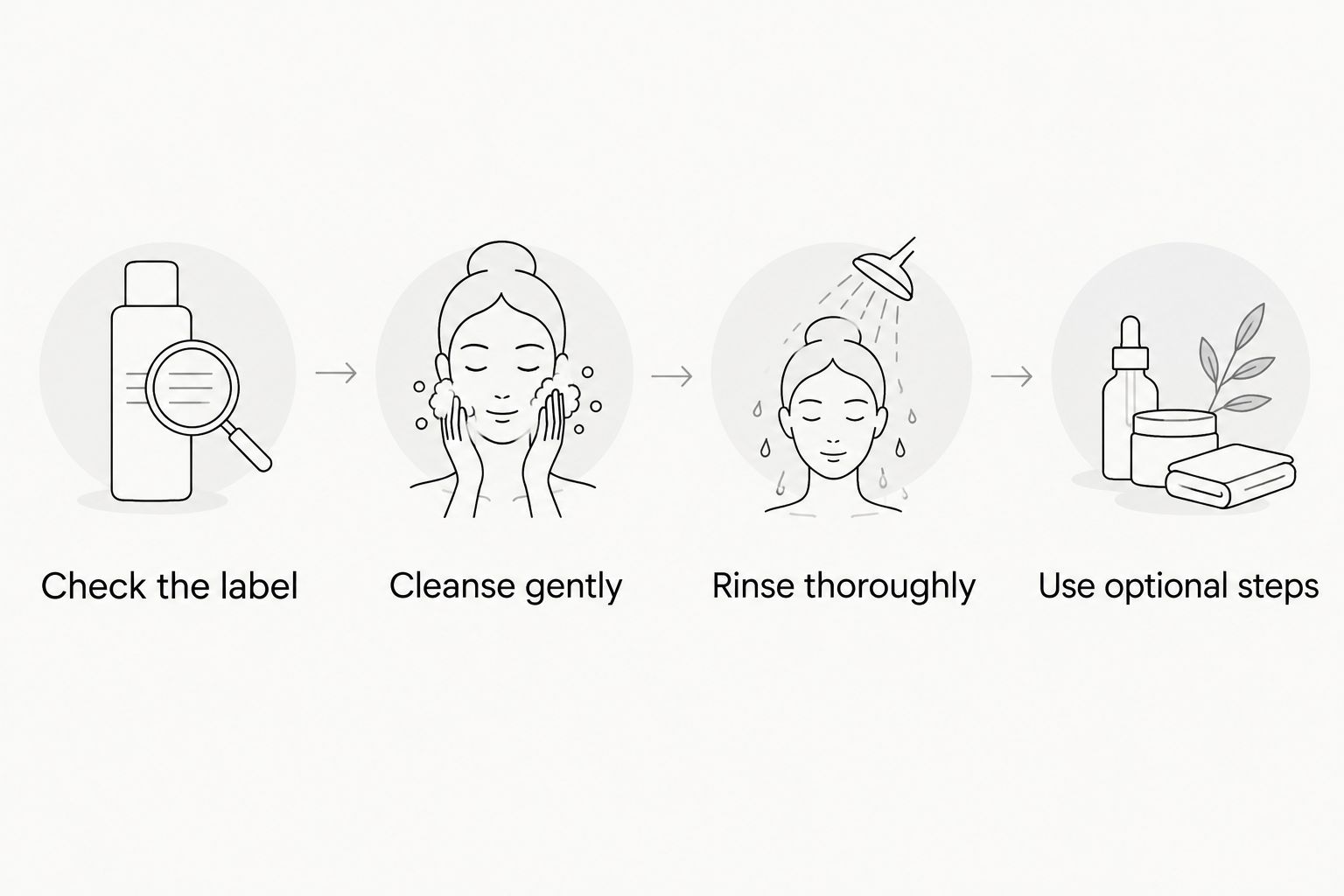
This sequence is a framework, not permission to combine every product you own. If you use prescription skincare, follow your clinician's instructions rather than changing its order around a new mist.
Rinse-off cleanser: keep its removal job
Best for: washing away the day's buildup. A rinse-off cleanser belongs in the part of your routine where you remove products and residue. Choose one suited to your skin and the products you wear.
Its benefit is practical: you loosen material and rinse it off. Its limitation is equally practical: the wrong formula, too much friction, or unnecessary repeated washing can make your routine uncomfortable.
Do not judge a cleanser only by foam, scent, or the squeaky feeling it leaves behind. Judge whether it removes what you need removed and leaves your skin comfortable enough for the rest of your routine.
Leave-on mist: keep its role optional
Best for: people who want a separate, label-directed mist step. A hypochlorous acid mist is an addition to your routine, not a shortcut around removing sunscreen or makeup. Its directions should tell you where and how to use it.
The convenience is a spray application. The limitation is that convenience does not make it a cleanser, moisturizer, sunscreen, or makeup remover.
If you are editing your routine in 2026, ask a plain question before adding anything: what job is this bottle doing? If the answer is simply that it sounds useful for everything, narrow the job before making it a daily habit.
Why your cleansing needs vary
Your need for cleansing depends on what is on your skin and how your skin responds—not on whether you own a mist. Use these factors to make the decision:
- Sunscreen. Your cleansing step needs to address the sunscreen you actually wear. Follow its removal guidance, especially for water-resistant formulas.
- Makeup. A mist does not dissolve and remove a full face of makeup simply because you spray it over the top. Choose removal products suited to the makeup.
- Sweat and activity. After exercise, focus on gently washing away sweat and residue rather than repeatedly layering spray over them.
- Skin comfort. Stinging, tightness, or persistent discomfort is a reason to reassess your routine. Adding another product does not identify or resolve the cause.
- Product directions. A face product, body product, and surface product are not interchangeable just because they mention the same ingredient. The finished formulation and labeled use matter.
There is no need to turn these factors into a complicated schedule. Start with what you wore and did that day, then choose a removal step that fits.
Formula matters. So does the job.
Gina Rivera is the founder behind Xoxo Gina HALO™. That founder connection introduces the brand; the product's documented formulation and directions are what help you decide how it belongs in your routine.
Xoxo Gina HALO™ Wellness Mist is a hypochlorous acid mist in a 5 fl oz / 150 mL bottle. Its supplied product description specifies pH 4.5, a three-ingredient formulation, and purified water. Those are formulation details—not proof that the mist removes makeup or replaces cleansing.
Xoxo Gina HALO™ is best suited to shoppers seeking a hypochlorous acid mist, not a replacement cleanser. The distinction keeps the recommendation honest: the spray format offers a separate application step, while washing still handles removal.
For your 2026 shopping checklist, read bottle size and pH as facts about the product, not a scorecard for effectiveness. A 150 mL bottle tells you its volume. A pH of 4.5 describes acidity; neither figure establishes better cleansing, universal skin tolerance, or superiority over another formula.
Should I use hypochlorous acid before or after cleansing?
After cleansing is the straightforward place for a leave-on hypochlorous acid mist, unless its label gives different instructions. That order keeps washing as the removal step and the spray as a separate application.
Do not invent a waiting period or application schedule from advice about a different product. Follow the directions on your bottle, and keep any prescribed routine unchanged unless your clinician advises otherwise.
If you are trying to simplify, leave the optional step out before replacing the cleanser with it. Fewer steps should mean fewer unnecessary products—not leaving makeup or sunscreen behind.
Can I spray hypochlorous acid over sunscreen or makeup?
Spraying hypochlorous acid over sunscreen or makeup does not remove either one. It also does not renew sun protection or replace sunscreen reapplication according to the sunscreen label.
Whether a particular mist is intended for use over other products depends on its directions. Do not assume that a spray format guarantees compatibility with every makeup finish or sunscreen formula.
At the end of the day, return to the same question: what needs to come off? Use an appropriate cleanser or makeup-removal step for that task rather than treating a refreshing sensation as evidence of removal.
Can sensitive skin skip cleanser and use a mist instead?
Sensitive skin does not make a hypochlorous acid mist a cleanser substitute. If washing feels uncomfortable, review your cleanser, water temperature, technique, and other products rather than assuming a spray solves the problem.
Introduce new skincare cautiously. The American Academy of Dermatology recommends testing new skincare products on a small area before broader use; follow product-specific precautions and stop using a product that causes irritation.
For a sensitive-skin routine in 2026, prioritize comfort and clear instructions over adding steps. Persistent redness, burning, or other ongoing symptoms deserve advice from a qualified healthcare professional, not a succession of new mists.
Make it fit your day
After a workout
Start with the actual task: removing sweat and whatever else is on your skin. Wash gently when you can, using products suited to your face rather than assuming a body or equipment spray belongs there.
A mist does not turn a towel wipe into a full cleanse. If you enjoy a separate spray step, keep it separate—and follow the label rather than increasing applications because the workout was harder.
During travel
Keep your routine recognizable. Bring a suitable cleanser, moisturizer, and sunscreen rather than asking one unfamiliar product to replace them all.
Check current transport rules before packing liquids. The 5 fl oz / 150 mL bottle size is a product detail, not a promise that it meets every carry-on restriction or fits every travel plan.
At home with family
Read age guidance and directions for each intended user. A product marketed for everyday routines does not automatically have the same suitability for every adult and child.
Keep skincare use distinct from household cleaning. Do not infer surface-disinfection claims, eye-use instructions, or age suitability from the presence of hypochlorous acid alone.
Skip these shortcuts
Do not use a fresh feeling as your cleansing test. A cooling spray, pleasant texture, or lack of visible makeup does not establish that sunscreen and oily residue are gone.
Avoid these other mix-ups:
- More spray instead of washing. Extra applications do not add the missing removal step.
- Fewer ingredients as a safety guarantee. Ingredient count alone cannot tell you how every person will tolerate a finished product.
- Matching ingredients as matching products. Shared ingredient names do not establish identical concentration, formulation, directions, or intended use.
- Surface claims carried onto skin. Follow the specific product label. Do not transfer claims from another bottle or use category.
The better shortcut is a clear routine: remove what needs removing, keep useful steps, and leave out extras that have no defined role.
FAQ
Can hypochlorous acid skincare replace my face wash?
No. Hypochlorous acid skincare does not replace a face wash's removal of oil, sunscreen, makeup, and everyday buildup. Keep a suitable cleansing step and treat a mist as optional.
Should I use a hypochlorous acid mist before or after washing my face?
Use a leave-on hypochlorous acid mist after washing unless its label directs otherwise. Follow the bottle's instructions rather than applying timing rules from another product.
Does hypochlorous acid spray remove sunscreen?
A hypochlorous acid spray is not a substitute for removing sunscreen with an appropriate cleanser. Follow the sunscreen's removal guidance, especially for water-resistant products.
Can I use a hypochlorous acid mist instead of moisturizer?
Do not assume a hypochlorous acid mist replaces moisturizer. Choose moisturizer according to your skin's needs and follow the mist's directions for its separate role.
Is a three-ingredient mist automatically better for sensitive skin?
No. A three-ingredient formula does not guarantee better tolerance for sensitive skin. The finished formulation and your individual response matter.
Can I use the same hypochlorous acid spray on my face and household surfaces?
Use a spray only for the purposes stated on its label. A shared ingredient does not make skin products and surface products interchangeable or establish disinfection claims.
Do I need a hypochlorous acid mist in my 2026 skincare routine?
No. A hypochlorous acid mist is an optional skincare step, not a requirement. Keep it only if its labeled use serves a clear purpose in your routine.
One last thing
Simplifying your routine does not mean making one product do every job. It means keeping the steps that have a purpose and removing the ones that do not.
Before your next wash, notice what is on your face: sunscreen, makeup, sweat, or everyday oil. Let that guide the removal step. Then decide whether a mist belongs afterward. For Xoxo Gina HALO™, as for any skincare brand, a clear product role is more useful than an all-purpose promise.