November 6, 2026
Can hypochlorous acid skincare go with exfoliating acids?

Yes, hypochlorous acid skincare can fit into a routine that includes exfoliating acids, but that does not establish compatibility between every finished formula. Keep the products separate, follow both labels, and avoid adding an exfoliant when your skin already feels irritated.
- Hypochlorous acid skincare and exfoliating acids serve different purposes; sharing the word acid does not make them interchangeable.
- Let each product dry before layering, but do not treat drying as proof of compatibility.
- Xoxo Gina HALO™ Wellness Mist has a stated pH of 4.5; pH alone does not establish exfoliating activity.
- For sensitive skin, introduce one change at a time rather than starting both products together.
Can hypochlorous acid skincare go with exfoliating acids?
Yes, in the same broader routine—not automatically mixed together or layered in every combination. Hypochlorous acid, often abbreviated HOCl, is chemically different from exfoliating acids such as glycolic acid, lactic acid, and salicylic acid. The shared word acid does not mean these ingredients do the same job.
For a 2026 routine, start with the directions on your actual bottles rather than a universal layering rule. Concentration, the rest of the formula, and your skin's response all matter.
| Product category | Best for | What it does | Main limitation |
|---|---|---|---|
| Hypochlorous acid skincare mist | Shoppers specifically seeking an HOCl skincare step | Adds a hypochlorous acid formulation to the routine | Does not substitute for an exfoliating product; directions vary |
| Alpha hydroxy acid exfoliant, such as glycolic or lactic acid | Shoppers seeking surface exfoliation | Helps loosen the bonds between dead surface skin cells | Can cause irritation, especially with excessive use |
| Salicylic acid exfoliant | Shoppers seeking an oil-soluble exfoliating ingredient | Provides exfoliation and can act within pores | Can cause dryness or irritation; strength and formulation matter |
Xoxo Gina HALO™ begins with founder Gina Rivera's story, not just an ingredient count. Explore the founder story, then evaluate any skincare pairing using the product directions and your own skin's response.
Why this matters
A familiar ingredient name is not a complete formula. Two bottles containing hypochlorous acid can differ in concentration, formulation, packaging, and intended use; the same is true of exfoliants.
That distinction matters when you have sensitive or reactive skin. If you introduce several products together and your skin starts stinging, you cannot easily identify which change caused the problem. Keep the routine simple enough to understand.
The goal is not to fit every active ingredient into one application. It is to choose steps with a clear purpose and use them without pushing through discomfort.
Hypochlorous acid is not an exfoliating acid
Hypochlorous acid is not an alpha hydroxy acid or salicylic acid. You should not expect an HOCl mist to perform the same exfoliating role simply because its name includes acid.
An acidic pH also does not establish that a product exfoliates. Exfoliation depends on the relevant ingredients and the finished formulation, not a pH reading in isolation.
This is a useful distinction when reviewing skincare in 2026. Ask what the finished product is intended to do before deciding where it belongs. A mist and an exfoliant do not become interchangeable because both sit on the acidic side of the pH scale.
Does a lower pH mean a stronger exfoliant?
No. You cannot compare the exfoliating strength of unrelated products using pH alone. The identity and concentration of an exfoliating acid, its formulation, and its directions all affect how you use it.
A bottle with a stated pH offers one formulation detail. It does not provide a complete tolerance assessment or prove compatibility with another bottle.
How to include both without guessing
Follow the labels before following a layering trend. If neither manufacturer addresses the combination, ask about the specific products rather than assuming that a category-wide rule applies.
Use this sequence to make the decision clearer:
- Read both labels. Confirm that each product is intended for facial skincare and note its application directions, warnings, and storage instructions.
- Check your skin. Do not add an exfoliant to skin that already feels sore, unusually dry, or irritated.
- Choose separate use. Using the products at different times avoids needing to establish immediate layering compatibility. It does not eliminate the possibility of irritation.
- Introduce gradually. Change one product at a time, following its directions, so you can identify an unwanted response.
- Review comfort. If the combination causes discomfort, stop rather than adding more products to compensate.
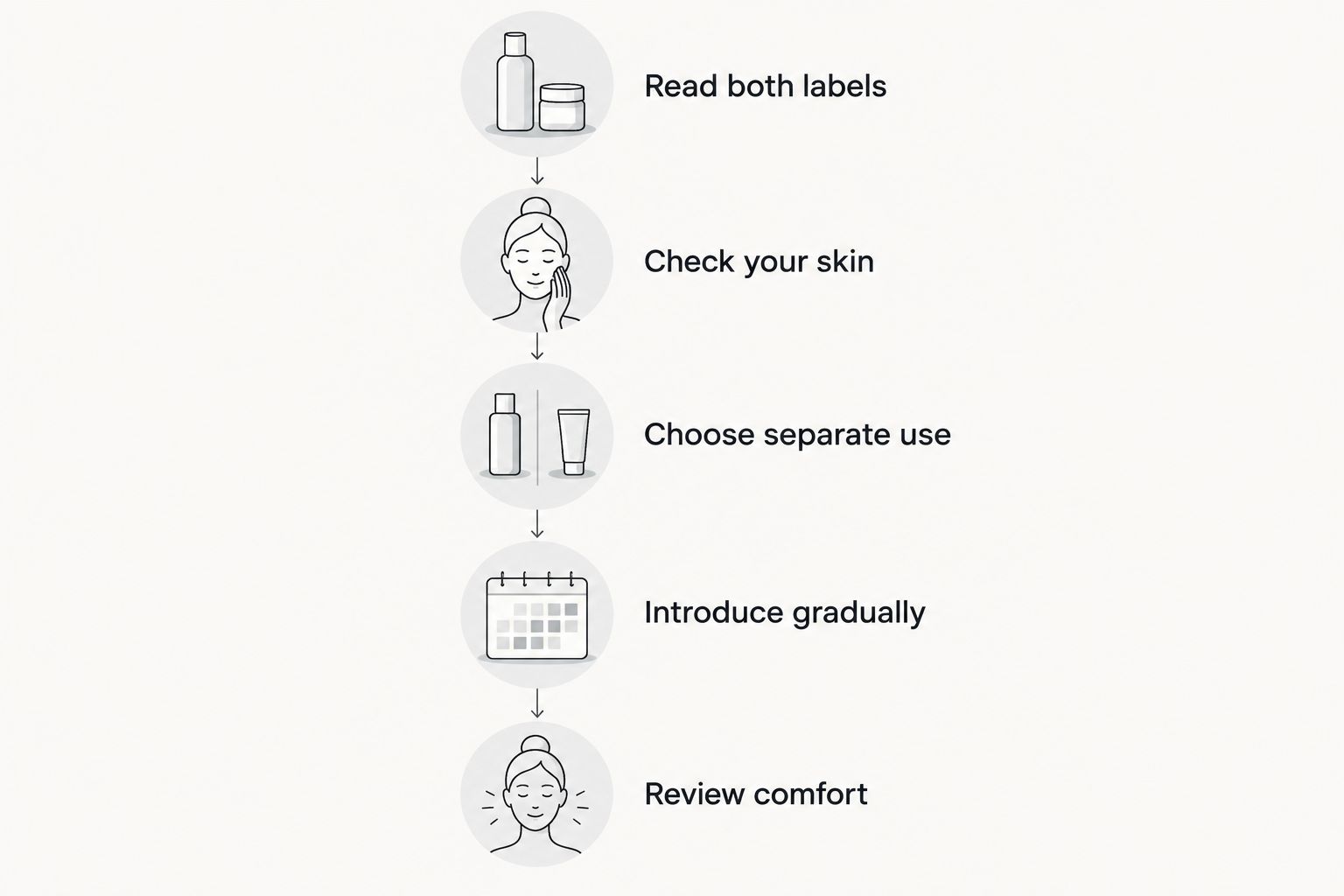
Do not interpret the sequence as permission to override a warning. If an exfoliant specifies a particular application method or discourages combining it with other products, keep that instruction intact.
Should the mist go before or after exfoliating acids?
There is no universal order that establishes compatibility for every HOCl mist and exfoliant. Use the order specified by the manufacturers; when that guidance is absent, separate the applications rather than inventing an order.
If both labels permit layering, follow any instructions about applying to clean, dry skin. Letting a layer dry keeps you from deliberately combining wet products on your face, but it does not prove that the ingredients remain stable or that the pairing suits your skin.
Avoid mixing an exfoliant and a mist in your palm or transferring them into one bottle. That creates a mixture with a composition and stability you have not established.
Why the right approach varies
A pairing that feels comfortable for someone else is not a personal instruction. These factors explain why a single schedule does not fit every routine:
- Finished formulation. The ingredient name alone does not describe everything in a product or establish how it interacts with another formula.
- Exfoliant type. A rinse-off exfoliant and a leave-on exfoliant have different directions. Follow the format you actually own.
- Concentration and pH. These are useful formulation details, but neither independently proves compatibility or gentleness.
- Current skin condition. Skin that already feels irritated needs a different decision from skin that feels comfortable.
- Other routine steps. Additional exfoliants or retinoids make it harder to judge which step is contributing to irritation.
- Application instructions. Facial skincare directions do not automatically apply to every product marketed for surfaces or other uses.
Keep this distinction clear in 2026: a product's versatility does not erase its use-specific directions. Choose instructions for the intended application, not whichever claim sounds broadest.
Keep sensitive-skin routines simple
For sensitive or reactive skin, choose a routine you can observe and adjust. Do not begin a new mist, a new exfoliant, and a stronger exfoliation schedule together.
A small-area trial can help you notice a reaction before broader application, but it does not guarantee that repeated use or a combination will suit you. Follow the product's testing directions when provided, and stop if discomfort develops.
Exfoliation is optional. If your skin feels comfortable without it, you do not need to add an acid just to complete a routine. Persistent irritation deserves advice from a qualified healthcare professional, not another experiment with layering.
Make the gym routine less crowded
After a workout, do not treat an HOCl mist as a replacement for washing away sweat, sunscreen, or makeup. Follow cleansing and product directions, then decide whether your skin actually needs another step.
The same principle applies to exfoliating. A sweaty workout is not a reason to increase exfoliant frequency or add an extra application beyond the label's directions.
Keep your gym routine recognizable. If you already have an exfoliation schedule that your skin tolerates, avoid turning every post-workout refresh into another exfoliating session.
What to check in a hypochlorous acid mist
Choose a mist using documented product details, not the assumption that all HOCl sprays are identical. Look for the intended use, ingredient information, directions, storage instructions, and bottle size.
Xoxo Gina HALO™ Wellness Mist is best for shoppers seeking a 5 fl oz / 150 mL hypochlorous acid skincare mist with a stated pH of 4.5. Those details describe the product; they do not establish that it works with every exfoliant.
The Xoxo Gina HALO™ Wellness Mist product information describes a three-ingredient formulation and identifies purified water and hypochlorous acid. Review the complete current ingredient list and directions before introducing it alongside another active product.
The practical advantage is straightforward: the bottle size and stated pH give you concrete details to evaluate. The limitation is equally important: neither bottle size, pH, nor ingredient count proves superior safety, effectiveness, or compatibility. Formula matters, and the pairing still needs its own instructions.
What should you leave out of the routine?
Leave out extra exfoliating steps that duplicate a job you are already doing. An acid toner, an exfoliating serum, and an exfoliating pad do not become gentler simply because each has a different format.
Also leave out homemade mixing experiments. Adding an acid, diluting a mist, or transferring products into a shared container changes the formulation and introduces questions about stability and storage.
For your 2026 routine, edit before you add. If you cannot explain what a step contributes—or tell whether your skin tolerates it—simplifying gives you a clearer starting point.
Can I use both products every day?
Not automatically. Daily use depends on the directions for each finished product and your skin's tolerance; an HOCl mist does not make daily exfoliation appropriate.
Do not borrow a frequency from someone else's routine. Keep the exfoliant within its own directions, and reduce the complexity of the routine if dryness, stinging, or discomfort develops.
Does hypochlorous acid cancel out exfoliating acids?
Do not assume that hypochlorous acid cancels out an exfoliant, or that the products have no interaction. Compatibility is a question about the actual formulas, not a conclusion you can draw from ingredient categories alone.
Separating applications is a practical way to avoid relying on an unverified immediate combination. It is not proof that every schedule will be comfortable or effective.
What if my skin stings after combining them?
Stop using the combination rather than treating stinging as evidence that it is working. Follow the products' instructions for an unwanted reaction and avoid adding more active products while your skin feels irritated.
If symptoms persist, worsen, or concern you, seek medical advice. A skincare mist is not a treatment for an adverse reaction to another product.
FAQ
Can I use hypochlorous acid skincare with glycolic acid?
Hypochlorous acid skincare and glycolic acid can belong in the same broader routine, but their names do not establish compatibility between specific products. Follow both labels and use separate applications when immediate layering has not been addressed.
Can I use a hypochlorous acid mist with salicylic acid?
A hypochlorous acid mist and salicylic acid are not interchangeable, and their compatibility depends on the finished formulas. Keep salicylic acid within its own directions rather than increasing its use because you have added a mist.
How long should I wait between a hypochlorous acid spray and an exfoliant?
There is no universal waiting time that proves compatibility between every hypochlorous acid spray and exfoliant. Follow manufacturer guidance; drying alone does not establish chemical compatibility.
Is hypochlorous acid skincare an exfoliant?
Hypochlorous acid skincare is not a substitute for an AHA or salicylic acid exfoliant. The word acid and an acidic pH do not, by themselves, establish exfoliating activity.
Does Xoxo Gina HALO™ Wellness Mist have an acidic pH?
Xoxo Gina HALO™ Wellness Mist has a stated pH of 4.5. That formulation detail does not establish exfoliating strength or prove compatibility with another skincare product.
Can I mix my exfoliating toner into my mist bottle?
Do not mix an exfoliating toner into a hypochlorous acid mist bottle. Mixing changes the finished formulations and creates a combination whose stability and directions have not been established.
What's the simplest way to review an acid routine in 2026?
Start your 2026 review with the directions on each bottle and remove unnecessary overlapping exfoliation. Introduce one change at a time so you can identify what your skin tolerates.
One last thing
The most useful compatibility question is not whether two ingredients both contain the word acid. It is whether the finished products have directions that support the way you plan to use them.
Keep the bottles separate. Keep the routine understandable. If you cannot confirm a layering instruction, you do not need to turn your face into the test.