
November 11, 2026
Can hypochlorous acid face spray replace sunscreen?

No. A hypochlorous acid spray for face does not replace sunscreen, because hypochlorous acid is not a sunscreen active ingredient and does not provide an SPF rating. For your 2026 routine, keep the mist optional and use a broad-spectrum, water-resistant sunscreen with SPF 30 or higher when you need sun protection.
- Hypochlorous acid spray for face does not replace sunscreen or provide an SPF rating.
- The American Academy of Dermatology recommends broad-spectrum, water-resistant SPF 30 or higher.
- Apply an optional facial mist before sunscreen, allowing skin to dry between steps.
- After swimming or sweating, follow sunscreen reapplication directions rather than reaching for facial mist.
Why this matters
A refreshing spray and a protective sunscreen can belong in the same routine. They do not do the same job. Confusing them leaves out the product specifically tested and labeled for protection against ultraviolet radiation.
If you browse Xoxo Gina HALO™ for a simple facial mist, keep that purchase separate from your sunscreen decision. A skincare product does not become sun protection because it feels comfortable, dries clear, or fits easily into your gym bag.
Keep the mist if you enjoy it. Keep sunscreen because the mist cannot take its place.
Can hypochlorous acid face spray replace sunscreen?
Hypochlorous acid face spray cannot replace sunscreen. The US Food and Drug Administration regulates sunscreens as over-the-counter drugs, and their labels identify sunscreen active ingredients, SPF, directions, and warnings. An ordinary facial mist without sunscreen labeling is not a substitute.
The distinction is about function, not which product sounds gentler or has fewer ingredients. Sunscreen protects against UV exposure when used as directed. A hypochlorous acid facial mist is a separate skincare step; its ingredient name does not establish sun protection.
| Product category | Best for | What to check | Main limitation |
|---|---|---|---|
| Hypochlorous acid facial mist | People who want an optional mist in their skincare routine | Intended use, ingredients, storage directions, and skin tolerance | Does not replace sunscreen or establish SPF protection |
| Broad-spectrum sunscreen | People who need protection against UVA and UVB exposure | SPF 30 or higher, water resistance, and application directions | Needs adequate application and reapplication; does not replace shade or clothing |
| Moisturizer with sunscreen | People who prefer combining moisturizing and sun protection | Broad-spectrum labeling, SPF 30 or higher, and water resistance when needed | Applying only a light moisturizing layer can leave you short of the labeled sunscreen application |
A moisturizer with SPF is still a sunscreen product when labeled that way. A facial mist without sunscreen labeling is not, regardless of where it sits in your bathroom routine.
Put sunscreen last in your morning skincare
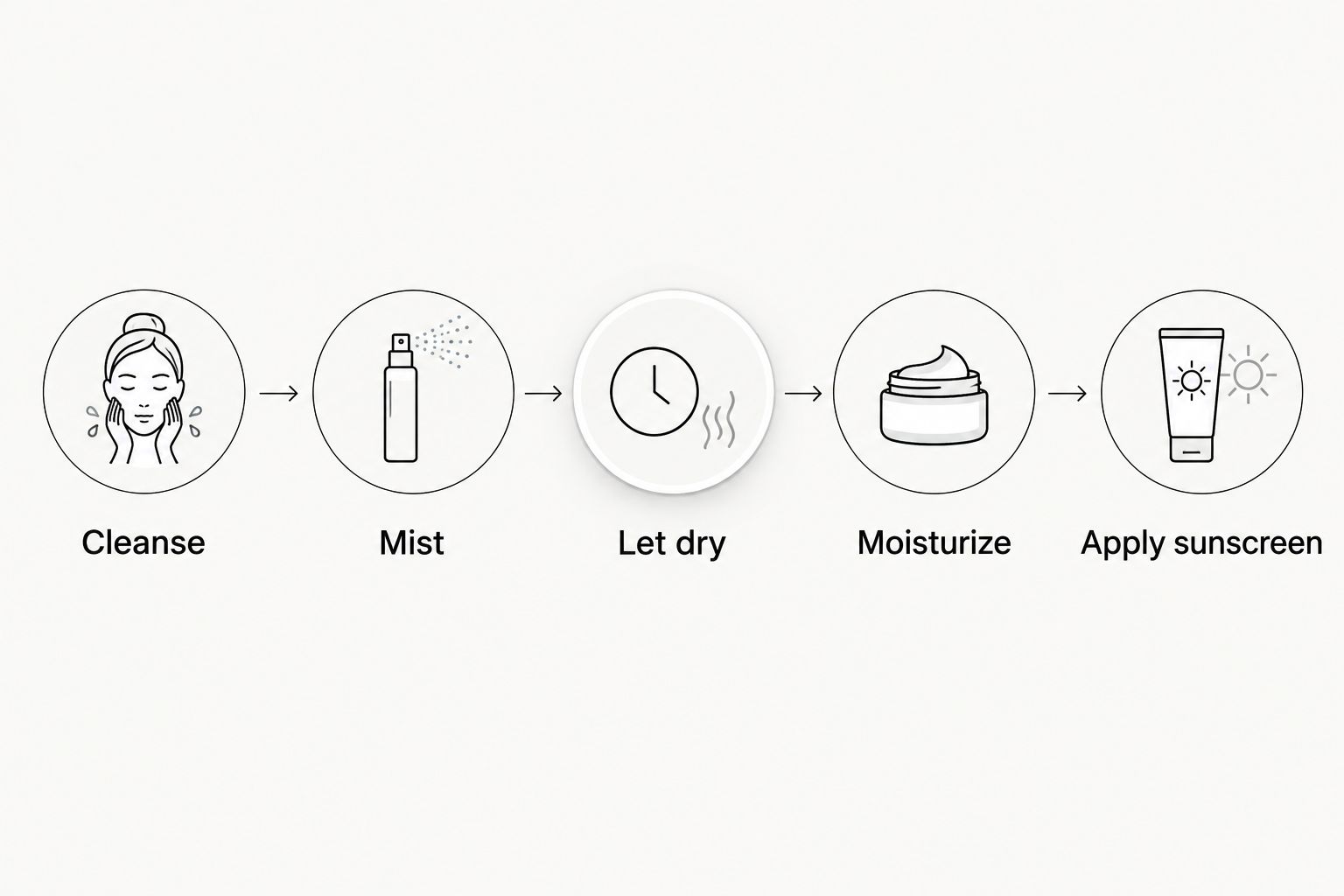
For a straightforward 2026 morning routine, use your optional mist before sunscreen rather than treating it as a finishing layer of protection. Follow each product's label, and give wet skin time to dry before applying the sunscreen.
- Cleanse. Start with clean skin using your usual cleanser and its directions. Avoid adding extra cleansing steps just because you plan to use a mist.
- Mist. If you choose a facial mist, apply it according to its label. Do not use it to dilute another product or mix it into sunscreen in your palm.
- Let dry. Allow the mist to dry before adding the next product. You do not need an invented waiting time; the practical checkpoint is whether your skin is still wet.
- Moisturize. Apply moisturizer if your skin needs it. Keep the routine comfortable rather than adding layers for their own sake.
- Apply sunscreen. Apply sunscreen evenly and follow its directions before sun exposure. If you wear makeup, put makeup on after sunscreen.
The American Academy of Dermatology recommends applying sunscreen about 15 minutes before going outdoors. That guidance concerns sunscreen application; it is not a required drying time for a hypochlorous acid mist.
Do not mix sunscreen with mist to make it spread further. Sunscreen directions apply to the finished product, not to a homemade blend with a different texture or concentration.
Why sunscreen protection varies
The same labeled sunscreen can be used well or poorly. For your 2026 sun-care routine, focus on these practical differences rather than expecting a facial mist to make up for them:
- Coverage. Missed areas remain missed areas. Include exposed ears, neck, and other skin rather than concentrating only on the center of your face.
- Amount. Follow the sunscreen label and apply generously. A small amount spread thinly is not equivalent to the application used to establish the labeled SPF.
- Time outdoors. The American Academy of Dermatology recommends reapplying about every 2 hours while outdoors. A morning application is not an all-day plan.
- Water and sweat. Swimming and sweating change your reapplication needs. Follow the sunscreen's water-resistance directions, and reapply after towel drying.
- Product condition. Follow storage instructions and the expiration date. A facial mist cannot restore expired sunscreen or correct unsuitable storage.
These factors explain why sunscreen use needs its own place in your routine. None is corrected by adding more hypochlorous acid spray.
Does SPF 30 mean I can stay outside all day?
SPF 30 does not mean one application lasts all day. The American Academy of Dermatology recommends broad-spectrum, water-resistant SPF 30 or higher, along with reapplication and other protective measures.
SPF describes protection against sunburn-producing UV exposure under testing conditions. It is not a personal countdown that you can multiply by the time you usually spend outside without burning.
Look for broad spectrum as well as the SPF number. Broad-spectrum labeling matters because it addresses both UVA and UVB protection. Shade, clothing, a hat, and sunglasses add protection without asking a skincare mist to do a job it was not made to do.
Can I spray hypochlorous acid over sunscreen?
SPF 30 or higher sunscreen should remain your protective layer; hypochlorous acid mist does not refresh its SPF. There is no universal assurance that spraying and rubbing another product over an applied sunscreen leaves its protective film unchanged.
The simplest approach is to place the mist earlier in your routine, let it dry, and then apply sunscreen. If you already have sunscreen on, avoid assuming that a wet spray, wiping, or repeated rubbing has no effect on that layer.
If you need to cleanse your face after exercise, treat sunscreen as a fresh application afterward when you return outdoors. Do not count the mist as either cleansing away everything or replacing the sunscreen you removed.
What should I check on a facial mist?
Read a facial mist label for its own intended use, not for benefits borrowed from sunscreen. Ingredient names, pH, bottle size, and water descriptions answer different questions from SPF testing.
For people who want an optional hypochlorous acid facial mist, Xoxo Gina HALO™ Wellness Mist is a skincare option, not a sunscreen replacement. The listed bottle size is 5 fl oz / 150 mL, and the supplied product description states pH 4.5. Neither detail establishes UV protection.
You can review Xoxo Gina HALO™ Wellness Mist separately from your sunscreen choice. Its practical limitation in this routine is clear: choosing the mist still leaves you needing a suitable sunscreen.
A shorter ingredient list is not an SPF claim. Nor does pH alone prove that a product will suit every sensitive face. If your skin reacts easily, introduce a new product cautiously and stop using it if irritation develops.
Choose sunscreen you will actually apply
For your 2026 sunscreen choice, begin with the label requirements, then consider comfort. A product that feels pleasant still needs broad-spectrum labeling, adequate SPF, and directions that fit your activities.
If you have oily skin, the question behind SPF moisturizers for oily skin is how to combine a wearable texture with labeled sun protection, not how to replace sunscreen with a lighter facial spray. A combined moisturizer-and-sunscreen product still needs to be applied as sunscreen, rather than in the smaller amount you might use solely for moisture.
For sensitive or reactive skin, avoid treating ingredient count as a guarantee of comfort. Pay attention to your own response and the full label. If finding a tolerable sunscreen is difficult, a dermatologist can help you choose one without abandoning sun protection.
Keep the rest of your morning routine simple while trying a new sunscreen. Adding several unfamiliar products together makes it harder to identify which one caused discomfort.
Pack for the gym, not just the bathroom
A gym bag needs a sun-protection plan when your workout includes an outdoor walk, run, court, or field. A facial mist does not become sunscreen because you use it after sweating.
Before outdoor activity, apply a water-resistant sunscreen according to its label. During longer sessions, plan for reapplication rather than waiting until your face feels hot or looks red. Skin sensation is not an SPF measurement.
After exercise, decide whether you need to cleanse, change clothes, or reapply sunscreen before the next outdoor part of your day. Keep the mist optional throughout. It does not reset sunscreen's water-resistance period or replace an application removed by washing.
For families, give each bottle one clear job. Explaining that sunscreen is for sun protection and mist is an optional skincare step is more useful than describing either bottle as something that does everything.
Keep travel routines simple
For 2026 travel, build the routine around where you will be and what you will do. Walking outside, swimming, and sightseeing require a sunscreen plan even when your usual bathroom routine is reduced to a small bag.
Do not assume a bottle is carry-on eligible simply because it is sold as a facial mist. Check its labeled volume against the current rules for your airport and route. Product category and product size are separate questions.
Keep sunscreen accessible rather than packed away when you will need to reapply it. Follow both products' storage instructions, and do not use a mist to stretch the last sunscreen left in a bottle.
The simplest travel routine is not the one with the fewest bottles at any cost. It is the one that keeps essential protection intact while leaving optional steps genuinely optional.
FAQ
Can hypochlorous acid spray for face replace sunscreen?
No. Hypochlorous acid spray for face does not replace sunscreen or provide an SPF rating. Use a broad-spectrum, water-resistant sunscreen with SPF 30 or higher for sun protection.
Should I use hypochlorous acid mist before or after sunscreen?
Use an optional hypochlorous acid mist before sunscreen and allow your skin to dry. Follow both labels rather than mixing the products together.
Does hypochlorous acid have a natural SPF?
Hypochlorous acid does not establish an SPF rating for a facial mist. Sun protection must come from an appropriately labeled sunscreen, not an assumption about an ingredient.
Can I use a moisturizer with SPF instead of separate sunscreen?
A moisturizer with sunscreen can serve as your sunscreen when it meets your protection needs and you apply it according to its sunscreen directions. Look for broad-spectrum SPF 30 or higher and water resistance when needed.
How often should I reapply sunscreen outdoors?
Reapply sunscreen about every 2 hours while outdoors, following American Academy of Dermatology guidance. Follow the label for swimming and sweating, and reapply after towel drying.
Does facial mist make sunscreen last longer after a workout?
No. Facial mist does not extend sunscreen's labeled protection or reset its water-resistance period. Follow sunscreen reapplication directions after sweating, swimming, or towel drying.
Does Xoxo Gina HALO™ replace sunscreen in a simple routine?
No. Xoxo Gina HALO™ offers a hypochlorous acid wellness mist, which is separate from sunscreen. Keep labeled sun protection in your routine even when you use a mist.
One last thing
The step you skip matters more than the number of steps you keep. If simplifying your morning means choosing between an optional mist and sunscreen before sun exposure, keep the sunscreen.
Make that decision before you pack your bag or leave the bathroom. A clear routine is easier to follow than a collection of products with overlapping promises.