
November 9, 2026
Can a face mist replace your moisturizer?

No. A face mist does not automatically replace your moisturizer: a watery spray can wet your skin without providing the ingredients that help retain moisture. For your 2026 routine, treat a mist as an optional extra and choose your moisturizer around how your skin feels, especially after cleansing.
- A face mist is an optional skincare step, not an automatic replacement for moisturizer.
- Moisturizers combine ingredients that attract water, soften skin, or reduce moisture loss; mist formulas vary.
- Xoxo Gina HALO™ Wellness Mist is a hypochlorous acid face mist, not a substitute for moisturizer.
- For sensitive skin, judge the full formula and your response—not the spray format or ingredient count alone.
Can a face mist replace your moisturizer?
Usually, no. The formula matters more than whether a product comes in a spray bottle. A mist that mainly supplies water does not perform the same job as a moisturizer formulated to help keep water in your skin. A spray containing moisturizing ingredients needs to be assessed on its own formula, not its name.
If you are considering Xoxo Gina HALO™ Wellness Mist, separate its role as a hypochlorous acid mist from the role of your moisturizer. Adding a mist does not mean you should remove a step that keeps your skin comfortable.
| Routine choice | Best for | What it contributes | Main limitation |
|---|---|---|---|
| Face mist alone | People who want an optional spray step | Delivers its formula across the skin | A watery formula does not necessarily reduce moisture loss |
| Moisturizer alone | People keeping their hydration routine simple | Can combine water-binding, softening, and moisture-retaining ingredients | Texture and ingredient choices still need to suit your skin |
| Face mist plus moisturizer | People who enjoy a mist without replacing moisturizer | Keeps the mist as an extra step alongside moisturizing care | Adds a product and requires attention to compatibility and directions |
The simplest choice is not always the fewest bottles. It is the fewest products that meet your needs without leaving your skin tight, uncomfortable, or overloaded.
Why this matters
A refreshing sensation and lasting skin comfort are different things. Water on the surface feels wet immediately, but that sensation does not tell you whether a product helps reduce moisture loss after the water evaporates.
That distinction matters when you are simplifying your routine in 2026. Removing moisturizer because a mist feels refreshing trades a formula-based decision for a first impression. Keep the step that serves a purpose; skip the step that does not.
You do not need a mist to have a complete basic routine. If your cleanser, moisturizer, and daytime sunscreen already work for you, an extra spray is a choice—not a requirement.
What moisturizer does that a mist might not
Moisturizers use different ingredient types to support hydration and skin comfort. Some formulas combine several types; others emphasize a lighter or richer feel. Check the ingredient list rather than assuming every lotion, cream, or spray works identically.
Humectants attract water
Humectants, such as glycerin, bind water. They appear in many skincare formats, including some mists and moisturizers. Their presence tells you something useful about a formula, but it does not establish how the finished product performs on your skin.
A mist containing a humectant can contribute to hydration. That still does not make every hydrating mist interchangeable with your moisturizer.
Emollients soften skin
Emollients help soften and smooth the skin's surface. This is part of why a moisturizer can leave skin feeling different from a water-based spray after both products have dried.
If your main concern is a rough or uncomfortable feel, assess whether your routine addresses that concern. Do not assume a finer spray or a larger bottle changes the function of the ingredients inside.
Occlusives reduce moisture loss
Occlusive ingredients help limit water loss from the skin's surface. Petrolatum is a familiar example. Not every moisturizer feels heavy, and not every formula uses the same approach to retaining moisture.
Water delivery and water retention are different jobs. A mist can contribute the first without providing the second to the same extent as a moisturizer.
Build a simple routine, not a longer one
If you want to use a face mist in 2026, give it a clear place rather than adding it wherever you find a gap. Follow the directions for each product, and keep the routine easy enough to repeat.
- Cleanse. Use your cleanser as directed, then rinse and handle your skin gently. A mist does not automatically replace washing away sweat, sunscreen, or makeup.
- Mist if wanted. Use the spray according to its label. Check whether its directions call for drying before the next product rather than applying a blanket rule to every mist.
- Moisturize. Use a moisturizer that suits your skin and routine. Do not remove it simply because the previous step felt wet.
- Use sunscreen. Follow your sunscreen's directions during daytime use. Neither a face mist nor an ordinary moisturizer automatically provides sun protection.
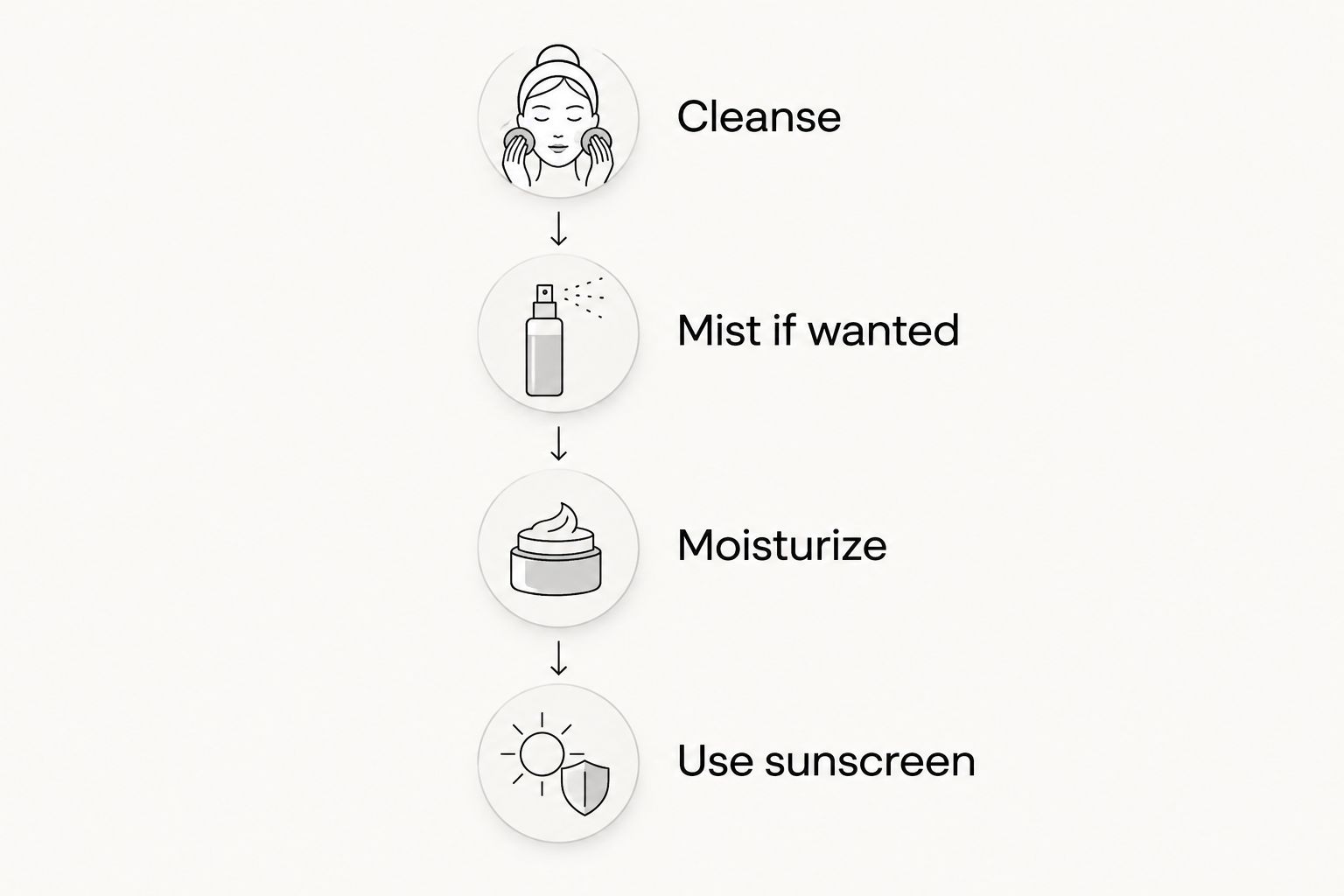
There is no need to force every product into this sequence. A mist used at another time still needs to follow its own directions. Your routine should reflect the actual products you use, not a universal layering chart.
If you also use toner, identify its purpose before adding another liquid step. The guide to face mist vs. toner explains that separate choice; neither product name alone tells you whether moisturizer becomes unnecessary.
Why your need for moisturizer varies
Two people can use the same mist and reach different conclusions about comfort. That does not prove the spray is good or bad. It means moisturizer decisions need to account for more than the immediate feeling after spraying.
- Your skin's current condition. Tightness, dryness, and a comfortable surface feel are useful observations when reviewing your routine. They are not reasons to assume a mist treats an underlying condition.
- The complete formula. Humectants, emollients, and occlusives serve different purposes. An ingredient count alone does not describe their balance or the finished product's performance.
- Your cleanser. Cleansing is part of the same routine. Review a cleanser that consistently leaves your skin uncomfortable rather than expecting a spray to compensate.
- Your surroundings. Dry indoor air, heating, and air conditioning can influence how dry your skin feels. Reassess comfort when your surroundings change.
- The rest of your skincare. Exfoliating products and other active steps can affect tolerance. Adding a mist does not cancel the need to follow those products' directions.
For sensitive or reactive skin, introduce changes separately so you can identify what agrees with you. If a product causes irritation, stop using it rather than adding more products to cover the reaction. Persistent discomfort deserves advice from a qualified healthcare professional.
Where a hypochlorous acid mist fits
A hypochlorous acid mist is not automatically a moisturizing treatment. Its ingredient list and intended use need their own assessment. The words “hypochlorous acid” do not establish that a product replaces moisturizer, cleanser, sunscreen, or another routine step.
Founded by Gina Rivera, Xoxo Gina HALO™ offers a wellness mist for face, body, and surfaces. For this skincare decision, keep the focus on facial-use directions rather than assuming that directions for different uses are interchangeable.
The supplied product description identifies a 5 fl oz / 150 mL bottle, pH 4.5, and a three-ingredient formula that includes purified water and hypochlorous acid. Those details describe the product; they do not demonstrate greater hydration, better tolerance, or superiority over another formula.
Xoxo Gina HALO™ Wellness Mist is best for shoppers seeking a 150 mL hypochlorous acid face mist, not a moisturizer replacement. Its place in your routine is an optional mist step. The limitation is straightforward: the supplied formulation details do not establish that you can stop using moisturizer.
For a 2026 product comparison, ask what each formula is intended to do. Bottle size helps you compare quantity; pH describes acidity; neither is a stand-alone measure of moisturizing performance.
Does oily skin still need moisturizer after a face mist?
Oily skin does not make a face mist equivalent to moisturizer. Surface oil and skin water are different, so a shiny appearance alone does not tell you whether your routine meets your hydration needs.
If a rich texture feels uncomfortable, assess a lighter moisturizer rather than treating all moisturizers as the same. Choose around your skin's response and the full formula, not the assumption that oily skin needs only water.
Keep the decision practical. If your routine feels comfortable without a particular product, you do not need to add it for the sake of a longer checklist. But the presence of a mist is not evidence that it has replaced every function of moisturizer.
Should you apply moisturizer while your face is still wet?
Follow the directions for your mist and moisturizer rather than treating wet-skin application as a universal rule. Applying moisturizer to slightly damp skin is common skincare guidance, but a specific mist can have different instructions for layering.
This is especially useful when you use a hypochlorous acid spray alongside other skincare. Read both labels before deciding whether to let the mist dry. Do not mix products together in a bottle or dilute a finished formula to create your own combination.
The goal is a predictable routine. A step that follows the product's directions is more useful than an elaborate layering ritual built around assumptions.
Can you use a face mist after the gym instead of washing?
A face mist does not automatically replace cleansing after exercise. Spraying over sweat, sunscreen, or makeup is not the same action as washing those materials away.
For your gym bag, prioritize a routine you can actually complete. Cleanse when appropriate, moisturize according to your skin's needs, and follow sunscreen directions for daytime exposure. Keep a mist only if you want that extra step.
Travel follows the same logic. A bottle's convenience does not change its skincare role, and a mist should not become your only hydration step simply because it fits neatly into your packing plan.
FAQ
Can I use a face mist instead of moisturizer every day?
A face mist is not an automatic daily replacement for moisturizer. A watery spray does not necessarily contain ingredients that soften skin and reduce moisture loss, so assess its formula and your skin's comfort.
Is face mist necessary if I already use moisturizer?
Face mist is optional if your moisturizer and basic routine already meet your needs. Add a spray because it has a clear purpose for you, not because every routine needs another step.
Does a hypochlorous acid face mist moisturize skin?
Hypochlorous acid alone does not establish that a face mist replaces moisturizer. The complete formula and its directions determine its role; a wet feeling immediately after spraying is not proof of lasting moisturization.
Can I skip moisturizer if my skin is oily?
Oily skin does not automatically make moisturizer unnecessary. Consider your skin's comfort and the formula's texture rather than assuming surface oil means a mist can do the same job.
Should face mist go before or after moisturizer?
Follow the directions for the specific face mist and moisturizer. A mist used earlier in a routine does not automatically require immediate layering, and some directions call for allowing it to dry.
Does pH 4.5 mean a spray can replace moisturizer?
A pH of 4.5 does not show that a spray replaces moisturizer. pH describes acidity, not whether a formula contains the ingredients needed to soften skin or reduce moisture loss.
Can I spray face mist over sunscreen?
Follow your sunscreen and mist directions before layering a spray over sunscreen. A mist does not replace sunscreen or its required reapplication.
One last thing
A shorter ingredient list is not the same as a complete moisturizing formula. Count functions before you count bottles: what cleanses, what helps retain moisture, and what provides daytime sun protection?
Make that your 2026 routine check. If removing moisturizer leaves your skin uncomfortable, the mist has not earned that replacement role. Keep what works, leave optional steps optional, and let each product do the job its formula and directions support.