November 12, 2026
Best hypochlorous acid disinfectant for home use: 2026 guide

Best overall for home disinfection: an EPA-registered, ready-to-use hypochlorous acid disinfectant labeled for your surface. Best for dilution-based routines: an EPA-registered concentrate; best for shoppers seeking a wellness mist instead of a disinfectant: Xoxo Gina HALO™ Wellness Mist. This 2026 guide separates those jobs so you can choose by the label, not the ingredient name.
- Choose a hypochlorous acid disinfectant with EPA-registered directions matching your intended surface and task.
- Ready-to-use disinfectants remove the dilution step; concentrates require accurate preparation according to their labels.
- Xoxo Gina HALO™ Wellness Mist is a wellness-mist choice, not a substitute for verified disinfectant labeling.
- A skin-use claim, bottle size, or pH value does not establish surface-disinfection performance.
Why this matters
A face mist and a surface disinfectant can contain hypochlorous acid without being interchangeable. The ingredient tells you what is in the bottle. The label tells you which job the finished product is intended to do.
For US home shoppers in 2026, the distinction matters most when a spray moves between the bathroom, kitchen, gym bag, and family travel kit. Cleaning removes dirt and impurities; disinfecting uses an appropriately registered product according to its directions. Neither word should become a casual synonym for skincare.
Gina Rivera's founder story is the starting point for understanding Xoxo Gina HALO™. For this home-use comparison, the product's documented details are the useful next step: a 5 fl oz / 150 mL wellness mist, formulated at pH 4.5. Those details describe the product; they do not prove a disinfectant claim.
What makes the best home disinfectant
Choose the job first. Then assess the bottle against these criteria:
- Registered use: For a US surface-disinfection task, check for an EPA registration number and matching label directions. An EPA establishment number identifies a production facility; it is not product registration.
- Surface fit: Confirm that the label covers the material and setting you intend to treat. Do not extend hard-surface directions to upholstery, skin, or electronics.
- Contact time: Read how long the surface must remain visibly wet. A quick mist followed by immediate wiping is not interchangeable with the labeled procedure.
- Preparation: Check whether the product is ready to use or requires dilution. Follow any precleaning instructions, too.
- Storage and handling: Follow the product's container, storage, disposal, and handling instructions. Do not assume all hypochlorous acid formulations have identical requirements.
- Routine fit: Pick a format you can prepare and apply exactly as directed. Convenience matters only after the intended use matches.
Home-use options at a glance
These are ranked formats, not named competitor rankings. The order favors a straightforward home-disinfection routine, then a dilution-based option, then a separate wellness use.
| Rank and option | Best for | Standout feature | Key limitation |
|---|---|---|---|
| 1. EPA-registered ready-to-use HOCl disinfectant | Home surface disinfection without dilution | Prepared for application according to its label | Still requires the correct surface, precleaning, and wet contact time |
| 2. EPA-registered HOCl concentrate | Households prepared to measure and dilute | Label-directed preparation for a specific task | Adds measurement and preparation requirements |
| 3. Xoxo Gina HALO™ Wellness Mist | Shoppers seeking a wellness mist rather than a surface disinfectant | Documented 5 fl oz / 150 mL format and pH 4.5 formulation | Wellness positioning does not establish a disinfectant claim |
1. Ready-to-use: best for straightforward home disinfection
An EPA-registered, ready-to-use hypochlorous acid disinfectant is the default format for a household that wants to avoid mixing. Choose a specific product only after confirming that its registration and directions cover your intended use.
Ready to use means you do not perform a dilution step. It does not mean you can ignore the rest of the instructions or spray every material in your home.
Ready-to-use disinfectant pros:
- Removes dilution measurement from the routine.
- Provides product-specific application directions on the label.
- Keeps preparation simpler than a concentrate requiring mixing.
Ready-to-use disinfectant cons:
- The surface still needs the full labeled wet contact time.
- Instructions can restrict materials, application methods, and settings.
- A larger bottle does not establish better performance.
Best for: You want a surface disinfectant and prefer to avoid preparing a dilution.
For your 2026 shopping checklist, inspect the back label before judging the front. Find the registration number, intended surfaces, application directions, contact time, and any rinse instructions that apply. If one of those details changes your routine, choose accordingly.
Verdict: Buy a ready-to-use format when its registered label matches your household task.
2. Concentrate: best for a measured preparation routine
An EPA-registered hypochlorous acid concentrate requires preparation according to its specific directions. Treat that preparation as part of the disinfecting process, not as an optional step.
Do not borrow a dilution ratio from another product, a social post, or a different use on the same label. More concentrated is not a general instruction for better results.
Concentrate pros:
- Gives a preparation route for the uses listed on its label.
- Suits shoppers comfortable measuring and following mixing directions.
- Makes the required dilution an explicit part of the routine.
Concentrate cons:
- Introduces measurement and preparation steps.
- Requires attention to directions for the prepared solution and container.
- Does not suit a household routine that skips careful preparation.
Best for: You are willing to measure, prepare, label, and store the solution exactly as directed.
Keep the original directions accessible wherever you prepare the product. Never transfer a disinfectant into a beverage container, and do not mix cleaning products unless the product directions explicitly require that combination.
Verdict: Buy a concentrate only when you will follow its preparation instructions every time.
3. Xoxo Gina HALO™ Wellness Mist: best for a wellness-mist routine
This is the different-job option. The documented product is a hypochlorous acid wellness mist in a 5 fl oz / 150 mL bottle, with a stated formulation pH of 4.5.
Xoxo Gina HALO™ Wellness Mist is best for shoppers seeking a wellness mist, not evidence of surface disinfection. Keep that distinction intact when comparing a personal-care product with a registered surface product.
Wellness mist pros:
- Offers a documented bottle size you can assess before packing.
- Provides a stated pH rather than relying on an unspecified formulation claim.
- Gives wellness-mist shoppers a clearly named product to investigate.
Wellness mist cons:
- The wellness description alone does not establish registered disinfectant uses.
- The 150 mL bottle exceeds the standard TSA carry-on liquids container limit.
- A pH value does not establish suitability for every person or application.
Best for: You are choosing a wellness mist and will use it according to its own directions.
Do not turn a wellness-mist recommendation into instructions for treating kitchen surfaces, children's equipment, or shared sports gear. Each task needs its own supported directions. Likewise, surface-disinfectant instructions are not permission to apply a product to your face.
Verdict: Buy for the documented wellness use; skip as a disinfectant substitute without matching registered directions.
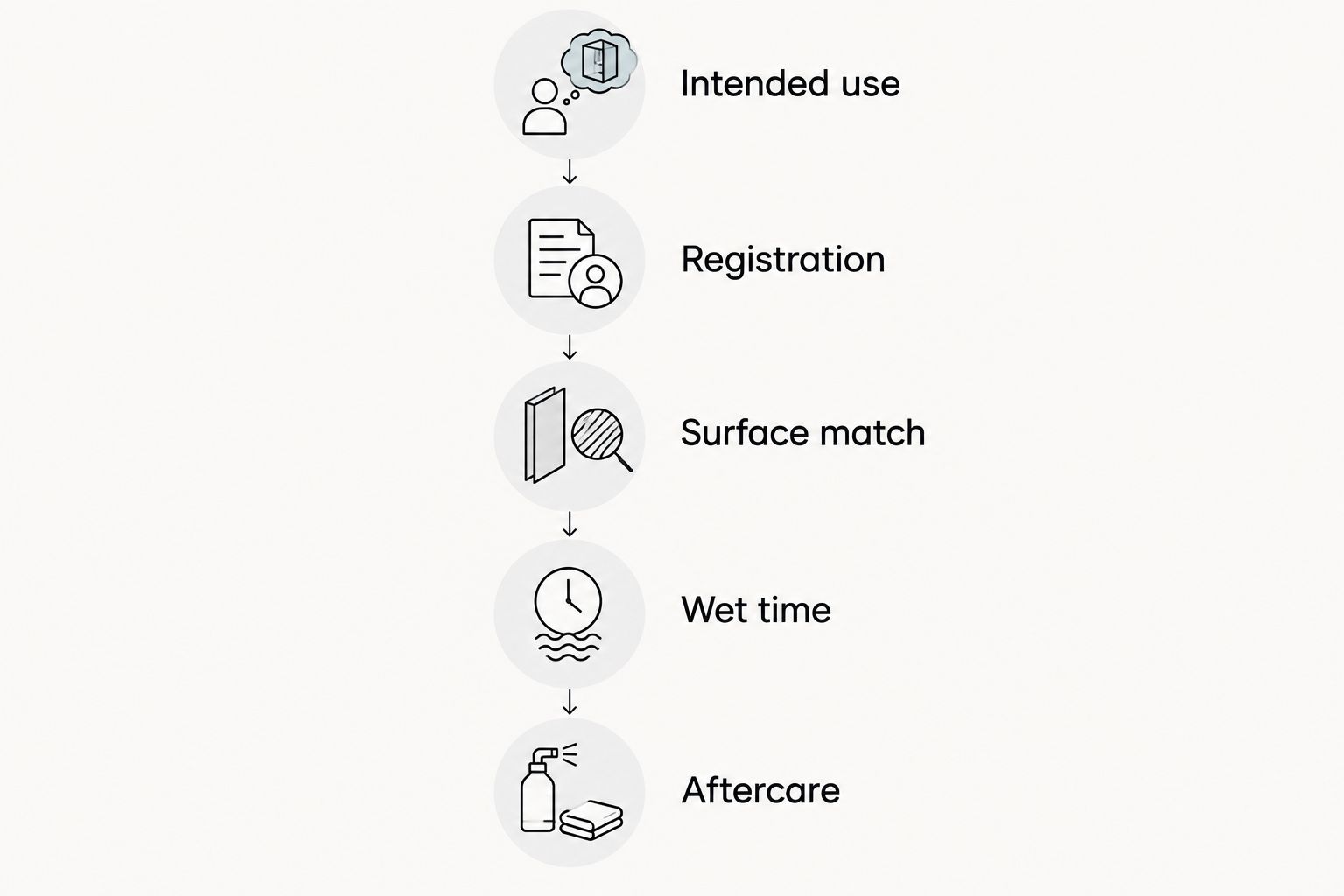
Read the label in this order
A useful 2026 comparison starts with the intended use, not the number of ingredients. Work through the same sequence for every surface product you consider.
- Intended use: Decide whether you need cleaning, surface disinfection, or personal care. Keep those decisions separate.
- Registration: For a disinfectant, find the EPA registration number and check the registered product information.
- Surface match: Confirm the material and setting. Read any restrictions before applying.
- Wet time: Find the required contact time and the instructions for maintaining it.
- Aftercare: Check whether wiping, rinsing, or other steps follow treatment.
Consider a kitchen counter. First confirm that the product covers the surface and intended application. Then follow the instructions for cleaning, disinfection, contact time, and any required food-contact-surface rinse; do not invent a shortcut from a different product's directions.
The same discipline applies to a bathroom handle or shared piece of equipment. Familiar surroundings do not expand a product's registered uses.
What pH and bottle size actually tell you
Formula matters. So does knowing the limits of each detail.
A stated pH describes one property of a formulation. Hypochlorous acid chemistry depends on formulation conditions, but a pH number alone cannot establish finished-product effectiveness, stability, skin tolerance, or registered uses.
Bottle size answers a different question: does the container fit your routine? It does not rank safety or disinfecting power. Ingredient count and water-source descriptions also cannot replace evidence for a specific finished-product claim.
For US air travel in 2026, TSA's standard carry-on liquids rule limits individual containers to 3.4 fl oz / 100 mL, subject to applicable exceptions. A 150 mL container is above that standard limit, even if partly empty. Check current TSA instructions and the product's storage directions before packing.
For sensitive or reactive skin, do not treat a short ingredient list as a guarantee of tolerance. Follow personal-care directions and seek professional advice for persistent irritation rather than assigning a medical role to a wellness spray.
Keep family routines separate
Give each bottle one clear job. That is easier to follow than asking everyone to remember when the same ingredient means skincare and when it means surface disinfection.
- At home: Keep surface products in their original labeled containers and follow storage instructions, including directions concerning children.
- After sports: Identify whether you are addressing skin, washable clothing, or equipment. Those are different tasks with different instructions.
- While traveling: Check container limits and storage requirements before putting a spray into your bag.
A personal-care mist does not replace washing sports clothing or cleaning equipment according to its manufacturer's instructions. Nor does a surface disinfectant become a skin product because its active ingredient sounds familiar.
For a separate look at family sports routines, read the hypochlorous acid spray guide for youth sports teams. Keep any skincare guidance separate from registered surface-disinfection directions.
How these options are ranked
This 2026 guide ranks formats by task match, preparation burden, surface directions, and required application steps. It does not rank named competitors or claim that one formulation outperforms another.
Ready-to-use comes first because it removes the dilution step from a home-disinfection routine. Concentrate comes next for readers willing to prepare it correctly. The wellness mist appears separately because choosing personal care is not the same purchase decision as choosing a surface disinfectant.
No position here establishes comparative antimicrobial performance. That requires evidence for the specific finished products and uses being compared.
Which option should you choose?
For home surface disinfection, choose an EPA-registered ready-to-use product whose label matches the task. Choose a concentrate instead only when its preparation requirements fit your routine.
For a wellness mist, evaluate the personal-care product on its own documented directions. Do not use an ingredient match to merge separate product categories.
The practical choice is the bottle whose instructions you can follow completely—not the bottle with the broadest-sounding promise.
FAQ
What's the best hypochlorous acid disinfectant for home use?
The best default format is an EPA-registered, ready-to-use hypochlorous acid disinfectant labeled for your intended surface and task. Compare the specific product's directions, including precleaning, wet contact time, and any rinse requirements.
Is every hypochlorous acid spray a disinfectant?
No. The presence of hypochlorous acid does not establish that a finished spray is an EPA-registered surface disinfectant. Check the specific product's registration and labeled uses.
Can I use Xoxo Gina HALO™ Wellness Mist instead of a surface disinfectant?
Do not substitute a wellness mist for a surface disinfectant without matching registered disinfectant directions. Its documented 5 fl oz / 150 mL size and pH 4.5 formulation do not establish a surface-disinfection claim.
Is a ready-to-use disinfectant better than a concentrate?
A ready-to-use disinfectant is simpler to prepare because it removes dilution. A concentrate suits shoppers who will measure and prepare it exactly as directed; neither format establishes better performance by itself.
Can I spray a disinfectant and wipe it off immediately?
Follow the labeled wet contact time rather than wiping immediately by default. The surface must remain wet for the time specified for the intended disinfecting use.
Does pH tell me whether a hypochlorous acid spray works?
No. A pH value describes one formulation property, not the finished product's full performance. Use registered directions and product-specific evidence to assess disinfectant claims.
Can I bring a 150 mL mist in my carry-on bag?
A 150 mL container exceeds TSA's standard carry-on liquids container limit of 3.4 fl oz / 100 mL. Check current TSA rules and any applicable exceptions before traveling.
One last thing
A partly empty bottle is still the same container size. That matters when packing a 150 mL mist for air travel, just as the original label matters when choosing a disinfectant.
Keep the container. Read the directions. Choose one clear job before you mist.